

How to Make an App Like Ticketmaster
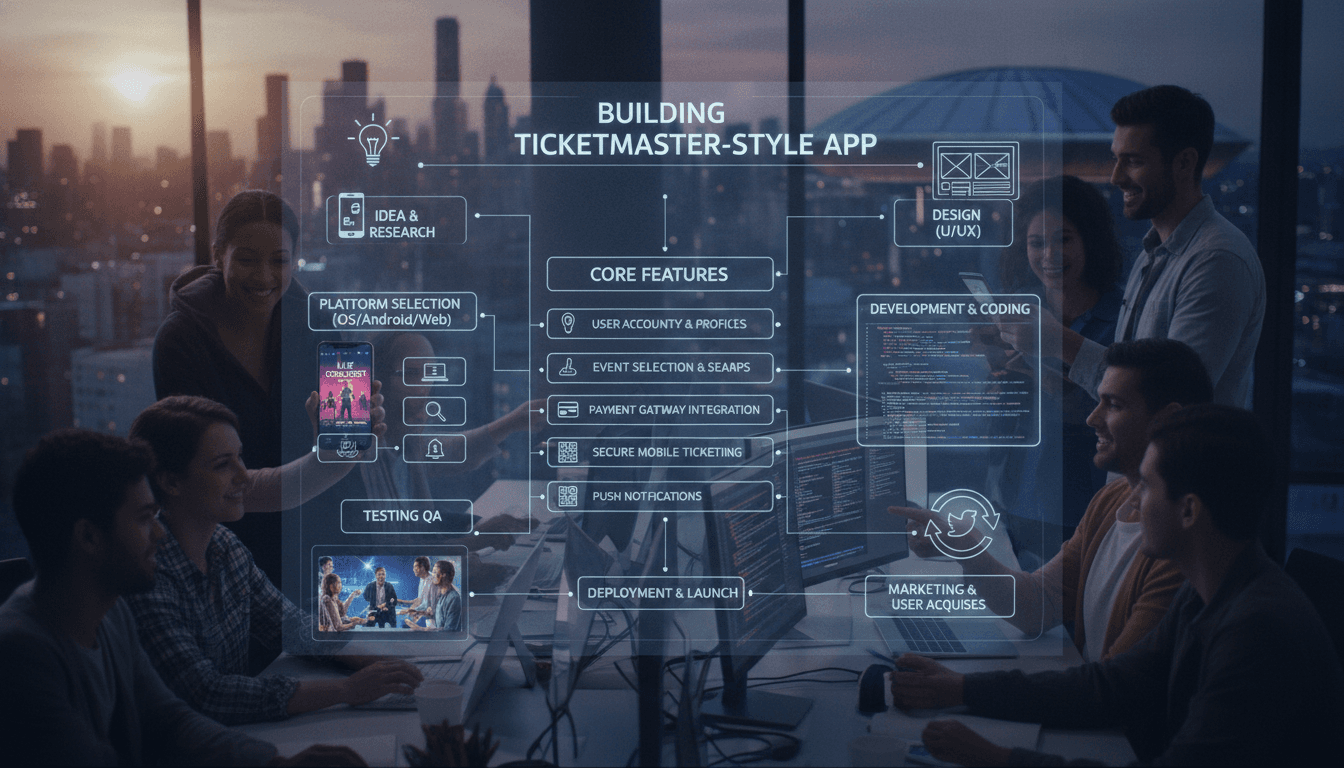
Building a ticketing platform at scale is one of those problems that looks straightforward until you start stress-testing it. The moment 50,000 people try to grab tickets for the same concert at 10:00 AM on a Friday, every architectural shortcut you took shows up immediately.
This post covers what it actually takes to build a platform comparable to Ticketmaster: the data model, the concurrency problem, the payment layer, and the operational complexity you need to plan for before writing the first line of code.
What Does the Core Architecture Look Like?
At its centre, a ticketing platform is an inventory management system with unusually spiky demand, strict consistency requirements, and high fraud exposure.
The core entities are:
- Events — venue, date, capacity, promoter
- Venues — sections, rows, seats, accessibility metadata
- Tickets — individual seat or general admission units, each with a unique identifier
- Orders — a transaction linking one or more tickets to a buyer
- Listings — resale inventory, if you support secondary markets
The seat map alone is non-trivial. Ticketmaster's maps are SVG-based with custom tooling layered on top. You need a coordinate system, section/row/seat hierarchy, and accessibility flags. Expect to spend 4–6 weeks on seat map tooling if you're building from scratch. Third-party options like Seats.io exist and are worth evaluating before committing to a custom build.
For a closer look at a related topic, read our guide on How to Make an App Like Eventful.
For the database layer, most teams start with PostgreSQL for transactional data and add Redis for lock management and session state. That combination handles most use cases up to mid-scale. Above roughly 10 million ticket inventory records, you'll want to think carefully about partitioning strategy.
How the Inventory State Machine Works
Each ticket moves through states: available → reserved → sold → cancelled → refunded. The transition from available to reserved is the most dangerous step. That's where overselling happens.
You need an atomic lock on each seat during checkout. Two options dominate:
Optimistic locking — check a version number at write time, retry on conflict. Works fine under moderate load. Fails badly during a spike when retry storms saturate your database.
Pessimistic locking (SELECT FOR UPDATE) — holds a row lock for the duration of checkout. Safer, but degrades under high concurrency because you're serialising writes per seat.
Most production platforms use a Redis-based distributed lock (via Redlock or a simpler single-instance approach if you can tolerate slightly weaker guarantees) to reserve seats for a TTL of around 10 minutes. PostgreSQL then handles the final commit. This separates the high-frequency locking layer from the transactional layer.
How Do You Handle the 50,000-Person Rush?
This is the defining engineering challenge. Ticketmaster handles it with a virtual waiting room, which is a queue that rate-limits entry to the purchase flow. You can build this with Redis queues and a stateless Node.js or Go service that issues tokens to users as capacity opens up. SQS with FIFO ordering is another option if you're already on AWS.
The key metrics to plan for:
| Load Type | Typical Peak | Mitigation |
|---|---|---|
| HTTP requests at ticket drop | 100,000+ req/s | CDN, waiting room, horizontal scaling |
| Concurrent checkout sessions | 5,000–20,000 | Redis locks, TTL-based seat holds |
| Payment requests | 500–2,000/min | Payment processor webhooks, async confirmation |
| Database writes | 10,000–50,000/min | Connection pooling (PgBouncer), write batching |
Auto-scaling helps but it has limits. EC2 instances take 2–3 minutes to become available. For a ticket drop that's over in 8 minutes, that's too slow. You need to pre-scale based on anticipated demand, which means having a system that tracks event registrations (pre-sale sign-ups) and triggers scale-out ahead of time.
Caching is critical for read-heavy paths. Event pages, seat maps, and pricing data should be served from CloudFront or Fastly, not your application servers. Only the inventory state check needs to hit your backend.
/// Not sure where to start?
Get the architecture before you commit
Tell us what you're building and we'll map the technical approach, stack, and rough timeline. No cost, no obligation, no sales call required.
Payment Processing and Fraud Prevention
Stripe is the default choice for most new platforms. It handles PCI DSS compliance, supports 3D Secure 2.0, and has good webhook reliability. PayPal remains important for markets where card penetration is lower. If you're targeting India, Razorpay or PayU are the pragmatic choices.
Fraud is a serious operational problem at scale. Bots buy large ticket allocations within seconds of a sale opening, then resell on secondary markets. Mitigation layers include:
- reCAPTCHA v3 or hCaptcha at checkout entry
- Purchase limits enforced at the account level, not just session level
- Velocity checks: flag accounts buying more than N tickets across M events in a rolling window
- Device fingerprinting via services like Sift or Kount
- Address verification and CVV checks on all card transactions
None of these individually stop sophisticated bot operators. Combined, they raise the cost of abuse enough to deter most of it. Expect 1–3% of orders to require manual review at scale.
For payout to promoters and venues, you'll need a split payment or escrow model. Stripe Connect supports marketplace payouts natively. Make sure your legal structure accounts for when money moves, especially if events get cancelled.
Related reading: How to Make an App Like Eventbrite.
What Does the Mobile and Frontend Layer Need?
Ticket buyers use mobile apps. As of 2024, roughly 65–70% of Ticketmaster's traffic comes from mobile. If you're building a native app, React Native is a reasonable choice if you want a single codebase. Flutter is the other serious option and tends to perform better for animation-heavy seat maps.
For a closer look at a related topic, read our guide on How to Make an App Like Songkick.
The seat selection UX is the most technically demanding part of the frontend. You need:
- A zoomable, pannable SVG or canvas-based seat map
- Real-time availability updates (WebSockets or Server-Sent Events)
- A 10-minute countdown timer tied to the seat hold
- Graceful handling of seat release when the timer expires
Real-time seat availability is harder than it sounds. If 200 users are looking at the same section, you need to push availability changes to all of them without hammering your backend. WebSockets via a managed service like Ably or Pusher are easier to operate than rolling your own. At very high concurrency, push-on-change is more efficient than polling.
Accessibility matters here too. The seat map must be navigable without a mouse and must expose accessibility information (wheelchair spaces, companion seats, sightline notes) clearly.
Ticketing, NFTs, and Fraud-Resistant Barcodes
Standard QR codes are trivially replicable. Ticketmaster uses SafeTix, which rotates the barcode every few seconds. The barcode is a time-based token generated client-side using a seed synced from the server. You can implement something equivalent using TOTP (RFC 6238) as the basis, with the event ID and seat ID baked into the token scope.
If you're exploring NFT-based ticketing, the practical reality is that on-chain ticket verification adds latency at entry gates and requires buyers to manage wallets. The use case makes more sense for collectible or VIP tier tickets where the ownership record has long-term value. For general admission volume ticketing, the overhead isn't worth it right now.
Conclusion
The core of a Ticketmaster-grade platform is a concurrency-safe inventory system, a queueing layer for demand spikes, a fraud-resistant barcode scheme, and a mobile-first UX built around real-time availability. None of those problems are unsolvable, but each one takes longer than it looks.
If you're scoping a build, start with the inventory and locking model. Get that right before touching the frontend. Everything else can be iterated on, but overselling tickets on launch day is not something you recover from quickly.
If you want an honest assessment of your current architecture or a plan for building one from scratch, talk to the team at Sodio.
FAQ
How long does it take to build a ticketing platform like Ticketmaster? An MVP with event creation, seat selection, payment processing, and QR-code ticketing typically takes 4–6 months for a focused team. A platform with resale markets, promoter dashboards, and high-concurrency waiting room infrastructure is a 12–18 month build at minimum.
What is the biggest technical risk in building a ticketing app? Overselling seats during a high-demand on-sale. If two users complete checkout for the same seat simultaneously, you have a serious operational problem. This is a database concurrency issue, and it needs to be solved at the architecture level with distributed locks or strict serialised writes before anything else.
Should I build on a white-label ticketing platform or from scratch? Platforms like Eventbrite, TicketSpice, or DICE cover a wide range of use cases and can go live quickly. Build from scratch only if you need control over the fee structure, resale markets, custom integrations, or a branded experience that third-party platforms can't support. The build cost is significant and should be justified by revenue or strategic necessity.
What database should I use for a ticketing system? PostgreSQL is the standard starting point. Its row-level locking, ACID guarantees, and mature ecosystem make it well-suited to transactional ticketing data. Pair it with Redis for short-lived locks and session state. At very high scale, teams sometimes move to distributed databases like CockroachDB for multi-region write availability, but that complexity is rarely justified below 50 million tickets per year.
How do I prevent bots from buying all the tickets? No single method is sufficient. Layer reCAPTCHA or hCaptcha at checkout, enforce per-account purchase limits in your database (not just the session), run velocity checks across accounts, and use a device fingerprinting service. A virtual waiting room also helps by randomising queue position, which reduces the advantage of being first to hit the endpoint.
Have a project in mind? Contact Sodio Technologies to discuss your requirements and explore the right technology solution for your business.
/// Work with us
Talk to the engineers who'd build it
You'll get a technical scope, timeline and cost estimate from the people doing the work, not an account manager. In-house team, no subcontracting, since 2016.