

How to Make an App Like Venmo
How to Make an App Like Venmo
Peer-to-peer (P2P) payment apps have quietly rewired how people handle money. Splitting a dinner bill, chipping in for a group gift, or paying a friend back for concert tickets no longer requires cash, an ATM run, or an awkward "I'll get you next time." Venmo turned that everyday friction into a social, frictionless experience — and in doing so built a product used by tens of millions of people.
If you're considering building your own P2P payment platform, this guide walks through what Venmo actually is under the hood, the features that matter, the technology and compliance work involved, and what it realistically takes to ship.
What Makes Venmo, Venmo
Venmo isn't just a money transfer tool. Its differentiator has always been the social layer — a feed of transactions (with amounts hidden) annotated with emojis and inside jokes. That design choice turned a utility into a habit.
The core value proposition breaks down into three parts:
- Speed — money moves between friends in seconds, not business days.
- Simplicity — no account numbers, routing numbers, or IBANs. Just a username or phone number.
- Social proof — the feed normalizes the behavior and drives organic growth.
Any app competing in this space needs to nail the first two and find its own version of the third — whether that's social, rewards, business tooling, or a niche audience.
Related reading: How to Make an App Like Google Pay.
Step 1: Pick Your Model and Niche
"An app like Venmo" can mean several different businesses. Decide early, because it changes your licensing, architecture, and unit economics.
You may also find our article on How to Make an App Like PayPal useful.
- Closed-loop wallet — users load funds into a balance held by you and transfer within your ecosystem. Simpler to launch, but you're holding customer funds.
- Bank-linked transfers — you act as an orchestration layer on top of ACH, card rails, or open banking APIs. Lower balance risk, higher dependency on partners.
- Card-issuing wallet — add a physical or virtual debit card tied to the wallet balance, which is how Venmo and Cash App expanded revenue.
- Cross-border remittance — higher margins, dramatically heavier compliance and FX handling.
- Vertical-specific P2P — payments for gig workers, students, sports teams, faith communities, or a specific country corridor.
Most successful challengers didn't beat Venmo head-on. They picked an underserved segment or geography and went deep.
Step 2: Define the Feature Set
MVP Features
Resist the urge to ship everything. A credible first release needs:
- Onboarding & KYC — phone/email signup, identity verification, document capture where required.
- Funding sources — link a bank account or debit card; tokenize and store securely.
- Send & request money — the core loop, including notes and recipient lookup by username or contact.
- Wallet balance & transaction history — clear, searchable, exportable.
- Withdrawals / cash-out — standard (free, slower) and instant (fee-based) options.
- Notifications — push and in-app for received payments, requests, and failures.
- Security basics — biometric login, PIN, device binding, session management.
Features That Drive Retention
- Social feed and reactions — the Venmo signature, optional privacy controls per transaction.
- Bill splitting — split evenly, by percentage, or by item.
- Group pools — shared pots for trips, gifts, or rent.
- QR codes — instant in-person payment without typing a handle.
- Recurring payments and reminders — rent, subscriptions, chore money.
- Business profiles — let merchants and sellers accept payments, unlocking transaction fees.
- Debit card issuing — extends the wallet into everyday spend.
- Rewards and cashback — a proven retention lever in crowded markets.
Admin & Back-Office
Founders consistently underestimate this. You'll need dashboards for user management, KYC review queues, transaction monitoring, dispute and chargeback handling, fraud case management, ledger reconciliation, and reporting for regulators.
Step 3: Understand the Compliance Reality
This is the part that separates fintech from ordinary app development. You cannot move other people's money without a legal framework.
For a closer look at a related topic, read our guide on How to Make an App Like Cash App.
Money transmission licensing. In the US, that historically means state-by-state money transmitter licenses (MTLs) — expensive, slow, and operationally heavy. In the EU and UK, it means an e-money or payment institution license. Many startups avoid this entirely by partnering with a licensed sponsor bank or a Banking-as-a-Service (BaaS) provider and operating as an agent.
KYC and AML. You must verify identity, screen against sanctions and PEP lists, monitor for suspicious activity, and file reports where required. Budget for an ongoing compliance function, not a one-time integration.
PCI DSS. If you touch card data, you're in scope. The practical answer for most teams is to never touch raw card numbers — use a tokenizing provider so the sensitive data lives in their vault.
Data protection. GDPR, CCPA, and regional equivalents govern what you store, for how long, and how users can delete it. Financial record retention requirements often conflict with deletion rights — plan your data model with that tension in mind.
Consumer protection. Error resolution, dispute timelines, and disclosure requirements (Regulation E in the US, for example) are non-negotiable and should be designed into your support workflows from day one.
Engage fintech counsel before you write production code. The legal structure determines your architecture, not the other way around.
Step 4: Choose the Technology Stack
Mobile
- Cross-platform: Flutter or React Native gets you iOS and Android from one codebase — usually the right call for an MVP, provided your team handles native modules for biometrics and secure storage carefully.
- Native: Swift and Kotlin give you the tightest control over security APIs, Secure Enclave / Keystore, and platform payment integrations. Worth it at scale or if security posture is a core differentiator.
Backend
- Languages/frameworks: Node.js (NestJS), Python (Django/FastAPI), Go, Java (Spring Boot), or .NET. Go and Java are common in payments for their concurrency and maturity.
- Architecture: A modular monolith is often the pragmatic start; split into microservices as domains stabilize — identity, ledger, payments, notifications, fraud, compliance.
- Databases: PostgreSQL for transactional and ledger data (ACID compliance is non-optional here), Redis for caching and rate limiting, and a data warehouse for analytics and regulatory reporting.
- Messaging: Kafka or RabbitMQ for event-driven flows, webhooks from providers, and asynchronous settlement.
The Ledger
Build a double-entry ledger from day one. Never derive balances by summing ad-hoc transaction rows. Every movement of value should be an immutable, append-only pair of entries. Reconciliation with your bank partner and dispute resolution both depend on this, and retrofitting it later is painful.
Third-Party Integrations
- Bank linking: Plaid, Yodlee, TrueLayer, or regional open banking aggregators.
- Payments & payouts: Stripe, Adyen, Dwolla, Marqeta (for card issuing), or your sponsor bank's APIs.
- KYC/AML: Onfido, Jumio, Persona, Alloy, ComplyAdvantage.
- Fraud: Sift, Sardine, or in-house models fed by device fingerprinting and behavioral signals.
- Comms: Twilio, Firebase Cloud Messaging, SendGrid.
Step 5: Design for Trust
In a payments app, UX and trust are the same thing. Design priorities:
- Confirm before you commit. Show recipient name, avatar, and amount on a dedicated confirmation screen. Misdirected payments are the #1 support complaint in P2P apps.
- Make state unambiguous. Pending, completed, failed, reversed — users should never wonder where their money is.
- Progressive disclosure in onboarding. Ask for the minimum to get started, then request additional KYC data when the user hits a threshold that requires it.
- Privacy controls that are obvious. Default visibility settings have been a genuine PR problem for Venmo. Let users choose, and make the current setting visible at the moment of payment.
- Accessible error messaging. "Transfer failed" is useless. Say why, and say what to do next.
Step 6: Build Security In
Security is a product requirement, not a checklist item.
- Encryption — TLS 1.3 in transit, AES-256 at rest, field-level encryption for PII.
- Tokenization — never persist raw card or account numbers.
- Authentication — biometrics, device binding, step-up auth for high-value or unusual transactions.
- Fraud detection — velocity limits, device fingerprinting, geolocation anomalies, behavioral scoring, and a manual review queue.
- Mobile hardening — certificate pinning, jailbreak/root detection, code obfuscation, anti-tampering.
- Operational security — least-privilege access, audit logging on every admin action, secrets management, and regular third-party penetration testing.
Step 7: Plan the Business Model
P2P transfers themselves are usually free — that's the acquisition engine. Revenue comes from adjacent services:
- Instant transfer fees — a percentage cut for moving funds immediately instead of in 1–3 days.
- Merchant transaction fees — business accounts pay for accepting payments.
- Card interchange — revenue on debit card spend from the wallet.
- Credit-card-funded payments — a fee for funding transfers via credit card.
- Float and interest — on held balances, where regulation permits.
- Premium features — advanced analytics, higher limits, priority support.
- Crypto or investing add-ons — as Cash App demonstrated, adjacent financial products can outperform core payments in margin.
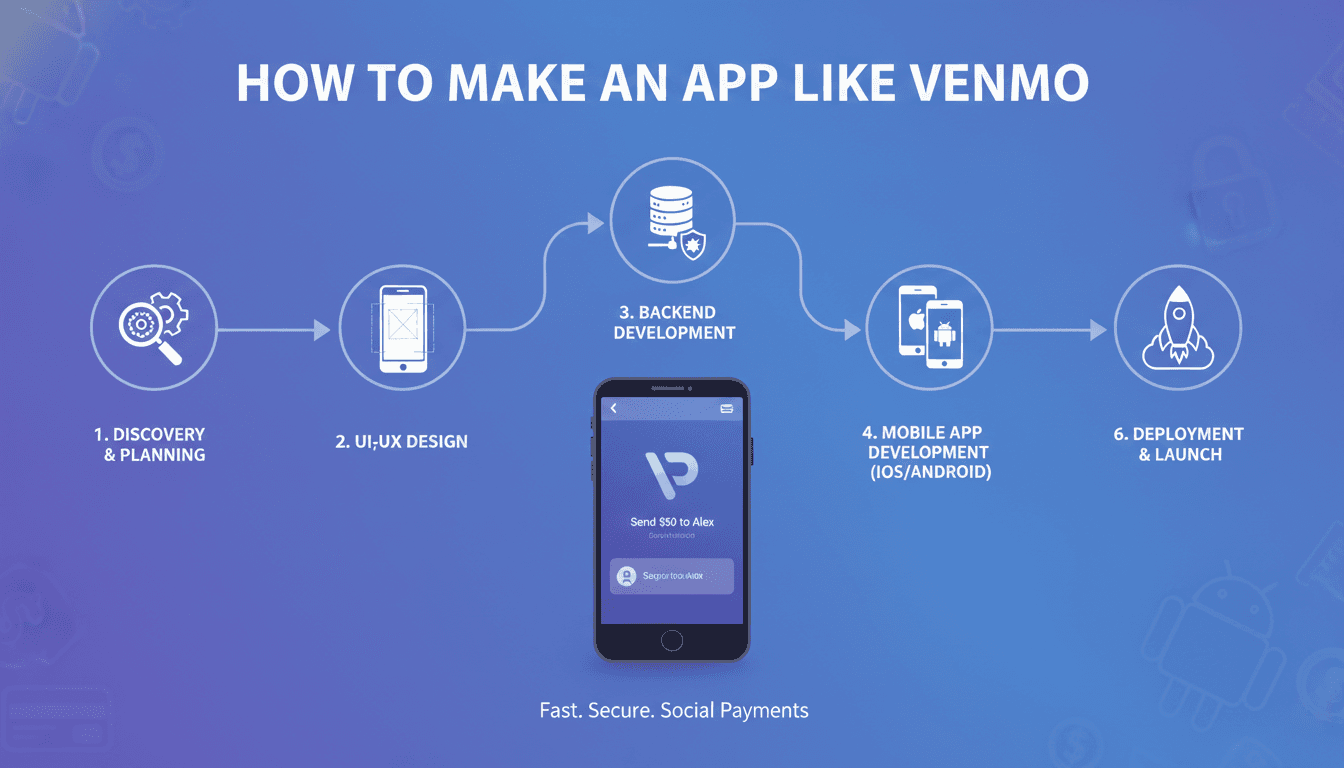
Step 8: Development Roadmap and Cost
A realistic sequence:
- Discovery & compliance scoping (3–6 weeks) — market, regulatory path, partner selection, technical architecture.
- UX/UI design (4–6 weeks) — user flows, design system, prototypes, usability testing.
- MVP development (4–6 months) — core send/receive, KYC, funding, ledger, admin panel.
- Security audit & QA (4–6 weeks) — penetration testing, load testing, compliance review.
- Pilot launch (4–8 weeks) — limited geography or closed beta with transaction caps.
- Scale & iterate — social features, business accounts, card issuing.
Cost ranges vary widely by region and scope, but as a rough guide: a lean MVP with a BaaS partner typically lands in the $80,000–$150,000 range; a full-featured, multi-region platform with card issuing and in-house compliance tooling can run $250,000–$500,000+. Add ongoing costs for infrastructure, KYC checks per user, compliance staff, and support — these are recurring and material.
Common Pitfalls to Avoid
- Treating compliance as a phase two problem. It shapes everything. Start there.
- Skipping the double-entry ledger. You will regret it at your first reconciliation mismatch.
- Underinvesting in fraud. P2P apps are magnets for scams; an unprepared launch can be existential.
- Cloning Venmo feature-for-feature. Without a wedge — a niche, a geography, a rate advantage — you're competing against a product with network effects and a decade of head start.
- Ignoring support operations. Money problems generate urgent, emotional tickets. Staff and tool for it before launch, not after.
Final Thoughts
Building an app like Venmo is a fintech company disguised as a mobile app project. The interface is deceptively simple; the ledger, compliance, fraud, and partner integrations behind it are where the real work lives.
The teams that succeed do three things well: they choose a specific audience rather than chasing everyone, they treat regulation as an architectural input from day one, and they obsess over trust in every pixel and every error state. Get those right, and the technology is very achievable with a competent engineering partner.
If you're ready to explore what a P2P payments product could look like for your market, start with a discovery engagement that pairs technical architecture with regulatory strategy — it's the cheapest insurance you'll ever buy on a project like this.
Have a project in mind? Contact Sodio Technologies to discuss your requirements and explore the right technology solution for your business.
/// Work with us
Talk to the engineers who'd build it
You'll get a technical scope, timeline and cost estimate from the people doing the work, not an account manager. In-house team, no subcontracting, since 2016.