

How to Make an App Like Wally
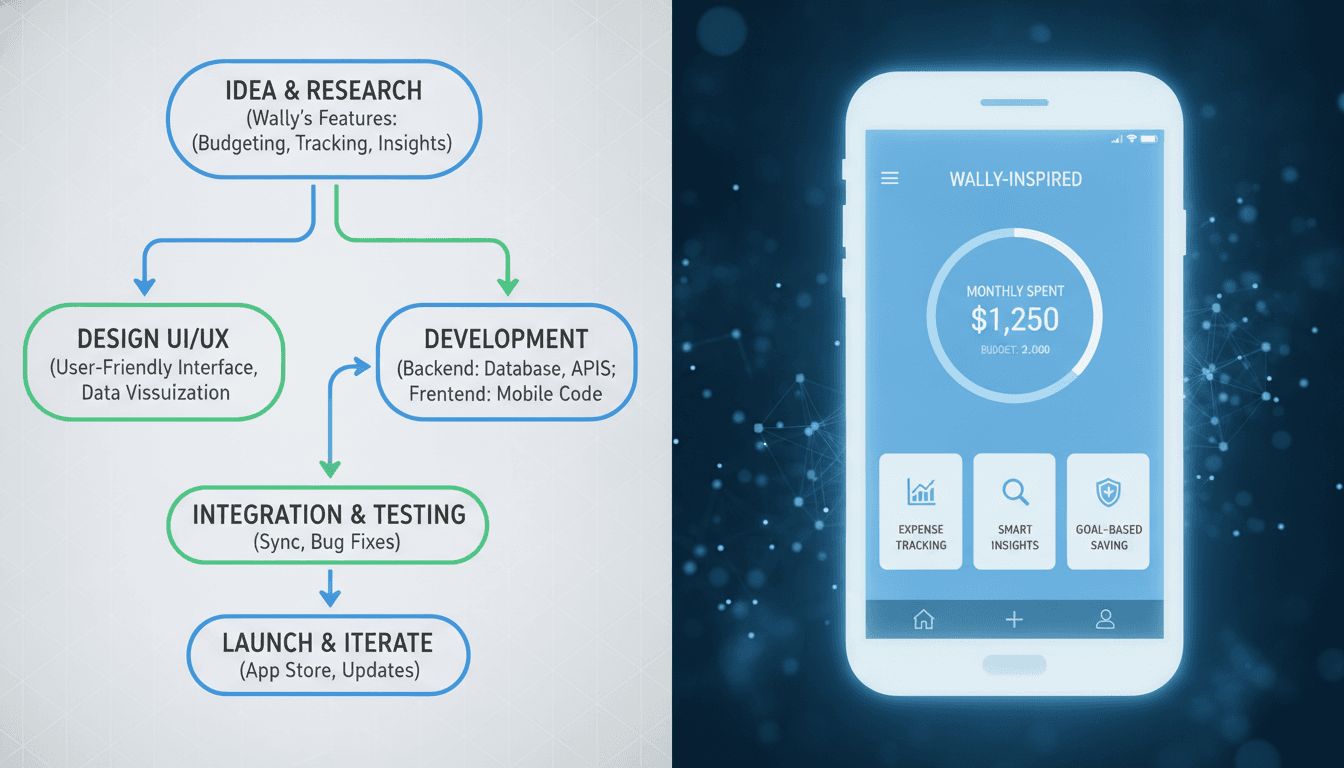
A practical breakdown of the architecture, cost drivers, and engineering decisions behind building a personal finance app like Wally — written for teams who are about to scope the work.
What Wally Actually Does Under the Hood
Wally is a personal finance tracker. Users link bank accounts, log manual transactions, set budgets, and get a consolidated view of their spending. The core loop is simple: ingest transactions, categorise them, surface insights. Everything else, currency conversion, receipt scanning, goal tracking, is layered on top.
The reason apps like this are harder to build than they look is the data layer. Financial data comes from multiple sources with inconsistent formats, delayed feeds, and varying reliability. Getting a clean, real-time picture of someone's finances across five accounts at three banks in two currencies is a genuinely hard engineering problem.
If this is relevant to your project, check out How to Make an App Like PocketGuard.
The Core Modules
Any Wally-equivalent needs at least these components:
- Account aggregation — connecting to bank APIs or Open Banking providers
- Transaction ingestion pipeline — normalising and deduplicating incoming data
- Categorisation engine — rule-based or ML-based, often both
- Budget and goal engine — stateful logic with user-defined rules
- Notification system — threshold alerts, weekly summaries, anomaly flags
- User auth and data isolation — critical given the sensitivity of financial data
Each of these can be built independently and scaled independently. That matters when you're planning your team structure.
How Does Bank Integration Actually Work?
This is the question most teams get wrong at the scoping stage. The answer varies significantly by region.
In the UK and EU, PSD2 mandates Open Banking. You connect to an aggregator like TrueLayer, Plaid (EU), or Nordigen (now GoCardless), and they handle the bank-by-bank integration under a single API. You pay per connection or per request, and you inherit their reliability guarantees and their rate limits.
For a closer look at a related topic, read our guide on How to Make an App Like Mint.
In the US, Plaid dominates. It covers around 12,000 institutions. Finicity and MX are alternatives with different pricing models. None of them are free at scale. Plaid's per-item pricing means your cost base scales linearly with your user count unless you negotiate a volume deal.
In India, Account Aggregator (AA) framework under RBI is the right path. It uses a consent-based architecture where the user controls data sharing. Integration requires working with a licensed AA entity like Finvu or OneMoney.
For a closer look at a related topic, read our guide on How to Make an App Like Spendee.
The trade-off is build-vs-buy on the aggregation layer. Building direct bank integrations is only rational if you're operating in a single market with a small number of target banks and you have regulatory relationships already. Otherwise, buy the aggregation layer and own your product logic.
What Does the Tech Stack Look Like?
There is no single correct answer, but here is what a pragmatic stack looks like for an MVP that can scale.
| Layer | Recommended choice | Why |
|---|---|---|
| Mobile | Flutter 3.x or React Native | Single codebase for iOS and Android |
| Backend API | Node.js (Fastify) or Python (FastAPI) | Fast I/O, good ecosystem for financial tooling |
| Database | PostgreSQL + Redis | Relational integrity for transactions, cache for session and budget state |
| Message queue | RabbitMQ or AWS SQS | Decouple ingestion from processing |
| Categorisation | Rule engine first, then fine-tuned classifier | Rules are debuggable; ML adds coverage |
| Auth | Auth0 or Supabase Auth with MFA enforced | Do not roll your own |
| Hosting | AWS or GCP with VPC isolation | Standard for fintech compliance |
For the categorisation engine specifically: start with a rule-based system using merchant name patterns and MCC codes. Once you have enough labelled data (typically 50,000+ transactions), train a classifier on top. A fine-tuned DistilBERT on transaction descriptions outperforms rule-only systems significantly on edge cases, but rules remain essential for explainability and debuggability.
/// Not sure where to start?
Get the architecture before you commit
Tell us what you're building and we'll map the technical approach, stack, and rough timeline. No cost, no obligation, no sales call required.
How Long Does It Take to Build and What Does It Cost?
Assuming a cross-functional team of six (two mobile engineers, two backend engineers, one designer, one QA), here is a realistic timeline:
- Weeks 1–4: Auth, onboarding, account linking via aggregator API
- Weeks 5–10: Transaction ingestion, deduplication, basic categorisation
- Weeks 11–16: Budget engine, goal tracking, notifications
- Weeks 17–20: Analytics views, currency handling, manual transaction entry
- Weeks 21–24: Security audit, penetration testing, app store submission
That puts a solid MVP at roughly five to six months. A production-ready v1 with polished UX and compliance documentation is closer to eight to nine months.
Cost depends heavily on location and seniority. At Bengaluru market rates with experienced engineers, a project like this typically runs between $80,000 and $140,000 for the build phase, excluding third-party API costs and ongoing infrastructure. Plaid alone can add $0.30 to $0.50 per connected account per month at early-stage volumes.
Do not underestimate the security and compliance work. If you are handling financial data, you need SOC 2 Type II readiness, at minimum, plus a formal penetration test before launch. Budget 15–20% of your total build cost for this.
The Parts Teams Consistently Underestimate
Deduplication. When a bank feed has a delay and a user also manually logs a transaction, you need a matching algorithm. Fuzzy matching on amount, merchant, and timestamp works reasonably well, but edge cases accumulate fast.
Currency handling. If you support multi-currency, you need a reliable exchange rate feed. Open Exchange Rates and Fixer.io both offer APIs. Storing amounts in the smallest unit of the base currency and converting at read time is cleaner than storing converted values, which go stale.
Offline mode. Users expect budget views to work without a connection. This means local state management on the client. Flutter's Hive or Drift, or SQLite via React Native's WatermelonDB, handle this well. The sync logic when connectivity returns is where bugs tend to cluster.
Notification fatigue. Alerting every transaction annoys users within a week. Good threshold logic, user-configurable quiet hours, and digest-style summaries require more thought than teams allocate in the initial scope.
Conclusion
The engineering surface for a Wally-like app is well-understood. The hard parts are data reliability, categorisation quality, and security compliance, not the UI or the core CRUD logic. If you are building for a specific market, pick the right aggregation provider first. Everything else is downstream of that decision.
If you are scoping this out and want a second opinion on your architecture or a realistic estimate for your specific market, get in touch with the team at Sodio. We have built financial data products across multiple regions and can give you a straight answer on what is achievable and at what cost.
FAQ
How much does it cost to build an app like Wally? A production-ready personal finance app typically costs between $80,000 and $150,000 to build, depending on team location, feature scope, and target markets. Third-party API costs like bank aggregators and exchange rate feeds add ongoing operational expense on top of the build cost.
Do I need a financial licence to build a budgeting app? In most jurisdictions, a read-only budgeting app that does not move money or offer financial advice does not require a financial services licence. However, if you connect to bank accounts via Open Banking APIs, you typically need to work through a licensed aggregator rather than connect directly, which sidesteps the licensing requirement.
What is the best tech stack for a personal finance app? Flutter or React Native for mobile, FastAPI or Fastify for the backend, and PostgreSQL as the primary database covers most cases well. The more important decision is your bank aggregation provider, Plaid, TrueLayer, or the RBI Account Aggregator framework depending on your target market.
How does transaction categorisation work? Start with a rule-based system using merchant names and MCC codes. This handles 70–80% of transactions accurately and is easy to audit. Overlay a trained classifier, fine-tuned on your own transaction data, to improve coverage on ambiguous entries. Never rely on ML alone; rules are essential for explainability.
How long does it take to build a Wally-type app? A functional MVP takes four to six months with a team of six experienced engineers. A polished v1 with security audits, compliance documentation, and app store approval takes eight to nine months. Rushing the security and testing phase is the most common cause of post-launch problems in fintech products.
Have a project in mind? Contact Sodio Technologies to discuss your requirements and explore the right technology solution for your business.
/// Work with us
Talk to the engineers who'd build it
You'll get a technical scope, timeline and cost estimate from the people doing the work, not an account manager. In-house team, no subcontracting, since 2016.