

How to Make an App Like Wealthfront
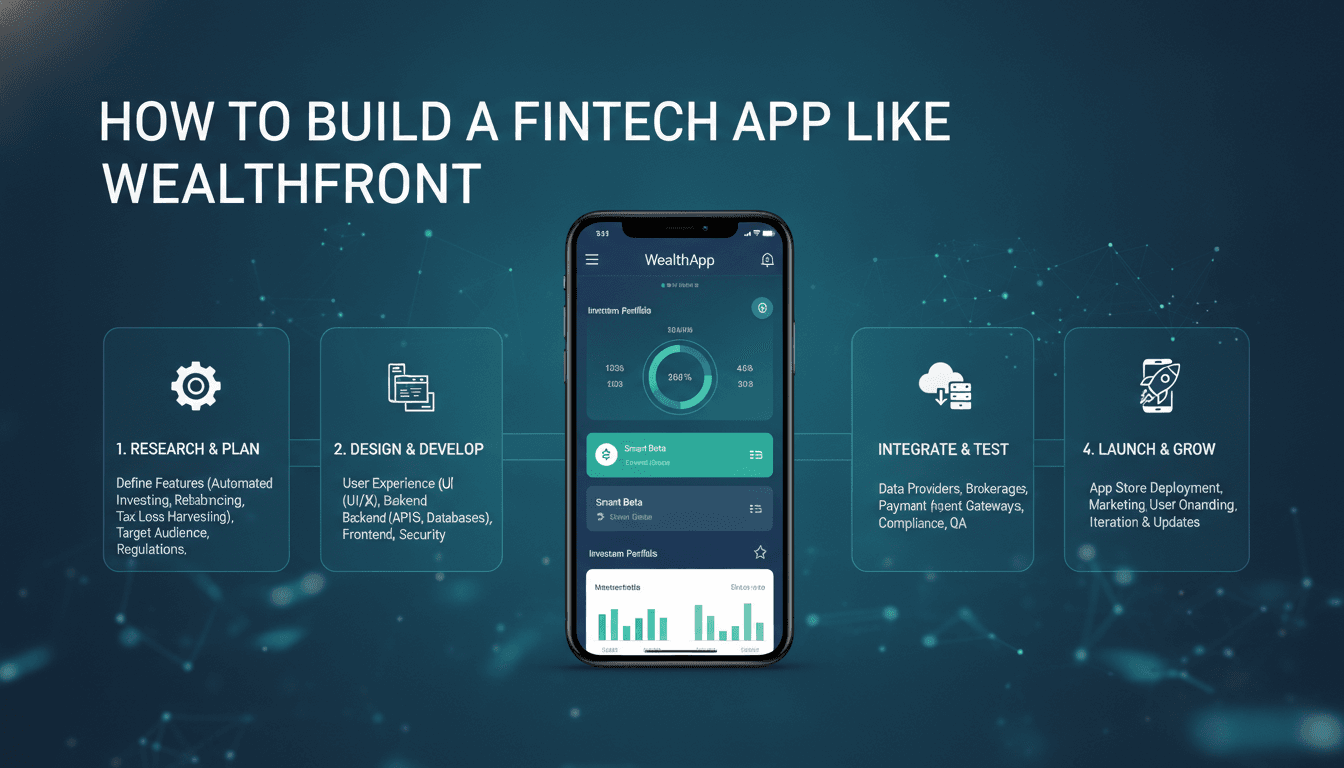
Building a robo-advisor is one of the more technically demanding projects in fintech. The surface looks simple — a clean UI, a questionnaire, some portfolio charts. Underneath, you're dealing with brokerage integrations, real-time market data, tax-lot accounting, regulatory compliance, and a risk engine that has to be defensible to both your users and your regulators. This post covers what it actually takes to build something like Wealthfront: the architecture, the trade-offs, and where teams consistently underestimate effort.
What Does Wealthfront Actually Do Under the Hood?
Wealthfront is a robo-advisor. Users answer a risk-tolerance questionnaire, deposit money, and the platform allocates it across a portfolio of ETFs, rebalances automatically, and runs tax-loss harvesting on eligible accounts. The public-facing product is polished, but the engineering surface is wide.
The core capabilities you need to replicate:
- Account aggregation — pulling in external accounts via Plaid or MX to give users a net-worth view
- KYC/AML onboarding — identity verification, sanctions screening, and ongoing monitoring
- Brokerage execution — placing, cancelling, and tracking orders against a clearing firm or prime broker
- Portfolio construction engine — translating risk scores into asset allocations
- Rebalancing logic — drift-based or calendar-based, with wash-sale awareness
- Tax-loss harvesting — identifying unrealised losses, selling, buying a correlated substitute, tracking the 30-day wash-sale window
- Reporting and statements — cost-basis tracking (FIFO, average cost, specific identification), performance calculations, year-end 1099 generation
Each of these is a project in itself. Teams that scope this as a single sprint are in trouble.
How Long Does It Take to Build a Robo-Advisor?
Honest answer: a production-ready MVP with real brokerage connectivity, KYC, and basic portfolio management takes 9 to 14 months with a competent team. A full feature set, including tax-loss harvesting and multi-account support, is closer to 18 to 24 months.
The timeline breaks down roughly like this:
| Phase | Duration | Key deliverables |
|---|---|---|
| Discovery and architecture | 6–8 weeks | Tech stack decisions, brokerage partner selection, compliance review |
| KYC and onboarding | 8–12 weeks | Identity verification, document capture, account approval flows |
| Brokerage integration | 10–16 weeks | Order management, position sync, cash management |
| Portfolio engine | 8–12 weeks | Risk model, allocation logic, rebalancing rules |
| Tax-loss harvesting | 10–14 weeks | Lot-level accounting, wash-sale logic, substitute security rules |
| Client portal and reporting | 8–10 weeks | Dashboard, performance charts, statements |
| QA, compliance, launch | 8–12 weeks | Pen testing, audit trail review, regulatory sign-off |
These phases overlap, but the brokerage integration is almost always on the critical path. Pick your clearing firm or prime broker early. Apex Clearing, DriveWealth, and Alpaca are the common choices for newer platforms. Each has different API quality, onboarding timelines (Apex can take 3 to 6 months to fully onboard a new firm), and cost structures.
The Portfolio Engine: Where the Real Complexity Lives
A questionnaire maps to a risk score. A risk score maps to a model portfolio. The model portfolio is a target allocation across asset classes, implemented using ETFs. This sounds straightforward until you run into the messy real-world cases.
Drift-Based Rebalancing
You need to define a rebalancing trigger. Threshold-based rebalancing, where you rebalance when any holding drifts more than 5% from target, is standard. The problem is that naive implementations generate excessive trades, which creates tax drag and transaction costs. You want to net buys and sells, rebalance with cash flows first (dividends, deposits), and only place trades when the tax and cost benefit justifies it.
Wash-Sale Compliance
This is where most teams underestimate the work. Under IRS wash-sale rules, if you sell a security at a loss and buy a "substantially identical" security within 30 days before or after the sale, the loss is disallowed. Wealthfront uses substitute ETFs (for example, selling Vanguard Total Stock Market and buying Schwab U.S. Broad Market ETF) to maintain market exposure while realising the loss.
You need a substitute security map, a 30-day lookback per lot per security, and logic that checks across all accounts held by the same taxpayer, not just the one account you're rebalancing. If a user holds the same ETF in their IRA and their taxable account, your wash-sale engine needs to know that.
This requires lot-level accounting from day one. You cannot bolt this on later. Every position has to be tracked as individual lots with acquisition date, acquisition price, and cost-basis method.
/// Not sure where to start?
Get the architecture before you commit
Tell us what you're building and we'll map the technical approach, stack, and rough timeline. No cost, no obligation, no sales call required.
Which Tech Stack Should You Use?
There's no single right answer, but here are the choices that appear most often in production robo-advisors and the reasons behind them.
Backend: Python is dominant in the portfolio and quantitative logic layer. FastAPI or Django REST Framework for the API layer. For the order management system and anything touching money movement, Java or Go are common because they're easier to reason about under concurrency. You don't want Python's GIL in your order router.
Database: PostgreSQL for transactional data. Lot-level accounting demands ACID compliance. TimescaleDB (built on Postgres) for price history and time-series data. Redis for caching NAVs and position snapshots.
Event architecture: Kafka or AWS EventBridge for decoupling the order management system from the portfolio engine from the notification layer. You need a reliable audit log of every state change. Every order state transition, every rebalance decision, every harvesting event should be a durable event.
Infrastructure: AWS is the dominant choice in US fintech for SOC 2 and FINRA audit reasons. Specifically, EKS for containerised services, RDS for Postgres, and CloudTrail plus CloudWatch for the audit trail regulators will ask to see.
Market data: Polygon.io for real-time and historical price data. For corporate actions (splits, mergers, dividends), you'll need a dedicated vendor like Intrinio or a feed from your clearing firm. Corporate actions are a common source of accounting bugs.
What Does It Cost to Build This?
A realistic budget range for a full robo-advisor build, including a competent engineering team, compliance tooling, and third-party APIs, sits between $800,000 and $2.5 million depending on scope and team location. Wealthfront raised $65 million before launch. You won't need that, but you should not plan for $200,000 either.
The biggest cost drivers:
- Brokerage and clearing fees (often a per-account per-month fee plus per-trade fees)
- Compliance and legal (a registered investment advisor requires ongoing compliance infrastructure)
- Engineering time on the tax engine and lot accounting (routinely 2x the initial estimate)
- Market data licensing (real-time data is expensive; plan for $2,000 to $15,000 per month depending on coverage)
If you're a startup, seriously consider whether you can launch with a more limited feature set. Tax-loss harvesting is a differentiator, but it is not required for day one. Starting with model portfolios, basic rebalancing, and a clean onboarding flow gets you to market faster and lets you validate the business before building the harder parts.
Conclusion
The architecture of a Wealthfront-style platform is not exotic, but the surface area is large and the failure modes are expensive. Lot-level accounting errors become tax problems for real users. Wash-sale bugs can cost users money and expose you to regulatory risk. Order management bugs can mean real money getting stuck.
The practical next step is to map your feature set against a phased delivery plan, pick your clearing firm early (the onboarding timeline will surprise you), and design your lot accounting schema before you write a single order. If you want to talk through the architecture in more detail, get in touch with the team at Sodio.
FAQ
How much does it cost to build an app like Wealthfront? A realistic production build, covering KYC, brokerage integration, portfolio management, and basic tax-loss harvesting, costs between $800,000 and $2.5 million. The range depends heavily on team location, the scope of the tax engine, and clearing firm fees. Cutting corners on lot-level accounting typically creates more expensive problems later.
Do you need to be a registered investment advisor (RIA) to build a robo-advisor? Yes, in the US you need RIA registration with the SEC (if you manage over $100 million in assets under management) or with your state regulator below that threshold. You also need to comply with FINRA rules if you're executing trades. Most platforms work with a compliance consultant during the build phase, not after.
What is the hardest part of building a robo-advisor? Lot-level accounting and wash-sale compliance are consistently the most underestimated parts of the build. They require careful schema design from the start and touch every part of the system. Brokerage integration timelines, particularly clearing firm onboarding, are the most common source of project delays.
Can you use a white-label solution instead of building from scratch? Yes. Providers like Riskalyze, Orion, and Betterment for Advisors offer white-label platforms. If your differentiation is in the client experience or a specific investment methodology rather than the underlying technology, a white-label approach is worth evaluating seriously. Building from scratch makes sense when the portfolio logic or tax optimisation is your core IP.
How do robo-advisors make money? The standard model is an annual management fee, typically 0.25% to 0.50% of assets under management. Wealthfront charges 0.25% per year. Some platforms supplement this with interest on cash balances, margin lending, or premium subscription tiers. The fee percentage sounds small but becomes meaningful at scale — Wealthfront managed over $50 billion in assets as of 2023.
Have a project in mind? Contact Sodio Technologies to discuss your requirements and explore the right technology solution for your business.
/// Work with us
Talk to the engineers who'd build it
You'll get a technical scope, timeline and cost estimate from the people doing the work, not an account manager. In-house team, no subcontracting, since 2016.