

How to Make an App Like Webull
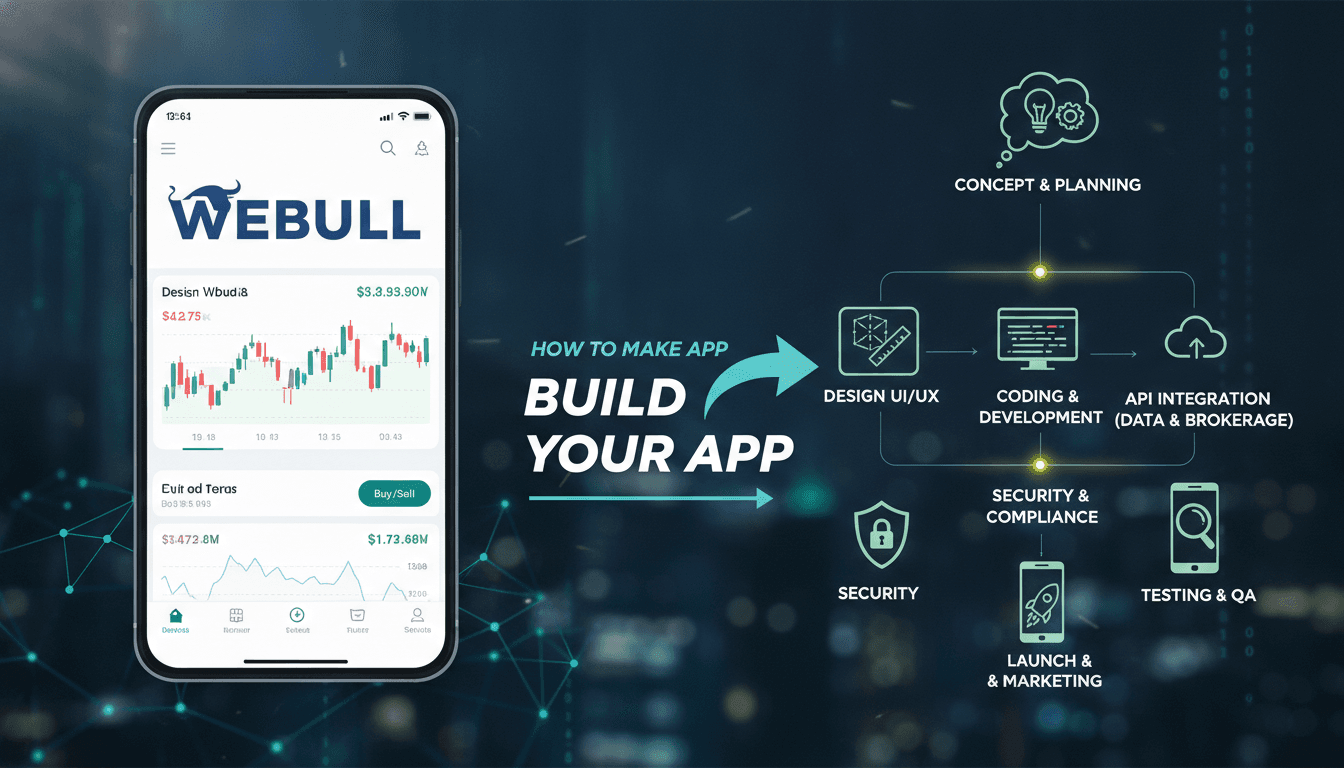
How to Make an App Like Webull
Commission-free trading apps have rewritten the rules of retail investing. Webull, with its clean charts, extended-hours trading, paper trading simulator, and deep analyst data, has become a favorite among self-directed investors who want more than a simple "buy" button.
If you're planning to build a stock trading app like Webull, you're stepping into one of the most rewarding — and most heavily regulated — corners of fintech. This guide walks through what Webull actually does under the hood, the features you need, the tech stack that supports them, compliance realities, monetization models, and what it costs to bring the product to market.
You may also find our article on How to Make an App Like Ally Invest useful.
Why Build a Trading App Like Webull?
Retail participation in capital markets has grown dramatically over the past decade, driven by zero-commission trading, fractional shares, and mobile-first onboarding. A few reasons founders keep targeting this space:
- Recurring engagement. Traders open their app multiple times a day — engagement metrics rival social media.
- Multiple revenue streams. Margin interest, premium market data, subscriptions, securities lending, payment for order flow (where permitted), and interest on idle cash.
- Underserved niches. Options-focused traders, emerging markets, Shariah-compliant investing, thematic ETFs, crypto-plus-equities hybrids, and regional exchanges are all wide open.
- Platform expansion. A brokerage app can grow into a broader wealth platform: retirement accounts, robo-advisory, savings, cards, and lending.
Understanding What Makes Webull Work
Before writing a line of code, break Webull down into its functional layers:
1. Brokerage layer. Account opening, KYC/AML, funding, order routing, execution, clearing, settlement, custody, and statements. Webull operates through a registered broker-dealer; most new entrants partner with an existing one.
2. Market data layer. Real-time and delayed quotes, Level 2 depth, historical candles, corporate actions, fundamentals, analyst ratings, and news — all licensed from exchanges and data vendors.
3. Experience layer. The charts, watchlists, screeners, alerts, paper trading, community feed, and portfolio analytics that actually differentiate one app from another.
Your competitive advantage will almost always live in layer three, while layers one and two are largely bought, licensed, or partnered.
Related reading: How to Make an App Like TD Ameritrade.
Core Feature Set
Onboarding and KYC
- Phone/email signup with OTP verification
- Identity verification: government ID capture, selfie liveness check, address proof
- Automated KYC/AML screening against sanctions and PEP lists
- Suitability questionnaire (investment experience, risk tolerance, income)
- Tax forms (W-9/W-8BEN or local equivalents)
- Account type selection: cash, margin, retirement, joint, corporate
Funding and Withdrawals
- Bank linking via open banking aggregators
- ACH, wire, instant deposits, UPI/SEPA/local rails depending on geography
- Transfer-in from another broker (ACATS or regional equivalent)
- Withdrawal limits, holds, and settlement-aware available balance
- Multi-currency wallets if you support international markets
Trading Engine Interface
- Order types: market, limit, stop, stop-limit, trailing stop, OCO, bracket
- Time-in-force: day, GTC, extended hours, fill-or-kill
- Fractional shares support
- Options chains with multi-leg strategy builders
- Extended-hours and overnight trading windows
- Crypto and futures modules if licensing permits
- Pre-trade risk checks: buying power, pattern day trader rules, position limits
Charting and Analysis
- Candlestick, line, area, Heikin-Ashi, and depth charts
- 50+ technical indicators and drawing tools
- Multi-timeframe views from tick-level to monthly
- Level 2 order book and time-and-sales tape
- Stock screeners with fundamental and technical filters
- Earnings calendars, analyst price targets, institutional holdings
Portfolio and Insights
- Real-time P&L, unrealized vs. realized gains
- Asset allocation and sector exposure breakdowns
- Dividend tracking and projected income
- Performance benchmarking against indices
- Tax lot views and year-end tax documents
Engagement Features
- Customizable watchlists with syncing across devices
- Price, volume, and technical alerts via push notifications
- Paper trading with virtual balance
- In-app news feed and social/community discussion
- Educational content, tutorials, and glossary
- Widgets, wearables, and desktop/web parity
Security
- Biometric login and device binding
- Two-factor authentication and trusted-device management
- Session timeouts and transaction PINs
- Anomaly detection on logins and withdrawals
- Full audit logging of every order and account change
Technology Architecture
Mobile Front End
- Native (Swift, Kotlin) for the best chart rendering performance and low-latency streaming — the route most serious trading apps take.
- Cross-platform (Flutter, React Native) to move faster and share logic, with native modules for charting and WebSocket handling.
Either way, invest heavily in a GPU-accelerated custom charting component. Off-the-shelf chart libraries usually buckle under high-frequency tick updates.
To explore this further, see How to Make an App Like Charles Schwab.
Backend Services
A microservices architecture is standard here. Typical services include:
- Auth & identity — sessions, MFA, device trust
- Account service — profiles, KYC status, documents
- Order management (OMS) — order lifecycle, validation, routing to broker/clearing partner
- Risk engine — buying power, margin calls, PDT tracking
- Market data gateway — normalizes vendor feeds, fans out over WebSockets
- Portfolio service — positions, cost basis, P&L computation
- Notification service — alerts, push, email, SMS
- Reporting service — statements, confirmations, tax docs
Common stack choices: Go, Java, or Rust for latency-sensitive paths; Python or Node.js for orchestration and analytics; Kafka or Pulsar for event streaming; PostgreSQL for transactional data; Redis for hot state; ClickHouse or TimescaleDB for tick and candle storage.
Market Data Pipeline
Market data is the single hardest engineering problem in a Webull-style app. You'll need to:
- Ingest exchange or vendor feeds (FIX/FAST, binary protocols, or vendor REST/WS APIs).
- Normalize symbols and corporate actions across venues.
- Aggregate ticks into candles at multiple resolutions.
- Fan out updates to thousands of concurrent subscribers with minimal latency.
- Enforce entitlements — who's allowed to see real-time vs. delayed data, professional vs. non-professional rates.
Plan for connection multiplexing, backpressure handling, and graceful degradation when a feed drops.
Infrastructure
- Cloud-native deployment on AWS, GCP, or Azure with multi-AZ redundancy
- Kubernetes for orchestration, with dedicated node pools for latency-critical services
- Co-location or low-latency peering near exchange data centers if you route orders directly
- Observability: distributed tracing, real-time dashboards, synthetic order monitoring
- Disaster recovery with tested RTO/RPO targets — regulators will ask
Regulatory and Licensing Reality
This is where most trading app projects live or die. You have three broad paths:
Path 1: Become a broker-dealer. Register with your jurisdiction's regulator (SEC + FINRA in the U.S., FCA in the U.K., SEBI in India, ASIC in Australia). Expect 6–18 months, substantial net capital requirements, a compliance officer, written supervisory procedures, and ongoing audits.
Path 2: Partner with a broker-as-a-service provider. Companies like Alpaca, DriveWealth, Apex Clearing, or regional equivalents provide accounts, custody, execution, and clearing via API. You build the experience and act as an introducing broker or technology provider. This is the fastest realistic route to market.
Path 3: Operate as a non-custodial tool. Build charting, screening, and analytics, then connect to users' existing brokerage accounts via OAuth. Far lighter regulatory load, but you give up the richest revenue streams.
Regardless of path, you'll need to handle KYC/AML, record retention, trade surveillance, best-execution reporting, advertising review, data residency, and customer complaint handling.
Monetization Models
- Margin interest on borrowed funds — usually the largest revenue line
- Premium subscriptions for Level 2 data, advanced screeners, and extended analytics
- Payment for order flow, where legally permitted
- Interest on uninvested cash balances
- Securities lending revenue share
- Options and futures per-contract fees
- Add-on products: retirement accounts, robo-portfolios, cards, lending
- Data and research packages licensed from third parties and resold
Development Roadmap
Phase 1 — Discovery and compliance mapping (4–8 weeks). Define target markets, choose your regulatory path, select broker/clearing and data partners, produce a feature spec and architecture blueprint.
Phase 2 — Design (4–8 weeks). Information architecture, chart interaction design, order ticket flows, accessibility, and a design system that scales across mobile, tablet, and web.
Phase 3 — MVP build (16–28 weeks). Onboarding, funding, watchlists, quotes, basic charting, market and limit orders, portfolio view, and paper trading.
Phase 4 — Certification and testing (6–10 weeks). Partner certification, load testing against market-open spikes, security penetration testing, and regulatory review of disclosures and marketing.
Phase 5 — Launch and iterate. Start in one jurisdiction with one asset class. Add options, extended hours, Level 2, crypto, social features, and additional markets based on real usage.
Cost Expectations
Costs vary enormously by regulatory path and asset coverage, but rough ranges:
- Analytics/charting app on top of third-party brokerage connections: $60,000 – $120,000
- MVP brokerage app via a broker-as-a-service partner (single market, equities + ETFs): $150,000 – $350,000
- Full-featured multi-asset platform with options, margin, and web/desktop parity: $400,000 – $1,000,000+
- Own broker-dealer license and clearing infrastructure: add regulatory capital, legal fees, and compliance staffing on top
Ongoing costs deserve equal attention: market data licensing can run tens of thousands per month at scale, plus cloud infrastructure, support staffing, compliance audits, and continuous security testing.
Common Pitfalls to Avoid
- Underestimating market data costs and entitlement rules. Exchange fees scale with users and professional-user classification.
- Treating charting as a UI detail. It's a performance engineering problem that needs dedicated effort.
- Building for the average day, not market open. Traffic spikes 10–50x at open, on earnings days, and during volatility events.
- Shipping ambiguous order flows. Confusing order tickets create real financial losses and regulatory complaints.
- Ignoring idempotency. Duplicate order submissions from flaky networks are a catastrophic bug class.
- Skipping the paper trading mode. It's one of Webull's strongest acquisition and retention tools, and it's cheap to build.
How to Differentiate
Cloning Webull feature-for-feature is a losing strategy. Pick an angle:
- Target a specific geography with poorly served local brokerage apps
- Go deep on one asset class — options strategy tooling, for example
- Build AI-assisted research: earnings call summaries, anomaly detection, natural-language screeners
- Lean into community: verified track records, copy trading, curated portfolios
- Serve a values-based segment: ESG, faith-based screening, or thematic investing
Final Thoughts
Building an app like Webull is equal parts product craft, engineering rigor, and regulatory discipline. The apps that win aren't necessarily the ones with the longest feature list — they're the ones that feel fast, accurate, and trustworthy when markets are moving fastest.
Start by locking down your regulatory path and partners, then focus your engineering budget on the two things users feel every single session: real-time data quality and chart responsiveness. Everything else can be layered on once you've earned their trust.
Have a project in mind? Contact Sodio Technologies to discuss your requirements and explore the right technology solution for your business.
/// Work with us
Talk to the engineers who'd build it
You'll get a technical scope, timeline and cost estimate from the people doing the work, not an account manager. In-house team, no subcontracting, since 2016.