

How to Make an App Like YNAB (You Need A Budget)
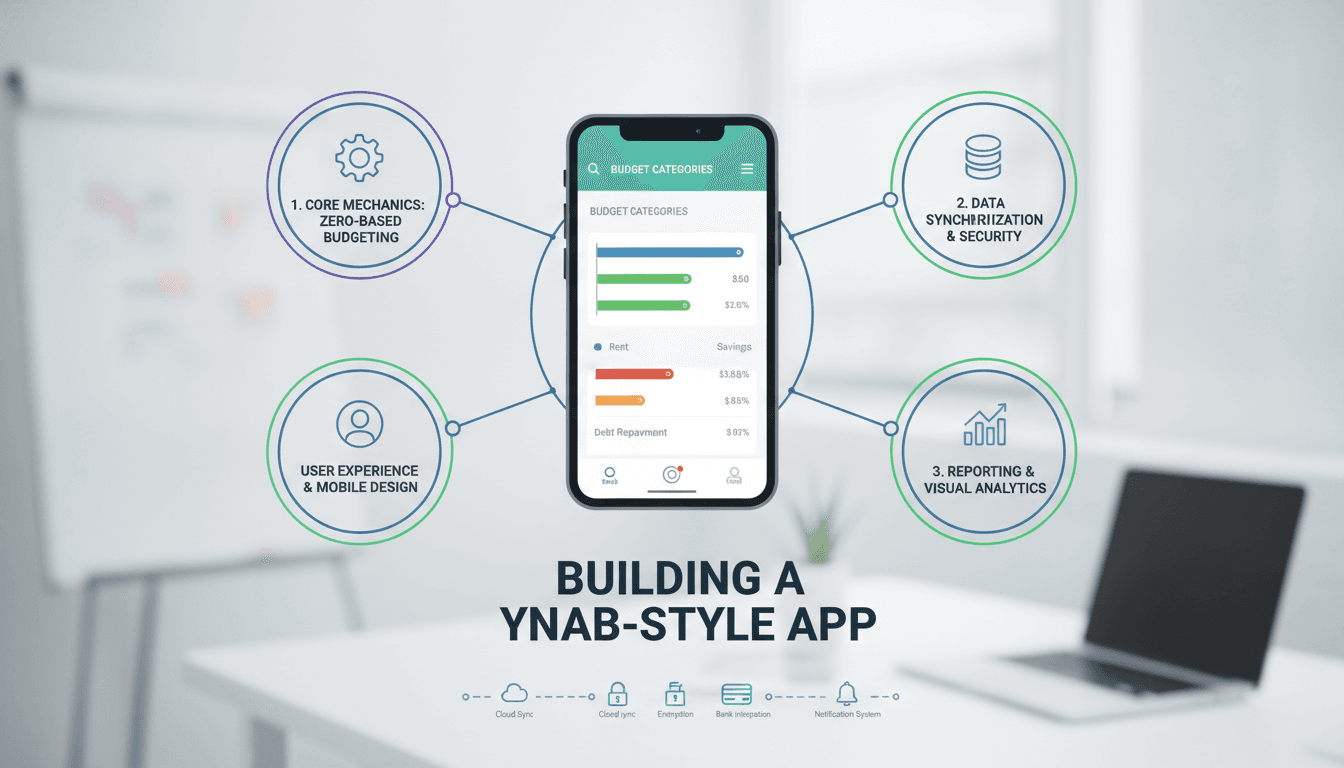
Building a personal finance app that competes with YNAB means solving genuinely hard problems: real-time sync, envelope budgeting logic, multi-device conflict resolution, and bank connectivity. This post breaks down the architecture, the trade-offs, and the decisions that actually matter.
What Makes YNAB Technically Different From a Simple Budget Tracker?
Most budget apps are glorified spreadsheets. YNAB is not. The core mechanic is zero-based budgeting: every pound or dollar of income gets assigned to a category before it's spent. That sounds simple until you model it in code.
The data model has to track three distinct states for every category: assigned, activity (actual transactions), and available (assigned minus activity, rolled over from prior months). Rolling over balances correctly across months, handling mid-month income, and letting users move money between categories in real time — these are the interactions that break naive implementations.
On top of that, YNAB syncs across web, iOS, and Android. Users expect changes on one device to appear on another within seconds. That means you're building an event-sourced or CRDT-based sync layer, not a simple REST API with a PostgreSQL read.
The budgeting engine
The budgeting engine is the heart of the system. Every category has a monthly record. When a transaction hits, the engine recalculates available for that category. If a user moves £50 from "Groceries" to "Dining Out", both category records update atomically. You need ACID guarantees here. PostgreSQL with row-level locking works. A document database without transactions does not.
YNAB also supports credit card payment categories, which is a special-case accounting pattern most clones get wrong. When you spend on a credit card, the category is debited but the credit card payment category grows. The net effect on your budget is zero until you pay the card. Modelling this correctly takes deliberate schema design.
Sync and conflict resolution
YNAB uses its own sync protocol built around delta sync. Each change generates a delta record with a vector clock or logical timestamp. Clients send their local deltas to the server, which merges them and broadcasts resolved state. This is not trivial to build from scratch.
For a new build, you have two realistic options:
| Approach | Pros | Cons |
|---|---|---|
| Event sourcing (append-only log) | Full audit trail, replayable state | Complex read models, higher storage |
| CRDT-based sync (e.g. Automerge) | True offline-first, automatic merge | Immature tooling, steep learning curve |
| Delta sync with server authority | Simpler to reason about, easier to debug | Server is single point of truth, conflicts need explicit resolution |
For most teams, delta sync with a server-authoritative model is the right starting point. You lose pure offline capability but you gain debuggability.
What Does the Tech Stack Actually Look Like?
There is no single correct stack, but here is what holds up under scrutiny for a YNAB-like product at early scale.
Backend: Node.js (TypeScript) or Go for the API layer. PostgreSQL 15+ for transactional data. Redis for session state and pub/sub for real-time category updates. A message queue (RabbitMQ or SQS) if you're processing bank transaction webhooks asynchronously.
Mobile: React Native with a local SQLite store (via WatermelonDB) gives you the offline-first sync story without maintaining two separate native codebases. WatermelonDB is specifically designed for large local datasets with sync, which maps well to this use case. For a premium native feel on iOS, SwiftUI is viable but doubles your mobile team requirement.
Web: React with Zustand or Redux Toolkit for state management. The budgeting state updates frequently enough that you want fine-grained subscriptions, not a monolithic store re-render on every transaction.
Bank connectivity: This is the piece most teams underestimate. In the UK, open banking via the FCA-regulated PSD2 framework means you connect through an AISP. Plaid covers the US, Canada, and parts of Europe. TrueLayer handles UK and European open banking well. Budget 3–6 months for integration, testing, and dealing with bank-specific quirks. Some banks return transaction data in formats that require significant normalisation.
/// Not sure where to start?
Get the architecture before you commit
Tell us what you're building and we'll map the technical approach, stack, and rough timeline. No cost, no obligation, no sales call required.
How Long Does It Take to Build, and What Does It Cost?
A realistic MVP with core budgeting, manual transaction entry, and no bank sync: 4–5 months with a team of three engineers (backend, mobile, frontend/web). That gets you to something you can put in front of users.
Adding bank connectivity via Plaid or TrueLayer: add 6–8 weeks. Real-time sync across devices with conflict resolution: add another 4–6 weeks. Multi-currency support: add 3–4 weeks for the exchange rate layer and display logic alone.
Fully featured, production-grade: plan for 12–18 months with a cross-functional team of five to seven people. That includes QA, a part-time product person, and someone dedicated to the bank integration layer.
Cost depends on where your team is based and whether you're building in-house or with a partner. For a custom build at Sodio, the engagement structure depends on scope definition. The more precisely you define the sync behaviour and the budgeting rules upfront, the fewer surprises appear mid-build.
Where teams overspend
The two areas that blow budgets consistently:
- Bank connectivity edge cases: bank APIs change, tokens expire, webhooks arrive out of order, institutions return duplicate transactions. Plan for ongoing maintenance, not a one-time integration.
- Sync logic: teams frequently underestimate how many edge cases exist when a user edits the same transaction on two offline devices simultaneously. Allocate dedicated engineering time for this, not sprint scraps.
Security and Data Handling
You're holding sensitive financial data. That changes the architecture requirements materially.
Encryption at rest is a baseline: PostgreSQL column-level encryption for account numbers and bank tokens using pgcrypto or application-layer AES-256. Plaid and TrueLayer access tokens should never sit in plain text in your database. Use a secrets manager (AWS Secrets Manager or HashiCorp Vault) from day one, not as a retrofit.
Transport: TLS 1.3 everywhere. If you're in the UK or EU, you're subject to GDPR. That means a data processing agreement with every third-party service touching user data, a clear data retention policy, and the ability to delete a user's data completely on request, including from backups.
OWASP's ASVS Level 2 is a sensible baseline for an app at this level. It covers authentication, session management, API access control, and data exposure. Run it as a checklist during design, not as a post-launch audit.
Conclusion
Building a YNAB-style app is a solvable engineering problem, but the complexity is in the details: the budgeting engine's accounting rules, the sync protocol, and the bank connectivity layer. Get those three right and the rest follows reasonably. Get them wrong and you'll be refactoring core logic under production load.
If you're at the stage of scoping out the build, the most useful thing you can do right now is write down exactly how you want category rollovers and credit card categories to work. That spec will reveal most of the hard edge cases before a line of code is written. If you'd like a technical review of your spec or an architecture session, reach out to the team at Sodio.
FAQ
How much does it cost to build an app like YNAB? A scoped MVP with manual transaction entry and core budgeting logic typically takes 4–5 months and costs between $80,000 and $150,000 depending on team location and seniority. A production-ready version with bank sync, real-time multi-device support, and security hardening is closer to $300,000–$600,000 over 12–18 months.
Do I need open banking APIs, or can I use screen scraping? Screen scraping is legally restricted in the UK and EU under PSD2 and is increasingly blocked by banks. Use a regulated AISP like TrueLayer (UK/EU) or Plaid (US/Canada/parts of EU). The API coverage is better, the data is more reliable, and you're not running compliance risk.
What database should I use for the budgeting engine? PostgreSQL. The budgeting engine requires ACID transactions for atomic category updates, and you'll want row-level locking for concurrent edits. Document stores like MongoDB lack the transaction guarantees needed for correct zero-based budget accounting without significant additional complexity.
Can I build this with a cross-platform mobile framework? Yes. React Native with WatermelonDB is a solid choice for offline-first sync and large local datasets. Flutter is an alternative if your team has Dart experience. Pure native (SwiftUI + Jetpack Compose) gives better platform integration but roughly doubles your mobile engineering cost.
How do I handle bank transaction duplicates?
Implement an idempotency layer on transaction ingestion. Assign a deterministic ID based on the transaction's source, date, amount, and merchant identifier. On insert, use PostgreSQL's ON CONFLICT DO NOTHING with that ID as a unique key. Most bank APIs also return their own transaction IDs, which you should store and index separately.
Have a project in mind? Contact Sodio Technologies to discuss your requirements and explore the right technology solution for your business.
/// Work with us
Talk to the engineers who'd build it
You'll get a technical scope, timeline and cost estimate from the people doing the work, not an account manager. In-house team, no subcontracting, since 2016.