

How to Make an App Like Zelle
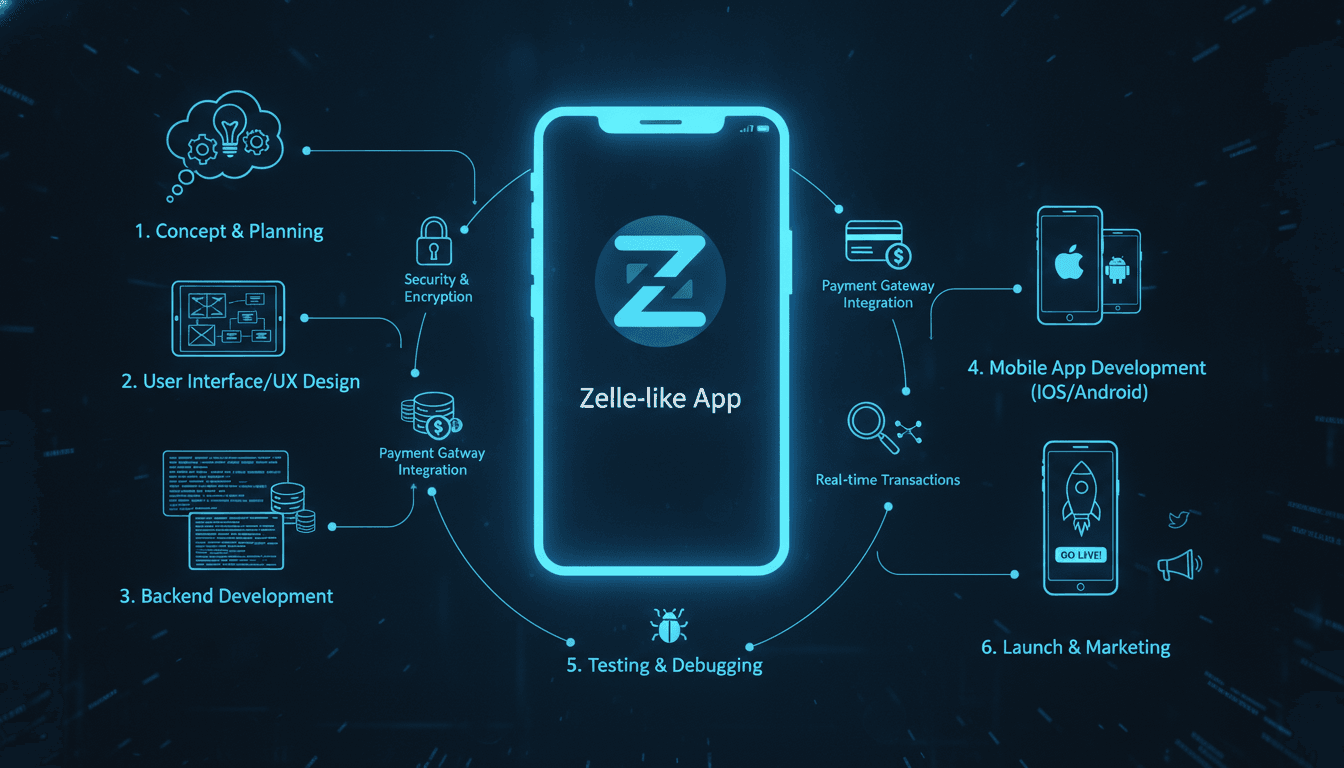
How to Make an App Like Zelle
Peer-to-peer (P2P) payments have quietly become one of the most-used features on the modern smartphone. Splitting rent, paying a contractor, sending money to a family member across the country — all of it now happens in seconds, from a phone, without a single piece of paper changing hands.
Zelle sits at the center of that shift in the United States, moving hundreds of billions of dollars a year by plugging directly into bank accounts instead of holding balances in a wallet. If you're a bank, a credit union, a fintech startup, or a platform with an existing user base, building your own Zelle-style money transfer app is an increasingly common strategic move.
We cover a closely related subject in How to Make an App Like Alipay.
This guide walks through how Zelle actually works, what you need to build, what it costs, and where projects like this typically go wrong.
What Makes Zelle Different from Other Payment Apps
Before designing anything, it's worth being precise about the model you're copying, because "app like Zelle" and "app like PayPal" are very different engineering problems.
For a closer look at a related topic, read our guide on How to Make an App Like PayPal.
Zelle is bank-to-bank, not wallet-to-wallet. When you send $50 through Zelle, the money moves from your checking account to the recipient's checking account. There's no stored balance sitting in the app. Cash App, PayPal, and Venmo, by contrast, hold funds in a wallet you top up and withdraw from.
That single architectural choice cascades into everything else:
- Speed. Transfers typically settle in minutes because they ride on real-time payment rails rather than batch ACH.
- Regulatory posture. Not holding customer funds changes your money transmitter licensing obligations substantially — though it does not eliminate compliance work.
- Identity model. Users are identified by an email address or mobile number that's been tokenized and linked to a bank account, not by a username inside your app.
- Irreversibility. Zelle transfers are effectively final, which is great for merchants and terrible for fraud victims. This is the single biggest reputational risk in the category.
- Revenue. Zelle charges consumers nothing. The value to participating banks is retention and deposit stickiness, not transaction fees.
Decide early which of these you're replicating. A hybrid model — wallet balance plus instant bank transfer — is entirely viable, but it's a different product with a different licensing path.
Core Features for an MVP
Resist the urge to ship everything. A credible first release of a P2P transfer app needs roughly this:
Onboarding and Identity
- Phone number or email registration with OTP verification
- KYC (Know Your Customer) flow: name, date of birth, address, government ID, SSN or equivalent
- Document capture with liveness detection to block deepfake and photo-of-a-photo attacks
- Device fingerprinting at enrollment
Bank Account Linking
- Instant verification via an aggregator (Plaid, MX, Finicity, Akoya)
- Micro-deposit fallback for institutions the aggregator doesn't cover
- Support for multiple linked accounts with one set as default
Send and Request Money
- Send to a phone number or email, whether or not the recipient has registered
- Request money with an optional note and expiry
- Contact list integration with permission-gated access
- Split-bill and group request flows
- Recurring and scheduled transfers
Recipient Experience
- Enrollment invitation flow for unregistered recipients, with a claim window
- Auto-deposit for enrolled users
- Clear display of expected settlement time
Transaction Management
- Real-time status: initiated, processing, completed, failed, returned
- Full searchable history with filters and exportable statements
- Receipts and dispute initiation
Notifications and Security
- Push, SMS, and email alerts on every money movement
- Biometric authentication (Face ID, Touch ID, Android Biometric API)
- Per-transaction and daily/weekly/monthly limits
- Session timeouts and remote device revocation
Admin and Operations
- Back-office dashboard for transaction monitoring and manual review
- Fraud case management queue
- Customer support tooling with impersonation-free account lookup
- Reconciliation reports against settlement files
Technology Architecture
Mobile Clients
For most teams, Flutter or React Native delivers the right balance of speed and quality for a payments app — the UI is form-heavy rather than graphics-heavy, so cross-platform overhead is minimal. Choose native Swift and Kotlin if you need deep integration with Apple Pay, Google Wallet, secure enclave key storage, or NFC tap-to-pay from day one.
Whatever you pick, enforce certificate pinning, jailbreak/root detection, screenshot blocking on sensitive screens, and secure key storage in the Keychain or Android Keystore. Never cache account numbers or tokens in plain text.
Backend
A microservices architecture is the standard choice here, and for good reason: the fraud engine, ledger, notification service, and KYC orchestrator all have different scaling and availability profiles.
A typical decomposition:
| Service | Responsibility |
|---|---|
| Identity | Registration, auth, MFA, device trust |
| KYC/Compliance | ID verification, sanctions screening, CIP records |
| Account Linking | Aggregator integration, token vault, account health |
| Payments Orchestrator | Transfer lifecycle, idempotency, retries |
| Ledger | Double-entry record of every movement |
| Fraud & Risk | Scoring, velocity rules, holds |
| Notifications | Push, SMS, email fan-out |
| Reporting | Statements, reconciliation, regulatory filings |
Language choices: Java/Kotlin (Spring Boot) and Go dominate financial backends for their maturity and concurrency characteristics. Node.js and Python are perfectly capable, and Python is especially attractive for the risk-modeling side.
Data layer: PostgreSQL for the ledger and anything requiring ACID guarantees. Redis for sessions, rate limits, and velocity counters. Kafka or a managed equivalent for the event backbone — every state change should emit an event so fraud, notifications, and analytics can react without coupling. An append-only immutable audit log is non-negotiable.
Infrastructure: AWS, GCP, or Azure with multi-AZ deployment, Kubernetes for orchestration, infrastructure-as-code, and separate environments with no production data in lower tiers. Target 99.99% uptime — payment outages generate support volume and regulatory attention in equal measure.
The Payment Rails
This is the part you cannot build yourself. Your options in the US market:
- RTP Network (The Clearing House) — real-time, credit-push, 24/7, wide bank coverage
- FedNow — the Federal Reserve's instant rail, growing quickly
- Same-day ACH — cheap, batch-based, slower, supports debits
- Card rails (Visa Direct, Mastercard Send) — push-to-debit-card, near-instant, higher cost
- Zelle itself — if you're a financial institution, joining Early Warning Services' network is often faster than building parallel infrastructure
Most non-bank fintechs reach these rails through a Banking-as-a-Service partner or a sponsor bank: Unit, Treasury Prime, Synctera, Increase, Column, or similar. The sponsor bank holds the charter; you build the experience. Expect meaningful diligence before they'll onboard you.
Outside the US, look at UPI in India, PIX in Brazil, Faster Payments and Open Banking in the UK, SEPA Instant across the EU, and PayNow in Singapore.
Compliance: The Part That Determines Your Timeline
Engineering is rarely the bottleneck on a payments product. Compliance is.
Licensing. In the US, moving money for others generally requires state-by-state money transmitter licenses — a multi-year, seven-figure undertaking if done independently. Partnering with a sponsor bank or a licensed BaaS provider lets you operate under their authority. Most startups take this route.
AML/BSA program. You need a written program, a designated compliance officer, ongoing transaction monitoring, Suspicious Activity Report filing, Currency Transaction Reports where applicable, and OFAC sanctions screening on every counterparty.
KYC/CIP. Collect and verify identity at onboarding, retain records for five years, and re-verify on risk triggers.
Regulation E. Governs consumer error resolution and unauthorized transfer liability for electronic fund transfers. Your dispute workflows, timelines, and disclosures must map to it precisely.
Data protection. PCI DSS if card data touches your systems, SOC 2 Type II because partners will ask, GDPR or CCPA depending on geography, and encryption in transit (TLS 1.3) and at rest (AES-256).
Fraud disclosures. Zelle's history with scam liability has drawn sustained regulatory and congressional scrutiny. Build in-flow warnings, confirmation screens for first-time recipients, and honest messaging about irreversibility. Treat this as a product requirement, not a legal footnote.
Engage fintech counsel before you write the first line of code. The architecture you choose has legal consequences.
Fraud Prevention and Risk
Because instant transfers are irreversible, fraud prevention has to be preventive rather than corrective.
At onboarding: document verification with liveness checks, phone number tenure and carrier checks, email age scoring, device reputation, and cross-referencing against consortium fraud databases.
At transaction time: velocity limits by amount, count, and recipient; new-recipient friction; behavioral biometrics (typing cadence, hold patterns); geolocation and IP consistency; and machine-learning scoring on the full feature set. Artificial intelligence models trained on your own transaction history will materially outperform static rules within months of launch.
Scam-specific controls: warn when a recipient was added minutes ago, flag language patterns associated with romance and impersonation scams, and add cooling-off delays on unusually large first transfers. Some networks now add a confirm-payee step that shows the recipient's registered name before sending — a simple, effective intervention.
Account takeover defenses: step-up authentication on profile changes, SIM-swap detection signals, notification of every linked-device change, and a straightforward way for users to freeze their own account.
Fraud losses are a line item, not an edge case. Model them into your unit economics from the start.
UX Principles That Actually Matter
Payments UX succeeds by being boring and trustworthy.
- Make the amount the hero. A large numeric keypad and an unmistakable amount display reduce input errors more than any other design choice.
- Confirm the recipient, not just the amount. Show a name, an avatar, and the masked contact method before the send button.
- Never leave status ambiguous. "Processing" with an expected completion time beats a spinner every time.
- Design the failure states first. Insufficient funds, unsupported bank, limit exceeded, recipient not enrolled — these are the screens users actually see under stress.
- Keep onboarding under three minutes. Every additional KYC field costs conversion. Collect the minimum required, then progressively request more as usage increases.
- Accessibility is not optional. Large tap targets, screen reader labels on every amount and status, and full support for dynamic type.
Monetization
Zelle is free to consumers by design, which means copying it outright requires an indirect business model.
- Bank-sponsored (Zelle's model): the institution pays for the capability because it drives deposit retention and reduces cash and check handling.
- Instant transfer fees: free standard delivery, 1–2% for immediate settlement. This is the workhorse revenue line for most consumer P2P apps.
- Business tier: charge merchants and freelancers a per-transaction fee for invoicing, request links, and reconciliation features.
- Cross-border FX spread: significant margin available if you expand into international remittance.
- Interchange: issue a debit card on top of the wallet and earn interchange on spend.
- White-label licensing: sell your stack to credit unions and community banks that can't build it themselves.
- Adjacent products: savings, credit building, bill pay, and lending referrals monetize an engaged payments user base.
Development Timeline and Cost
Rough ranges for a US-market build, assuming a sponsor-bank partnership rather than independent licensing:
| Phase | Duration | Notes |
|---|---|---|
| Discovery, legal, partner selection | 6–10 weeks | Runs in parallel with design |
| UX/UI design | 6–8 weeks | Including full failure-state coverage |
| MVP development | 4–6 months | iOS, Android, backend, admin |
| Security audit and penetration testing | 3–5 weeks | Third-party, mandatory |
| Partner certification and compliance review | 4–8 weeks | Frequently the critical path |
| Beta and phased rollout | 4–8 weeks | Start with internal, then limited cohort |
Indicative budget: $180,000–$400,000 for a solid MVP with a competent team, rising to $600,000+ for multi-rail support, advanced fraud tooling, and business features. Ongoing costs include per-transaction rail and aggregator fees, KYC verification costs (roughly $1–3 per user), cloud infrastructure, fraud losses, compliance staffing, and support operations.
Do not underbudget the operational side. A payments app with no fraud analyst and no dispute team will fail regardless of code quality.
A Practical Launch Sequence
- Validate the wedge. "Another Zelle" won't win. Pick a niche — a specific immigrant corridor, gig workers, campus communities, a vertical SaaS platform embedding payments, or a bank that needs a modern front end.
- Secure the partner. Sponsor bank or BaaS provider first. Everything downstream depends on their rails, limits, and compliance requirements.
- Build the ledger before the UI. A correct double-entry ledger with idempotent operations is the foundation. Retrofit is painful and expensive.
- Launch narrow. One rail, one country, conservative limits, invite-only. Raise limits as your fraud model matures on real data.
- Instrument everything. Funnel conversion, settlement times, failure reasons by code, fraud rate by cohort. You cannot tune what you don't measure.
- Expand deliberately. Add rails, business accounts, cards, and cross-border once the core is stable and reconciliation is clean.
Closing Thoughts
Building an app like Zelle is less a mobile development project than a regulated financial infrastructure project with a mobile front end. The UI is the easy part. The hard parts are rail access, an auditable ledger, a fraud program that works on day one, and a compliance posture that survives examination.
For a closer look at a related topic, read our guide on How to Make an App Like Square Cash.
Teams that succeed treat partnership selection and ledger design as their first two decisions, launch with deliberately narrow scope, and invest in fraud prevention before they need it. Teams that struggle build a beautiful send-money screen and then discover that the money can't actually move.
If you're evaluating a P2P payments build, start with the compliance and partnership questions. The engineering roadmap follows from the answers.
Have a project in mind? Contact Sodio Technologies to discuss your requirements and explore the right technology solution for your business.
/// Work with us
Talk to the engineers who'd build it
You'll get a technical scope, timeline and cost estimate from the people doing the work, not an account manager. In-house team, no subcontracting, since 2016.