

How to Make an App Like Zillow
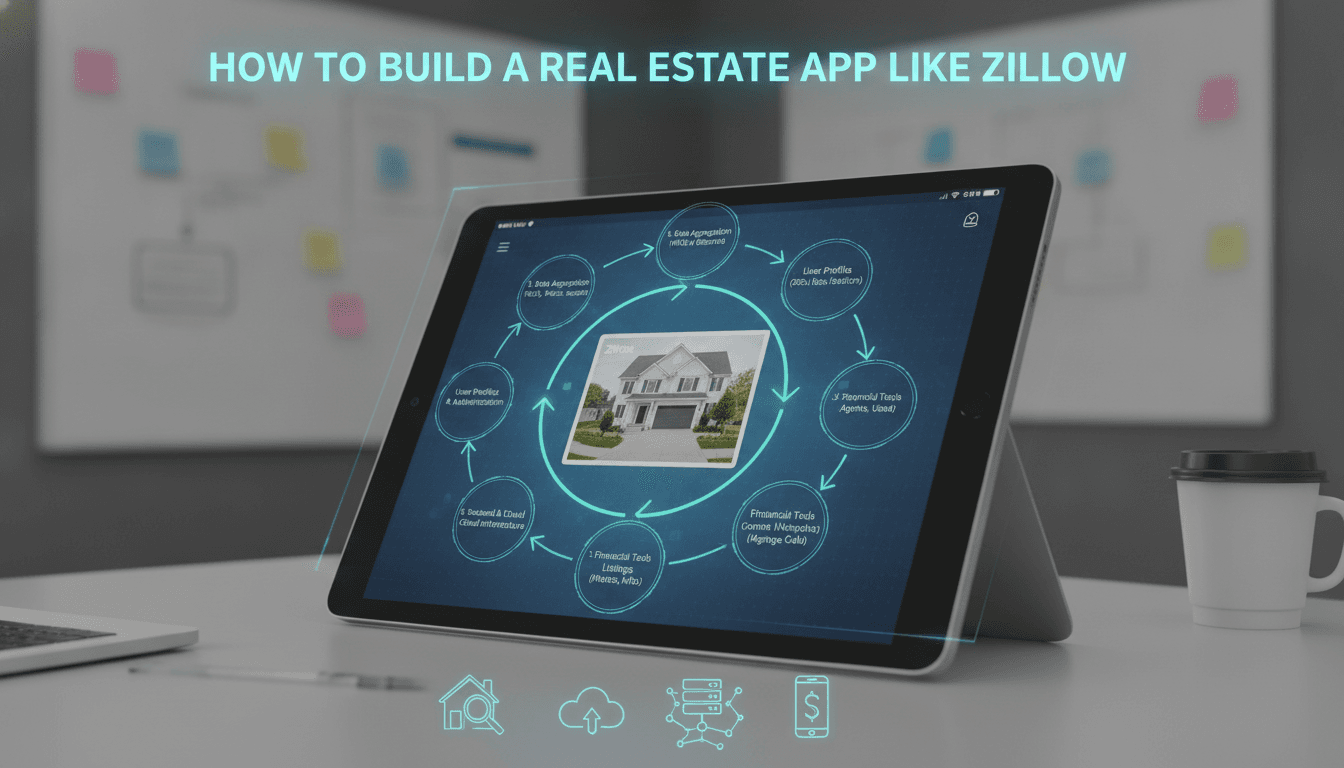
Building a real estate platform with Zillow's feature depth is a significant engineering undertaking. This post breaks down the architecture, data challenges, and cost decisions you'll face — so you can plan accurately before writing a line of code.
What Does a Platform Like Zillow Actually Do Under the Hood?
Most people think of Zillow as a property search engine. It is, but that description undersells the complexity. At its core, Zillow is a data aggregation and enrichment platform layered with a consumer-facing search product. The search experience is the easy part. The hard part is the data.
Zillow ingests property listings from thousands of Multiple Listing Services (MLS) across the United States, normalises inconsistent schemas, deduplicates records, and enriches them with tax records, ownership history, and neighbourhood data. Then it runs its own valuation model (the Zestimate) on top of all that.
If you're building a Zillow-like product for a specific geography or vertical (rental platforms, commercial real estate, property investment tools), you won't need to replicate all of this on day one. But you do need to understand which pieces you're skipping and which you can't.
The core feature surface
A production-ready real estate marketplace typically needs:
- Property listings with rich media (photos, floor plans, virtual tours)
- Geospatial search with map rendering
- Saved searches and listing alerts
- Agent/owner contact and lead capture
- Automated property valuation (AVM)
- Mortgage calculator and affordability tools
- User accounts with search history and favourites
- Admin and CRM tooling for agents
Each of these is a product in itself. A mortgage calculator is a few hours of work. A reliable AVM is months.
What Tech Stack Should You Build On?
There's no single right answer, but there are wrong ones. Here's what tends to work at different layers:
| Layer | Common choices | Notes |
|---|---|---|
| Frontend | Next.js 14 (App Router), React 18 | SSR matters for SEO on listing pages |
| Mobile | React Native or Flutter | Depends on team composition |
| Backend API | Node.js + Express, or Go for high-throughput endpoints | Go handles concurrent search requests better at scale |
| Database | PostgreSQL with PostGIS | PostGIS is non-negotiable for geospatial queries |
| Search | Elasticsearch 8.x or OpenSearch | Handles full-text + geo-filter combinations well |
| Media storage | AWS S3 + CloudFront | Standard CDN setup for images and tour files |
| Maps | Mapbox GL JS or Google Maps Platform | Mapbox is cheaper at volume; Google has better POI data |
PostGIS deserves emphasis. Polygon-based property searches ("show me listings inside this drawn boundary") require proper geospatial indexing. Trying to do this with bounding-box lat/lng queries in a standard relational database without PostGIS will cause you pain at any meaningful listing volume.
For the valuation model, you're looking at Python-based ML pipelines. Zillow's Zestimate reportedly uses gradient-boosted trees alongside neural network components. A reasonable starting point for a regional AVM is a XGBoost model trained on sold transaction data, property attributes, and local market features. Expect months of data collection and model iteration before you have something trustworthy enough to show users.
/// Not sure where to start?
Get the architecture before you commit
Tell us what you're building and we'll map the technical approach, stack, and rough timeline. No cost, no obligation, no sales call required.
How Do You Handle Property Data at Scale?
This is where most teams underestimate the work.
If you're building in a market with structured MLS data, you'll use RESO (Real Estate Standards Organisation) Web API feeds. These are standardised but not clean. Field names are consistent in theory; values are not. One MLS might encode property type as "SFR", another as "Single Family Residential", another as "1". You need normalisation pipelines before any of this reaches your database.
For markets without MLS access (most of the world outside North America), you're building web scrapers, partnering with data aggregators, or both. Scrapers work until they don't. Anti-scraping measures, rate limits, and DOM changes are ongoing maintenance costs. Factor that in.
A few architecture decisions that matter early:
- Event-driven ingestion: Use Kafka or AWS SQS to queue incoming listing updates. Don't write directly to your primary database from ingestion workers. Buffer first, validate, then write.
- Change data capture (CDC): Track listing state changes so you can push real-time alerts to saved searches. Debezium on PostgreSQL works well for this.
- Deduplication: If you're aggregating from multiple sources, listings will appear more than once. Build a deterministic deduplication key early (address normalisation + unit number + source priority).
Media is its own problem. A listing might have 40 high-resolution photos, a video walkthrough, and a 3D tour file. You need upload pipelines, transcoding (AWS Elastic Transcoder or MediaConvert for video), and thumbnail generation. Listing photo processing alone can be a meaningful percentage of your infrastructure cost.
What Will This Actually Cost to Build?
Rough estimates, assuming a mid-senior engineering team building an MVP for a single regional market:
| Phase | Scope | Estimated time |
|---|---|---|
| Data infrastructure | Ingestion, normalisation, storage | 8–12 weeks |
| Core search and listing pages | PostGIS + Elasticsearch + frontend | 10–14 weeks |
| User accounts, saved searches, alerts | Auth, notifications, preference storage | 4–6 weeks |
| Agent tools and lead management | CRM-lite, contact forms, dashboards | 6–8 weeks |
| AVM (basic) | Data collection + XGBoost model + API | 10–16 weeks |
| Mobile apps | React Native (iOS + Android) | 8–12 weeks |
These ranges assume you're not building from scratch on every dependency. Using managed services (RDS for PostgreSQL, AWS OpenSearch, Cognito for auth) compresses timelines meaningfully. Building everything self-hosted to reduce costs usually costs more in engineer time than it saves in infrastructure bills until you're at significant scale.
A functional regional MVP without AVM can realistically be built in 6–9 months with a team of 5–7 engineers. AVM adds another 3–6 months depending on data availability in your market.
Should You Build In-House or Work With a Partner?
If your core product is the real estate platform itself, your engineering team should own the architecture. That's your competitive moat.
Where external partners add genuine value: data pipelines (especially MLS integrations), ML model development if you don't have data scientists on staff, and mobile development if your team is backend-heavy.
The mistake most teams make is outsourcing too much too early and then inheriting a codebase they don't understand when they need to move fast. The second mistake is building everything in-house when the problem is already solved and the commodity solution is good enough.
MLS integration is a good example of the second mistake. Several vendors (e.g., Bridge Interactive, Spark Platform, Trestle) handle the RESO feed complexity for you. Paying for that rather than building it yourself is usually the right call unless MLS data processing is your product differentiation.
Conclusion
Building a real estate platform at Zillow's feature depth takes 12–24 months and a team that can hold geospatial data, ML pipelines, and consumer UX simultaneously. That's achievable, but only if you sequence the work correctly and don't underestimate the data layer.
The clearest next step: define which geography and which user persona you're building for first, then audit what data sources exist for that market before writing architecture documents. The data availability in your target market will constrain your roadmap more than any technology choice.
FAQ
How long does it take to build a real estate app like Zillow? A regional MVP with core search, listings, and user accounts takes roughly 6–9 months with a team of 5–7 engineers. Adding an automated valuation model extends that to 12–15 months. A full-featured platform matching Zillow's breadth is typically an 18–24 month effort with a larger team.
What database should I use for a real estate search platform? PostgreSQL with the PostGIS extension is the standard choice for geospatial property data. It handles polygon-based search queries, radius searches, and geographic indexing well. Pair it with Elasticsearch or OpenSearch for full-text search across listing fields. Avoid trying to do geospatial queries without PostGIS at any meaningful scale.
How does Zillow's Zestimate work? Zillow uses a combination of gradient-boosted tree models and neural network components trained on transaction data, property attributes, and market signals. For a regional AVM, XGBoost trained on local sold transactions and property features is a reasonable starting architecture. Accuracy depends heavily on transaction data volume and quality in your target market.
How do real estate platforms get their listing data? In North American markets, through RESO-standardised MLS data feeds, either directly or via aggregators like Trestle or Bridge Interactive. In other markets, through government land registries, data partnerships, agent-submitted listings, or web scraping. Each source has different reliability, latency, and licensing implications.
What's the most commonly underestimated part of building a property platform? The data normalisation layer. Listing data from multiple sources is inconsistent in field values, address formats, and property classifications even when the schema is standardised. Teams that skip proper normalisation pipelines end up with duplicate listings, broken search filters, and unreliable AVM inputs. It's not glamorous work, but it's foundational.
Have a project in mind? Contact Sodio Technologies to discuss your requirements and explore the right technology solution for your business.
/// Work with us
Talk to the engineers who'd build it
You'll get a technical scope, timeline and cost estimate from the people doing the work, not an account manager. In-house team, no subcontracting, since 2016.