

How to Make an App Like Zipcar
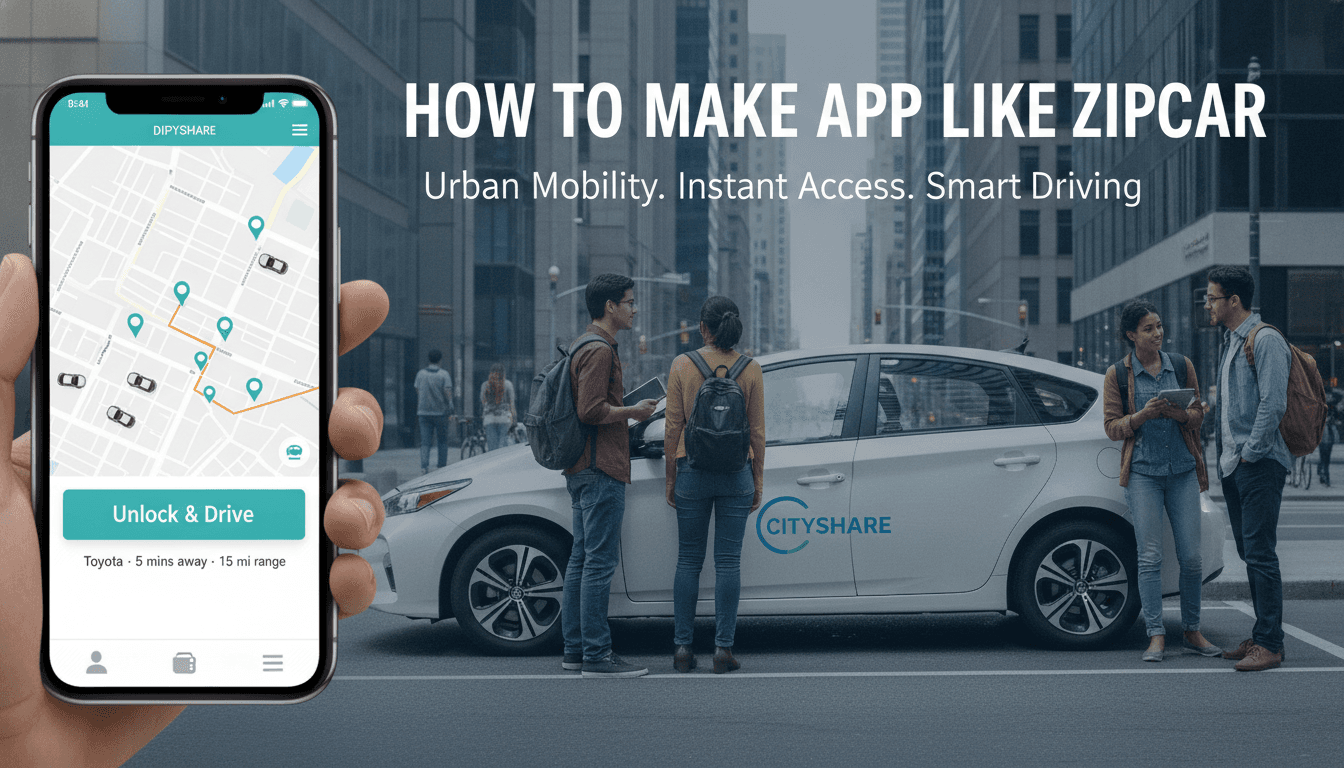
Building a car-sharing platform is an exercise in coordinating several hard problems simultaneously: real-time vehicle availability, keyless access hardware, payment processing, insurance liability windows, and fleet operations tooling. This post breaks down what it actually takes to ship something production-ready.
What Does a Zipcar-Like System Actually Consist Of?
Most people underestimate the surface area. A car-sharing app is not a booking app with a map. It is a distributed system where a mobile client, a telematics device inside each vehicle, a backend orchestration layer, and third-party services (payments, insurance, maps) all have to agree on state in near-real-time.
Related reading: How to Make an App Like Hertz 24/7.
The core functional domains are:
- User identity and driving licence verification
- Vehicle discovery and real-time availability
- Reservation and pricing engine
- Keyless entry and ignition control via IoT hardware
- Trip lifecycle management (start, active, end, damage reporting)
- Fleet operations dashboard for admins
- Billing, invoicing, and dispute handling
Each domain is independently complex. Keyless access alone involves Bluetooth Low Energy (BLE 5.x), cellular fallback, and secure key provisioning. Get the sequence wrong and users are locked out of cars in car parks at midnight.
The Telematics Layer
Every vehicle needs an OBD-II or CAN-bus connected telematics unit. Common choices are CalAmp, Ruptela, or custom units running embedded Linux. The device reports GPS coordinates, ignition state, door lock status, fuel level, and odometer readings over MQTT or a proprietary protocol to your backend. Polling frequency matters: 10-second intervals are typical for an active trip; you can drop to 60 seconds when a vehicle is parked.
The backend needs to persist this stream somewhere that supports time-series queries efficiently. InfluxDB or TimescaleDB (a PostgreSQL extension) are both reasonable. TimescaleDB is useful if you want to keep everything in one query layer, since trip summaries and user records are relational.
Keyless Access Architecture
Zipcar uses a proprietary RFID card. Most modern implementations prefer BLE because it eliminates physical card issuance. The flow is:
- User taps "Unlock" in the app
- App sends a signed unlock token to the backend
- Backend validates reservation state, then pushes a command to the telematics unit via a persistent WebSocket or MQTT channel
- Telematics unit relays the command to the vehicle's door control module
- Acknowledgement travels back up the chain; app confirms unlock
End-to-end latency under good conditions is under 2 seconds. Under poor cellular conditions it degrades. You need a BLE fallback where the app and a BLE-enabled dongle in the vehicle exchange a time-limited cryptographic token directly, bypassing the server. Token validity windows of 60 seconds, signed with ECDSA, work well in practice.
If this is relevant to your project, check out How to Make an App Like Car2Go.
How Should You Structure the Backend?
A monolith is fine to start if your team is small (under 5 engineers). The domains listed earlier map cleanly to bounded contexts in a modular monolith. Extract services only when a domain has meaningfully different scaling or deployment requirements.
The reservation engine is usually the first candidate to extract. It handles significant write contention (concurrent booking attempts on the same vehicle), and you may want to run it on a separate database replica or introduce Redis-based distributed locks. PostgreSQL advisory locks can handle this at modest scale without Redis, but they become a bottleneck above roughly 500 concurrent reservation attempts per second.
| Component | Recommended stack | Why |
|---|---|---|
| API layer | Node.js (Fastify) or Go | Low-latency, high-concurrency |
| Reservation engine | Go or Java 21 (virtual threads) | Predictable latency under contention |
| Telematics ingest | Elixir/Phoenix or Go | MQTT fan-in at volume |
| Time-series store | TimescaleDB | SQL interface, good compression |
| Cache / locks | Redis 7.x | Fast distributed state |
| Queue | RabbitMQ or Kafka | Depends on replay requirements |
| Mobile | React Native or Flutter | Single codebase, faster iteration |
Kafka makes sense if you need event replay for audit trails or downstream analytics. For most early-stage platforms, RabbitMQ is simpler to operate and sufficient.
/// Not sure where to start?
Get the architecture before you commit
Tell us what you're building and we'll map the technical approach, stack, and rough timeline. No cost, no obligation, no sales call required.
What Does Pricing and Insurance Integration Look Like?
Pricing is not just hourly rate times hours. You need to handle:
- Hourly vs. daily rate switching (Zipcar switches at 8 hours typically)
- Overage fees when users return late
- Fuel surcharges if a vehicle comes back below a threshold
- Promotional codes and corporate account billing
- Damage excess recovery
Build pricing as a pure function: given a reservation object, return a cost breakdown. Test it exhaustively. Pricing bugs are the fastest way to lose user trust and trigger chargebacks.
Insurance integration is jurisdiction-specific. In the UK, insurers like Markel and Zurich offer telematics-based fleet policies. The policy activates per trip, using start and end timestamps from your telematics data. You expose a webhook that the insurer's system calls to confirm trip events. The liability window (from unlock to lock) must be logged immutably; this is non-negotiable for claims handling.
For a closer look at a related topic, read our guide on How to Make an App Like Enterprise CarShare.
If you are building for multiple markets, treat insurance as a pluggable module. Each jurisdiction gets its own adapter implementing a common interface.
Regulatory and Compliance Considerations
GDPR applies the moment you process location data for EU residents. Location data is sensitive under Article 9 considerations in some interpretations, and definitely personal data under Article 4. You need a lawful basis for every processing activity, data minimisation in your telematics pipeline, and a defined retention policy (Zipcar retains trip data for defined periods post-trip for dispute resolution).
Driving licence verification in the UK typically goes through the DVLA's My Licence service or a third-party like Onfido or Credas. Automated checks reduce onboarding friction significantly compared to manual review. DVSA data includes endorsements and disqualifications, so checking at onboarding and periodically thereafter is standard practice.
Congestion zone and ULEZ compliance adds another layer if you are operating in London. Your trip data needs to flag vehicles entering these zones so you can pass through charges correctly.
How Long Does This Take to Build and What Does It Cost?
Honest answer: an MVP with real vehicles, real users, and production-grade keyless access takes 6 to 9 months with a team of 6 to 8 engineers. Less time is possible only by cutting scope aggressively, typically by dropping admin tooling or using off-the-shelf telematics dashboards in the first phase.
Cost depends heavily on location. A UK-based team at market rates for a 9-month build is in the £600k to £900k range. A mixed onshore/offshore model can bring that to £250k to £450k without compromising on the critical path (backend architecture, security, hardware integration).
Hardware costs stack up separately. A telematics unit per vehicle runs £80 to £200 depending on capability, plus SIM costs of roughly £5 to £15 per vehicle per month.
Off-the-shelf platforms like Ridecell or Vulog exist. They charge per-vehicle monthly fees (typically $20 to $60 per vehicle) and give you a functioning system faster, but you trade customisation and margin for speed. If you have unusual requirements around vehicle types, pricing models, or geographic constraints, custom-built is often the better long-term decision.
Conclusion
The technical complexity in a car-sharing platform concentrates in three places: the telematics and keyless access pipeline, the reservation engine under contention, and insurance/compliance integration. Everything else is hard but well-understood web engineering.
The next concrete step is scoping the telematics hardware decision before you write a line of backend code. The choice of telematics unit constrains your keyless access architecture, your data model, and your cellular/BLE fallback strategy. Get that wrong and the cost to unwind it is high.
If you are at the stage of evaluating build vs. buy or selecting a technical partner, the right conversation starts with your vehicle mix, target geographies, and your first-year fleet size. Those three numbers determine almost everything else.
FAQ
How long does it take to build a car-sharing app like Zipcar? A production-ready MVP with real keyless access, payments, and telematics integration takes 6 to 9 months with a team of 6 to 8 engineers. Cutting scope (particularly admin tooling) can compress this. Anything promising a working product in under 4 months is likely cutting corners on security or hardware integration.
What technology handles keyless car access in a car-sharing app? Most modern implementations use Bluetooth Low Energy (BLE 5.x) paired with a server-side command relay through the telematics unit. A cryptographic token signed with ECDSA provides a BLE fallback when cellular connectivity is poor. RFID cards are simpler but require physical issuance and replacement logistics.
Do I need to build my own telematics system or can I use an off-the-shelf one? You can start with off-the-shelf telematics platforms like CalAmp or Ruptela's hosted dashboards, but you will almost certainly need custom ingest and processing at the backend level. The raw data stream needs to feed your reservation state machine, billing engine, and insurance webhook in ways no generic dashboard supports out of the box.
What are the biggest regulatory hurdles for a car-sharing app in the UK? GDPR compliance for location data, driving licence verification via DVLA or a third-party KYC provider, and insurance policy integration are the main ones. If operating in London, ULEZ and congestion zone charge pass-through adds another layer. Each country has its own insurance API and licence verification mechanism, so multi-market rollout is more complex than it looks.
Should I build custom or use a platform like Ridecell or Vulog? Off-the-shelf platforms get you live faster and cost $20 to $60 per vehicle per month at scale. Custom builds cost more upfront but give you full control over pricing models, vehicle types, and integrations. If your fleet is under 200 vehicles and your model is standard, a platform is probably the right first step. Above that, or with unusual requirements, custom starts to make financial sense.
Have a project in mind? Contact Sodio Technologies to discuss your requirements and explore the right technology solution for your business.
/// Work with us
Talk to the engineers who'd build it
You'll get a technical scope, timeline and cost estimate from the people doing the work, not an account manager. In-house team, no subcontracting, since 2016.