

Learning and Development Platforms: Promoting Employee Growth
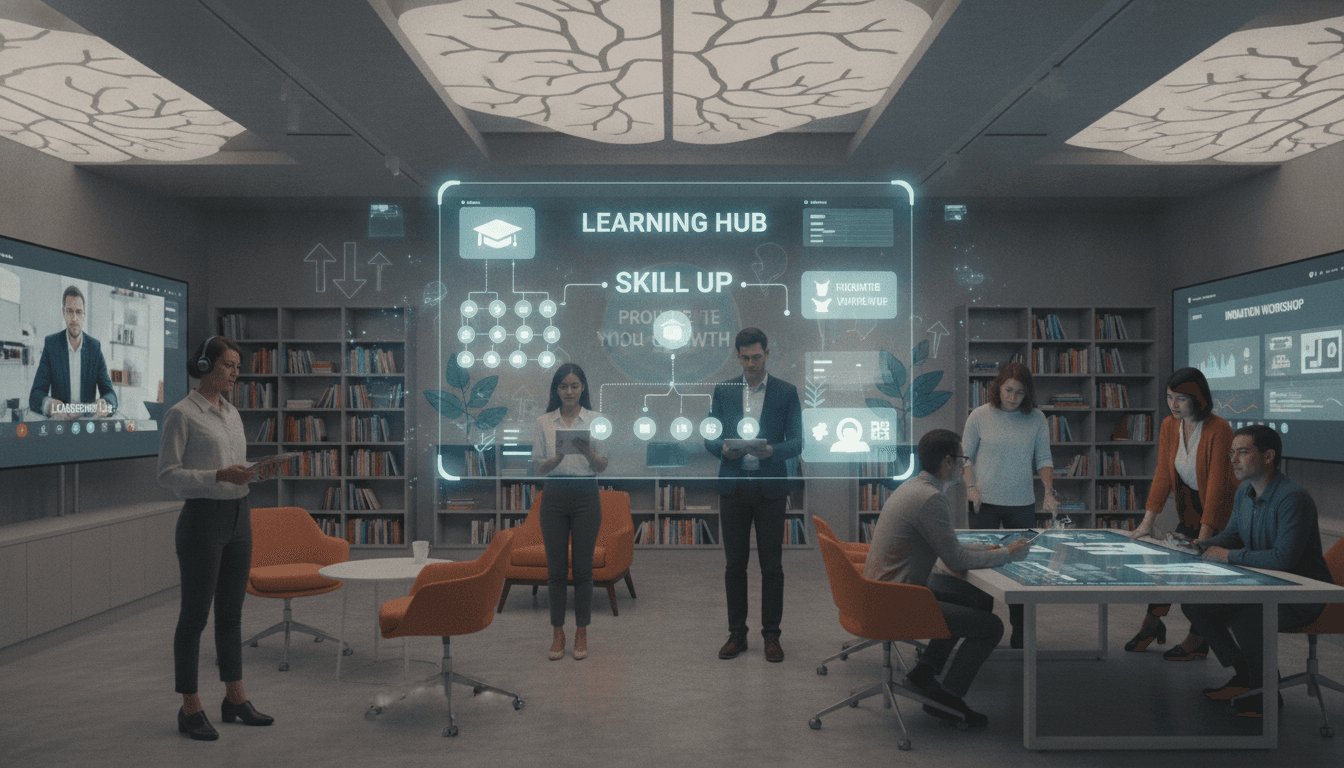
Learning and development platforms have matured significantly over the last decade. What started as basic LMS tools for compliance training have grown into systems that handle skill-gap analysis, personalised learning paths, peer-to-peer knowledge sharing, and integration with performance management. If you're evaluating whether to build something internally or adopt an existing platform, this post covers what actually matters under the hood.
What Does a Modern L&D Platform Actually Do?
The term "L&D platform" covers a wide surface area. At minimum, you need content delivery and progress tracking. Beyond that, the interesting engineering problems are in personalisation, analytics, and integration with adjacent systems like HRIS, performance review tools, and internal wikis.
Content Delivery and Standards
Most platforms support SCORM 1.2 or xAPI (Tin Can). xAPI is the more flexible of the two — it logs learning events from any context (mobile, simulator, on-the-job), not just inside a course player. If your organisation runs learning across varied environments, xAPI gives you the richer data model.
The content layer itself is often underestimated. Video hosting, transcript generation, subtitle synchronisation, and adaptive bitrate streaming (HLS, MPEG-DASH) all matter once you're at scale. A platform that stores MP4s in S3 with no CDN is going to hurt users on slow connections.
Personalisation Engines
Recommendation logic ranges from simple rule-based assignment (role = engineer → assign Python track) to collaborative filtering models trained on completion rates and assessment scores. Platforms like Degreed and 360Learning have invested heavily in the latter. Building this yourself means owning the data pipeline, model retraining schedule, and feedback loop — which is non-trivial if your ML team is already stretched.
Worth noting: personalisation only works if you have enough signal. Organisations with fewer than 500 learners often find that rule-based assignment outperforms ML recommendations simply because there isn't enough behavioural data to train on.
How Do You Choose Between Build and Buy?
This is the question most engineering leads actually face. The honest answer depends on how differentiated your learning model needs to be.
| Factor | Buy/SaaS | Build in-house |
|---|---|---|
| Time to first cohort | Days to weeks | 3–9 months minimum |
| Custom workflows (e.g. project-based assessment) | Limited | Full control |
| Integration with proprietary internal tools | Connector-dependent | Native |
| Data ownership and residency | Vendor-controlled | You own it |
| Ongoing maintenance cost | Subscription | Engineering headcount |
| Personalisation sophistication | Vendor roadmap | Your roadmap |
Off-the-shelf platforms like Cornerstone, Docebo, or TalentLMS cover 80% of use cases well. The remaining 20% — unusual org structures, real-time skill-gap dashboards, tightly coupled performance review flows — is where custom builds start to make sense.
If your learning content is itself a product (you're training external partners or customers), a generic LMS often creates friction at the boundary. That's a stronger case for building.
/// Not sure where to start?
Get the architecture before you commit
Tell us what you're building and we'll map the technical approach, stack, and rough timeline. No cost, no obligation, no sales call required.
What Does the Data Architecture Look Like?
Most L&D platforms store three categories of data: learner profiles, content metadata, and event streams.
Event Streams
The event stream is where the real analytics live. Every video play, quiz attempt, pause, rewind, and completion generates an event. At 1,000 active learners, this is manageable in a relational store. At 50,000, you're looking at Kafka or Kinesis for ingestion, with a data warehouse (Snowflake, BigQuery, Redshift) as the analytical layer. Connecting that to a BI tool like Metabase or Looker gives L&D teams self-serve reporting without engineering involvement in every query.
One pattern that works well: separate your transactional store (PostgreSQL for learner state, course completions) from your analytical store. Mixing OLTP and OLAP in a single database leads to slow dashboards and query contention.
Skill Taxonomies
Skill data is messier than it looks. "Python" in your HRIS might map to three different competency levels depending on which team defined it. Building a canonical skill taxonomy — even a simple one with around 200–400 nodes — is a one-time investment that pays back in cleaner reporting and better role-to-skill mapping. The ESCO framework (European Skills, Competences, Qualifications and Occupations) is a reasonable starting point if you don't want to build from scratch.
How Does AI Change What's Possible?
Generative AI has genuinely shifted what small L&D teams can produce. Content generation, quiz creation, and transcript summarisation are now fast enough to matter operationally.
Practically, this shows up in a few ways:
- Course authoring tools (Articulate Rise, Lectora) are adding AI-assisted drafting that cuts initial content production time by 40–60% in early benchmarks
- LLM-powered search across internal knowledge bases means employees can query documentation and get synthesised answers rather than scanning PDFs
- Conversational practice simulations, particularly useful for sales and customer-facing training, can be built on GPT-4o or Claude 3.5 with a prompt framework and guardrails — no fine-tuning required for most use cases
The risk area is hallucination in compliance-sensitive content. If your L&D platform is generating training on financial regulation or health and safety, you need a human review step before publication. Retrieval-augmented generation (RAG) with a curated source corpus reduces hallucination rate substantially, but doesn't eliminate it.
Integrating L&D with the Rest of Your Engineering Ecosystem
A standalone LMS that doesn't talk to your HRIS, Slack, or ticketing system creates manual work. The integrations that matter most are:
- HRIS sync (Workday, BambooHR, HiBob): so that new joiners auto-enrol, leavers auto-unenrol, and role changes trigger new learning paths without manual intervention
- SSO: SAML 2.0 or OIDC. Non-negotiable for enterprise deployments. Any platform that doesn't support this in 2025 is not worth evaluating further
- Notification routing: Learning reminders through the channel employees actually use (Slack, Teams, email) rather than a platform-native inbox nobody checks
- Performance data feedback loop: Connecting L&D completion and assessment scores back into performance review tools (Lattice, Leapsome) closes the loop between learning and development outcomes
SCIM provisioning for automated user lifecycle management is also worth checking early. Manual CSV uploads for user management are a maintenance burden that compounds with headcount growth.
Conclusion
L&D platforms are engineering problems as much as they are HR ones. The choice of standards (xAPI vs SCORM), data architecture, integration surface, and AI tooling all have downstream consequences that are hard to reverse once you're at scale.
If you're starting fresh, buy a SaaS platform and customise at the integration layer first. Only build custom if you have a clear gap the market doesn't solve, or if learning is itself a core product differentiator for your business.
The concrete next step: audit your current learning data. If you can't answer "which skills are improving in which teams, and at what rate," your data layer needs attention before your platform choice matters.
FAQ
What's the difference between an LMS and an LXP? An LMS (Learning Management System) is administrator-driven: you assign courses and track compliance. An LXP (Learning Experience Platform) is learner-driven: it surfaces content based on interests and behaviour. Many modern platforms blend both. The distinction matters for UX design, not underlying architecture, which is often similar.
Is xAPI worth adopting over SCORM? Yes, if you run learning outside a browser-based course player. xAPI logs events from mobile apps, physical simulations, and informal learning. SCORM 1.2 requires a course player and only tracks completion and score. For compliance-only training with standard course formats, SCORM is sufficient and simpler to implement.
How many learners do you need before custom-build makes financial sense? There's no fixed threshold, but the economics rarely favour a custom build below 2,000–3,000 learners. SaaS platforms typically price at $3–$10 per user per month. A custom build requires 6–12 months of engineering time plus ongoing maintenance. The case improves if learning is externally monetised or deeply integrated with proprietary systems.
What should I look for in an L&D platform's API? Rate limits, webhook support for real-time event delivery, and xAPI endpoint compatibility. Also check whether the API covers the full feature set or only a subset of it — many vendors have rich UIs but thin APIs, which creates problems when you try to automate enrolment or extract data programmatically.
Can generative AI replace human instructional designers? Not fully. AI accelerates content drafting, quiz generation, and summarisation, but instructional design involves sequencing, cognitive load management, and domain expertise that current models handle inconsistently. A realistic model is one instructional designer reviewing and curating AI-drafted content, rather than end-to-end AI authoring without human oversight.
Have a project in mind? Contact Sodio Technologies to discuss your requirements and explore the right technology solution for your business.
/// Work with us
Talk to the engineers who'd build it
You'll get a technical scope, timeline and cost estimate from the people doing the work, not an account manager. In-house team, no subcontracting, since 2016.