

Omnichannel Retail Solutions: Enhancing Customer Experience
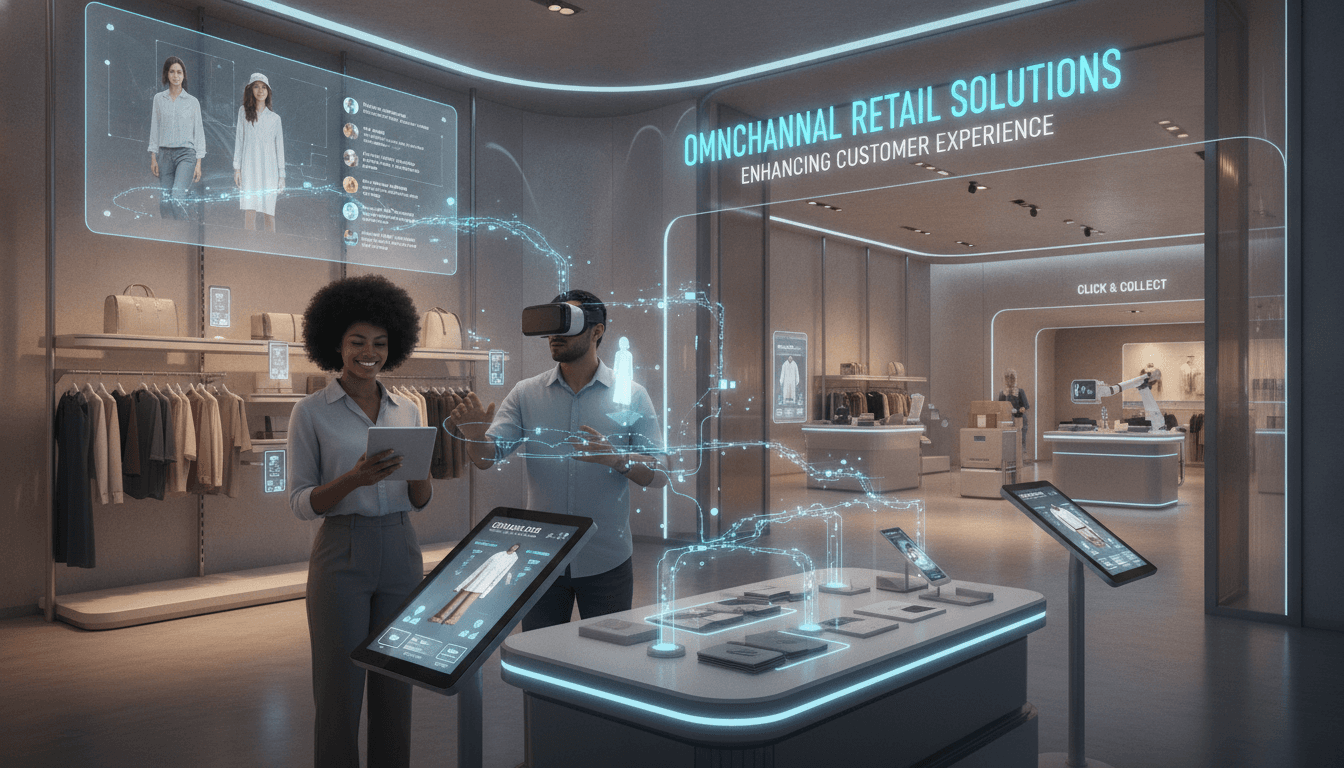
Retail has changed faster in the last five years than in the previous twenty. Customers now move between a brand's app, website, physical store, and social channels within a single purchase journey — and they expect every touchpoint to know what happened at the last one. Building the systems that make that possible is genuinely hard engineering, not just a configuration exercise.
What Does an Omnichannel Architecture Actually Look Like?
Most teams underestimate how much of the complexity lives in the data layer, not the front end.
A working omnichannel system has roughly four concerns:
- A unified customer identity that survives channel switches
- Real-time inventory state that every channel reads from the same source of truth
- Order orchestration that can route, split, and fulfil across locations
- Event propagation that keeps every downstream system (loyalty, CRM, analytics) consistent
The front-end channels — React storefront, native iOS/Android app, POS terminal — are relatively straightforward once those four concerns are solved. The hard part is the backbone.
Unified Customer Identity
This is where most first attempts fail. You end up with a guest ID from the website, a loyalty ID from the app, and a card-swipe record from the store, and no join key between them. The fix requires a deterministic identity resolution step at every session start: email, phone, or a cookie-backed device fingerprint matched against a master profile table.
Probabilistic identity resolution (matching on behavioural signals) can fill gaps, but treat it as an enrichment layer, not a foundation. Build the deterministic layer first.
Inventory as a Shared Service
Inventory has to be a service, not a database that each channel queries independently. The service owns write authority. Channels read from a projected view, usually cached with a TTL short enough that overselling probability stays acceptable for your margin profile. For most mid-market retailers, a 30-second cache with optimistic reservation on add-to-cart is a reasonable default. High-velocity SKUs (flash sales, limited drops) need reservation at the point of display, not checkout.
How Do You Handle Order Routing Across Physical and Digital Channels?
Order management is where the business rules get complicated quickly.
A customer buys online and wants same-day delivery. The warehouse is 40 km away. There's a store 2 km away with stock. Ship-from-store is cheaper and faster, but the store's pick-and-pack throughput is limited. The routing engine has to weigh distance, stock, fulfilment cost, SLA commitment, and store capacity — in real time, per order.
Implementing this as a rules engine works until the rules multiply. At around 20+ routing conditions, a rules engine becomes unmaintainable. At that point, a lightweight ML model trained on historical fulfilment outcomes performs better and is easier to audit. XGBoost on tabular order features is a practical starting point — no need for deep learning here.
The integration points that matter most:
- WMS (Warehouse Management System): push pick tasks via webhook, not polling
- Carrier APIs: rate-shop at order confirmation, not at shipping label creation
- Store POS: two-way sync for BOPIS (buy online, pick up in store) status updates
/// Not sure where to start?
Get the architecture before you commit
Tell us what you're building and we'll map the technical approach, stack, and rough timeline. No cost, no obligation, no sales call required.
What Are the Trade-offs Between a Composable and a Monolithic Commerce Platform?
This is the question most CTOs should be asking before any architecture decisions.
| Factor | Composable (MACH) | Monolithic (Shopify Plus, SAP Commerce) |
|---|---|---|
| Time to first transaction | Weeks to months longer | Days to weeks |
| Customisation ceiling | Effectively none | Hard limits on business logic |
| Integration complexity | High — you own the glue | Low — pre-built connectors |
| Vendor lock-in | Low at component level | High |
| Operational overhead | Significant | Managed by platform |
| Realistic team size needed | 5+ engineers | 1–2 developers |
Composable architecture (Commercetools, Contentful, Algolia, a custom OMS) makes sense when your business model requires logic that packaged platforms cannot express. If you are running standard catalogue and checkout flows with modest customisation, a monolith is faster and cheaper to operate. The industry trend towards MACH is real, but it is often adopted for architectural reasons that do not apply to the specific business adopting it.
Headless vs. Traditional Storefront
Headless gives you full control over the presentation layer. It also means you own performance — Core Web Vitals, SSR/SSG decisions, CDN configuration — entirely. Next.js 14 with React Server Components is the current practical default for headless storefronts. Expect to spend real engineering time on caching strategy; a headless storefront with poor cache design is slower than a well-tuned Shopify theme.
Personalisation at Scale: What Actually Moves Conversion?
Personalisation is the most over-promised and under-delivered capability in retail tech.
The things that consistently move conversion metrics are narrow:
- Ranking search results by individual purchase history (not just popularity)
- Personalised sort order on category pages
- Cart abandonment recovery with the specific abandoned item shown
Recommendation carousels on home pages have much smaller measured impact than the engineering effort they consume. Product-level collaborative filtering (matrix factorisation or a two-tower model) is technically interesting but rarely the highest-leverage investment for a retailer with fewer than 5 million monthly active users. At that scale, a well-tuned BM25 index with behavioural re-ranking gets most of the way there.
Real-time personalisation requires an event stream. Kafka or AWS Kinesis as the backbone, a feature store (Feast or Tecton) to serve pre-computed features at low latency, and a serving layer that can respond in under 100ms per request. That is a meaningful infrastructure commitment.
Conclusion
Omnichannel retail is an infrastructure problem disguised as a product problem. Get the identity layer and inventory service right first. Everything else — personalisation, routing, channel experience — is easier to build on top of a solid data foundation.
If you are at the point of deciding architecture, start by mapping every system that currently holds customer or inventory state. The count and the duplication will tell you where the real work is.
FAQ
What is the minimum viable tech stack to go omnichannel? You need unified customer identity, a single inventory service, and an order management system that can handle multiple fulfilment types. Channel count matters less than data consistency. Retailers have gone omnichannel with three channels and a well-structured database before investing in microservices.
How long does an omnichannel integration typically take to build? For a retailer with an existing e-commerce platform and one physical location, a foundational integration covering shared inventory and order routing typically takes 4–6 months of focused engineering. Adding channels, personalisation, and advanced routing adds time. Estimates that promise full capability in 8 weeks are usually scoped too narrowly.
Should we build a custom OMS or buy one? Buy first. Platforms like Fluent Commerce, Kibo, or Fabric OMS cover most routing and fulfilment scenarios. Build custom only when your fulfilment model has constraints that packaged software cannot express — for example, complex split-payment rules tied to fulfilment location, or regulatory requirements specific to your market.
How do we prevent overselling when stock is shared across channels? Optimistic reservation with a TTL (typically 15–30 minutes) handles most cases. Reserve on add-to-cart, confirm on payment. For high-demand items, move reservation to the point of product display and use a queue. The real fix is making inventory writes synchronous and reads eventually consistent with a short TTL.
What data does omnichannel personalisation actually require? Transaction history, browse events, and search queries are the three most predictive inputs. You do not need demographic data or third-party enrichment to see meaningful lift. Start with first-party behavioural signals and a simple re-ranking model before investing in a full feature store or ML pipeline.
Have a project in mind? Contact Sodio Technologies to discuss your requirements and explore the right technology solution for your business.
/// Work with us
Talk to the engineers who'd build it
You'll get a technical scope, timeline and cost estimate from the people doing the work, not an account manager. In-house team, no subcontracting, since 2016.