

Prompt Versioning and Regression Testing in Production
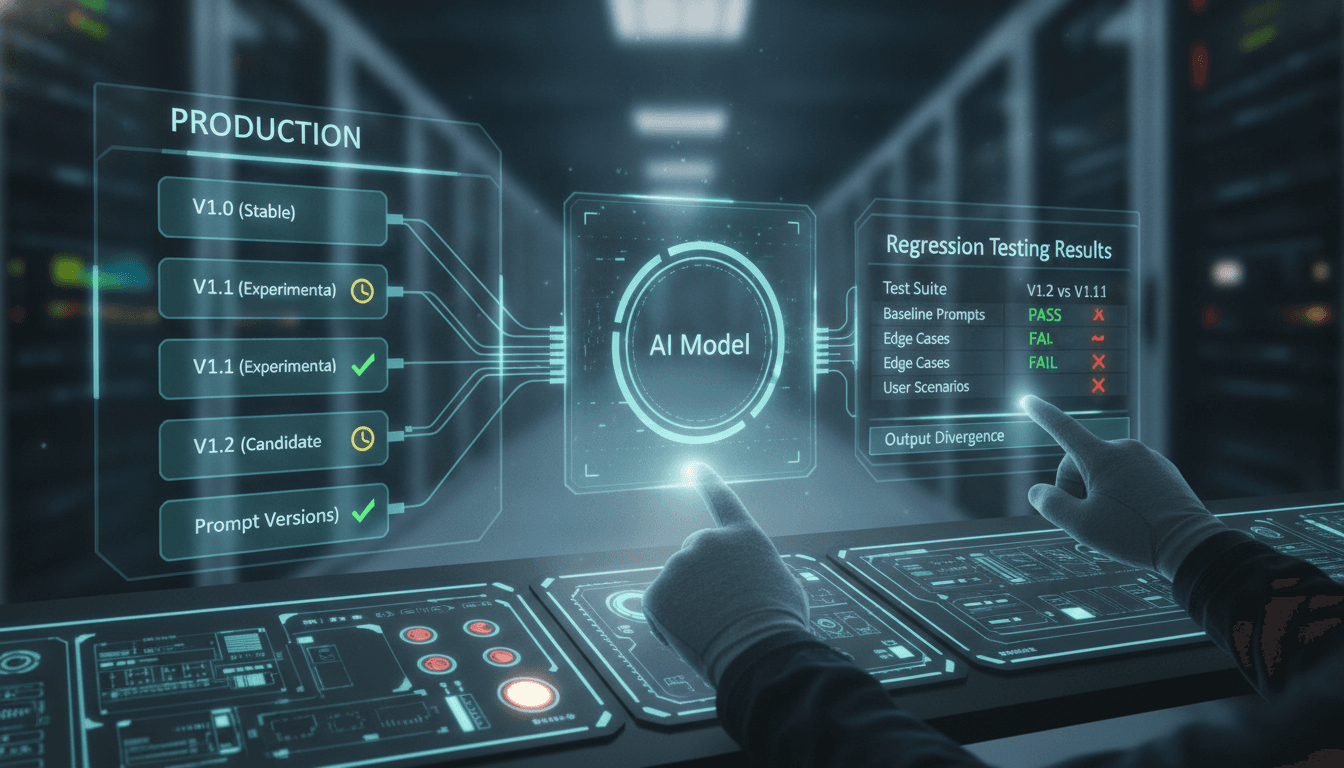
Treating prompts as throwaway strings is the fastest way to introduce silent regressions into an AI-powered product. Here is how to manage them the same way you manage code.
Why Prompts Break in Production Without You Noticing
A model update ships. A prompt that worked fine last Tuesday now returns structured JSON with an extra field your parser does not expect. No exception is raised. The field is silently dropped. A downstream feature quietly stops working.
This is the failure mode that prompt versioning and regression testing exist to prevent. Unlike a code change, a prompt change produces no compile error, no type mismatch, and often no immediate signal at all. The feedback loop is long, and by the time a user reports something wrong, the cause is buried in a git blame three deploys back.
The problem compounds when multiple engineers edit prompts directly in environment variables or a shared config file. There is no history, no review process, and no test suite. You are flying blind.
What Prompt Versioning Actually Means in Practice
Versioning a prompt means treating it as a first-class artefact with an identifier, a history, and a deployment lifecycle. There are two broad approaches.
Store Prompts in a Database, Not in Code
The simplest production pattern is a prompts table with columns like id, name, version (integer or semver string), body, model, temperature, created_at, and is_active. When your application needs a prompt, it fetches the active version by name at startup or via a cache with a TTL of around 60 seconds.
This gives you immediate rollback. If version 14 of invoice_extraction_prompt breaks on a new PDF format, you flip is_active to version 13 without a code deploy. It also gives you a full audit log, which matters in regulated industries.
The downside is operational overhead. You now have a database dependency in your prompt loading path. If the database is unavailable at startup, your application needs a fallback, typically the last-known-good prompt baked into the container image.
Git as the Source of Truth
Some teams keep prompts in a prompts/ directory in the same repo as the application code. Each prompt is a plain text or YAML file. Changes go through pull requests. This is simpler and works well if your team is small and prompt changes are infrequent.
The limitation is coupling. A prompt change requires a code deploy, which means you cannot hot-fix a broken prompt without going through your full CI/CD pipeline. For applications where prompt quality is a primary product concern, that is too slow.
A hybrid pattern solves both problems: Git is the source of truth for review and history, but a deploy step pushes the prompt into a database or a dedicated prompt management service like PromptLayer, LangSmith, or Weights & Biases Prompts. Code references the database, not the file.
How Do You Write Regression Tests for Non-Deterministic Outputs?
This is the question most teams get stuck on. The answer is that you are not testing for exact string equality. You are testing for structural correctness, semantic correctness, and constraint satisfaction.
Structural Tests
If your prompt is supposed to return JSON, test that the output is valid JSON and conforms to a schema. Use jsonschema in Python or zod in TypeScript. A structural test that checks for the presence of required keys and the correct types for values will catch the majority of regressions caused by model updates or prompt edits.
Semantic Tests Using a Judge Model
For outputs that cannot be reduced to a schema, use a second LLM call as a judge. You pass the prompt input, the expected behaviour description, and the actual output to a judge prompt, then parse the judge's verdict. GPT-4o or Claude 3.5 Sonnet works well for this. The judge prompt itself should be versioned and tested.
This sounds circular, but in practice it is reliable. The judge is evaluating a narrow, well-defined criterion, not generating creative content.
Constraint Tests
Define hard constraints the output must satisfy regardless of phrasing. For a summarisation prompt, constraints might include: output length below 150 words, no first-person pronouns, all named entities present in the source. These are cheap to test deterministically.
/// Not sure where to start?
Get the architecture before you commit
Tell us what you're building and we'll map the technical approach, stack, and rough timeline. No cost, no obligation, no sales call required.
Building a Regression Suite That Actually Runs in CI
A regression suite for prompts has four components:
| Component | What it does | Tool example |
|---|---|---|
| Fixture dataset | Curated inputs with expected behaviour descriptions | Static JSON files in the repo |
| Evaluator | Runs each fixture against the current prompt and model | Python script with openai SDK |
| Judge | Scores outputs against expected behaviour | GPT-4o with a rubric prompt |
| Gate | Fails CI if score falls below a threshold | GitHub Actions exit code |
The fixture dataset is the most important piece. You need at least 20 to 30 examples that cover your happy path, your edge cases, and the specific inputs that caused regressions in the past. Every time a prompt breaks in production, add that input to the fixture dataset before fixing the prompt. This is how the suite grows.
Running LLM calls in CI costs money and adds latency. A suite of 30 fixtures with a judge call per fixture is roughly 60 API calls per run. At GPT-4o pricing as of mid-2025, that is under $0.50 per run, which is acceptable for a pre-merge check. If cost is a concern, run the full suite only on changes to prompt files and use a fast, cheap model like gpt-4o-mini for structural tests.
What Should You Log in Production to Catch Regressions Early?
CI catches regressions before deployment. Logging catches the ones that slip through because real production inputs are always more varied than your fixture dataset.
Log the prompt name, version, model, input token count, output token count, latency, and a hash of the prompt body for every LLM call. Do not log the full prompt body or user inputs by default; that creates a data handling problem. Log the hash so you can correlate behaviour changes with prompt version changes after the fact.
Set up alerts on two metrics: output parse failure rate and latency p95. A sudden increase in parse failures usually means a prompt regression or a model update. A latency spike often means a model is returning longer outputs than expected, which can itself indicate a prompt regression where the model is generating preamble or explanation it was not supposed to.
Tools like Langfuse and Helicone make this easier by providing a structured logging layer on top of your LLM calls. Both support prompt versioning natively and will track which version of a prompt produced which outputs in production.
Conclusion
Start with the simplest thing that gives you history: move your prompts out of environment variables and into a versioned store. Add a structural test for each prompt output format. Build a small fixture dataset and wire it to CI. Add logging with version tracking.
The next concrete step is to pick one production prompt, write five fixture test cases for it, and run them against the current model in a script. That script is the foundation of your regression suite.
FAQ
What is the difference between prompt versioning and model versioning? Prompt versioning tracks changes to the text and parameters you send to a model. Model versioning tracks which model you are calling. Both matter independently. A prompt can regress because the prompt text changed, or because the underlying model was updated by the provider with no change to your code.
How many test fixtures do you need before a regression suite is useful? Twenty fixtures is a reasonable minimum. Ten covering the happy path and ten covering edge cases or past failure inputs gives you enough coverage to catch the majority of regressions. The suite becomes more valuable over time as you add inputs from real production failures.
Can you use open-source models as judges in the evaluation pipeline? Yes. Models like Llama 3.1 70B or Mistral Large run on self-hosted infrastructure and work well as judges for straightforward criteria. The trade-off is that they require more careful prompting than frontier models and may score inconsistently on nuanced semantic criteria. For binary pass/fail checks, they are reliable.
Should prompts live in the same repository as the application code? It depends on how frequently prompts change relative to code. If prompt changes happen as often as code changes, keeping them together simplifies review. If prompt iteration happens continuously and independently of code, a separate store with API access reduces deployment friction and lets non-engineers participate in prompt editing.
How do you handle prompt regressions caused by provider-side model updates?
Pin to a specific model version where the provider supports it. OpenAI exposes dated versions like gpt-4o-2024-08-06. Run your regression suite on a schedule against the pinned version, and re-run it before switching to a new version. Treat a model version upgrade the same way you treat a major dependency upgrade.
Have a project in mind? Contact Sodio Technologies to discuss your requirements and explore the right technology solution for your business.
/// Work with us
Talk to the engineers who'd build it
You'll get a technical scope, timeline and cost estimate from the people doing the work, not an account manager. In-house team, no subcontracting, since 2016.