

Safety and Compliance Software: Ensuring Workplace Safety
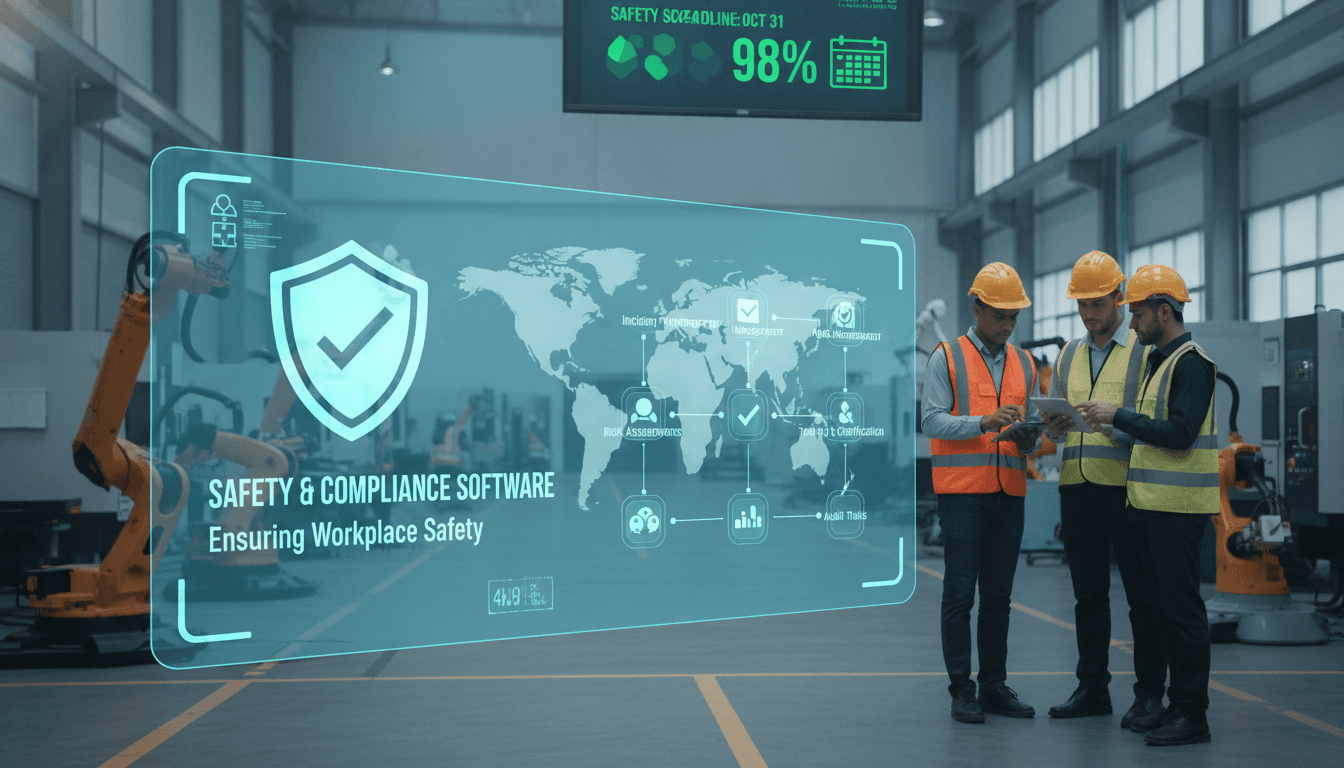
Safety and compliance software has matured significantly over the past decade. What used to be spreadsheets, paper checklists, and email trails has moved into structured, auditable systems with real-time data capture. If you're evaluating whether to build this capability in-house or adopt an existing platform, the architecture decisions matter more than the vendor pitch decks suggest.
What Does Safety and Compliance Software Actually Do?
At its core, this category of software manages four things: incident reporting, risk assessment, regulatory compliance tracking, and corrective action workflows. Most platforms layer on top of those with audit scheduling, permit-to-work systems, and document control.
The regulatory side is the part that tends to surprise engineering teams. In India, for example, the Factories Act 1948 and its state-level amendments require specific record formats. ISO 45001:2018, the international standard for occupational health and safety management systems, defines requirements that most enterprise buyers are now contractually obligated to meet. OSHA in the US mandates 300-log incident tracking with tight timelines. A system that doesn't map its data model to these standards creates compliance debt from day one.
The Data Model Is the Hard Part
Most safety incidents involve unstructured input: a worker describes what happened in free text, a supervisor adds context, photos get attached. Converting that into structured, queryable data requires either rigid forms (which people skip or game) or natural language processing to extract structured fields post-submission.
The better systems use a hybrid approach: a minimal required field set with free-text capture, followed by automated classification. Modern NLP models, particularly fine-tuned versions of BERT or domain-adapted LLMs, can classify incident type, severity, and root cause category with reasonable accuracy (typically 80-92% on held-out test sets, depending on how clean your training corpus is). That's good enough to trigger routing and escalation, not good enough to replace human review.
How Do Modern Platforms Handle Real-Time Monitoring?
This is where IoT integration becomes central. Sensor data from gas detectors, wearables tracking fall detection, environmental monitors for noise or particulate levels — all of this needs to feed into the compliance system with timestamps and location metadata.
The typical architecture looks like this:
| Layer | Common Stack |
|---|---|
| Edge devices | Modbus, MQTT over cellular or LoRaWAN |
| Ingestion | AWS IoT Core, Azure IoT Hub, or self-hosted EMQX |
| Stream processing | Apache Kafka + Flink for complex event processing |
| Storage | TimescaleDB or InfluxDB for time-series, PostgreSQL for relational |
| Alerting | Threshold-based rules engine + ML anomaly detection |
The alerting layer is where most implementations get into trouble. Pure threshold-based rules generate too many false positives in industrial environments. A gas detector near a loading bay will spike regularly during normal operations. Layering an anomaly detection model (isolation forest or LSTM-based approaches work well here) over the raw sensor stream reduces alert fatigue significantly.
One honest caveat: real-time sensor integration adds substantial operational complexity. You're now maintaining firmware update pipelines, dealing with network reliability in physically harsh environments, and managing device authentication at scale. If your primary need is incident reporting and audit trails rather than live monitoring, starting without IoT integration and adding it later is a defensible choice.
/// Not sure where to start?
Get the architecture before you commit
Tell us what you're building and we'll map the technical approach, stack, and rough timeline. No cost, no obligation, no sales call required.
Building In-House vs. Adopting a Platform
This is the decision most engineering teams spend too little time framing correctly.
Off-the-shelf platforms like Intelex, Cority, or Enablon cover the compliance workflow layer well. They have pre-built regulatory mappings, audit templates, and integrations with HR systems. If your compliance requirements are standard (ISO 45001, basic OSHA reporting, GDPR for employee data), an existing platform will get you live faster and cheaper than building.
The case for custom development is narrower but real:
- Your industry has highly specific regulatory requirements that generic platforms don't map to (mining, nuclear, chemical processing each have distinct frameworks)
- You need deep integration with operational systems (SCADA, ERP, production scheduling) that existing platforms treat as an afterthought
- You have existing sensor infrastructure that doesn't fit the ingestion patterns the vendors support
- Your data residency requirements make SaaS untenable
Building custom isn't faster. A production-grade incident management system with a proper audit trail, role-based access control, and regulatory reporting takes 6-9 months minimum for a competent team to build and harden. That timeline assumes you already have clear requirements, which safety compliance systems almost never start with.
What Are the Compliance Audit Trail Requirements You Cannot Skip?
Regulatory auditors are specific about what constitutes an acceptable audit trail. The record must be tamper-evident, timestamped to a reliable source, and attributable to a specific user. In practice this means:
Immutable append-only logging. Every state change in an incident record, every document version, every approval action needs a log entry that cannot be edited. Event sourcing as an architectural pattern handles this cleanly — your system state is a projection of an immutable event log.
Cryptographic signing is increasingly expected in high-stakes environments. Some implementations use a private blockchain (Hyperledger Fabric is the most common choice in enterprise safety systems) to provide tamper evidence without relying solely on database-level controls. This is worth the complexity when you're dealing with regulators who have the authority to impose significant penalties.
Digital signatures on submitted documents using X.509 certificates, with certificate management handled through an HSM or a managed service like AWS KMS, satisfy most regulatory requirements for document authenticity.
Access Control and Data Segregation
RBAC isn't enough in multi-site or multi-contractor environments. You typically need attribute-based access control (ABAC) where a site safety manager can see incidents at their site but not others, a corporate HSE team can see aggregated data across sites, and a contractor's safety rep sees only their workers' incidents. Getting this data model right early saves significant rework.
How Should You Think About Reporting and Analytics?
Lagging indicators (injury rates, near-miss counts, audit scores) are what most systems report on. The more useful capability is predictive: identifying patterns that precede incidents before they happen.
The standard safety metrics are worth knowing:
- TRIR (Total Recordable Incident Rate): (number of recordable incidents × 200,000) / hours worked
- LTIFR (Lost Time Injury Frequency Rate): (lost time injuries × 1,000,000) / hours worked
- Near-miss ratio: industry benchmark suggests 300 near-misses for every major injury (Heinrich's Triangle, though the ratios are contested in academic literature)
Building predictive models on top of these requires enough historical data to be meaningful. If your organisation has fewer than three years of structured incident data, predictive analytics will produce unreliable outputs. Start with good descriptive reporting and invest in data quality before adding ML layers.
Conclusion
The technology for building effective safety and compliance systems exists and is well-understood. The harder problems are requirements clarity, integration with operational systems, and maintaining data quality over time.
If you're starting fresh, map your specific regulatory obligations first, then decide whether a commercial platform covers them adequately. If your requirements fall outside what Intelex or Cority handles out of the box, that's the point at which a custom build becomes worth the investment.
If you want to talk through the architecture for a specific use case, including IoT integration, audit trail design, or regulatory mapping for your jurisdiction, reach out to the Sodio team directly.
FAQ
What is the difference between an EHS platform and a custom safety compliance system? EHS (Environment, Health, Safety) platforms like Intelex or Cority provide pre-built workflows for standard regulatory frameworks. Custom systems are built when your industry-specific requirements, existing infrastructure, or data residency constraints make a generic platform impractical. Custom builds take longer and cost more upfront; platforms have ongoing licensing costs and less flexibility.
Does ISO 45001 require software, or can you manage compliance manually? ISO 45001:2018 does not mandate software. It requires documented processes, evidence of hazard identification, risk assessment, and corrective action. Software makes the evidence trail easier to maintain and audit, but organisations have achieved certification with well-managed paper-based systems. At scale or across multiple sites, manual management becomes operationally difficult to sustain.
How do you prevent workers from skipping incident reports? You reduce friction in reporting and create psychological safety for submitting near-misses. Mobile-first interfaces, anonymous reporting options for lower-severity events, and clear policy that near-miss reporting is rewarded rather than penalised all increase submission rates. Technology helps, but cultural factors drive more of the outcome than any specific software feature.
What data should a safety compliance system capture at minimum? At minimum: incident date, time, location, type classification, people involved (with role and tenure data), immediate cause, contributing factors, and corrective actions with owners and due dates. Without structured corrective action tracking linked to incidents, the system becomes a reporting tool rather than a management tool.
Is blockchain necessary for a compliant audit trail? No. Most regulatory frameworks accept a well-implemented append-only database log with proper access controls as a valid audit trail. Blockchain adds tamper-evidence through cryptographic chaining and decentralisation, which is valuable when multiple independent parties need to verify records without trusting a single system administrator. For single-organisation deployments, a properly architected relational or event-sourced system is sufficient.
Have a project in mind? Contact Sodio Technologies to discuss your requirements and explore the right technology solution for your business.
/// Work with us
Talk to the engineers who'd build it
You'll get a technical scope, timeline and cost estimate from the people doing the work, not an account manager. In-house team, no subcontracting, since 2016.