

Shopify, Magento or Custom: Decide on Commercial Model
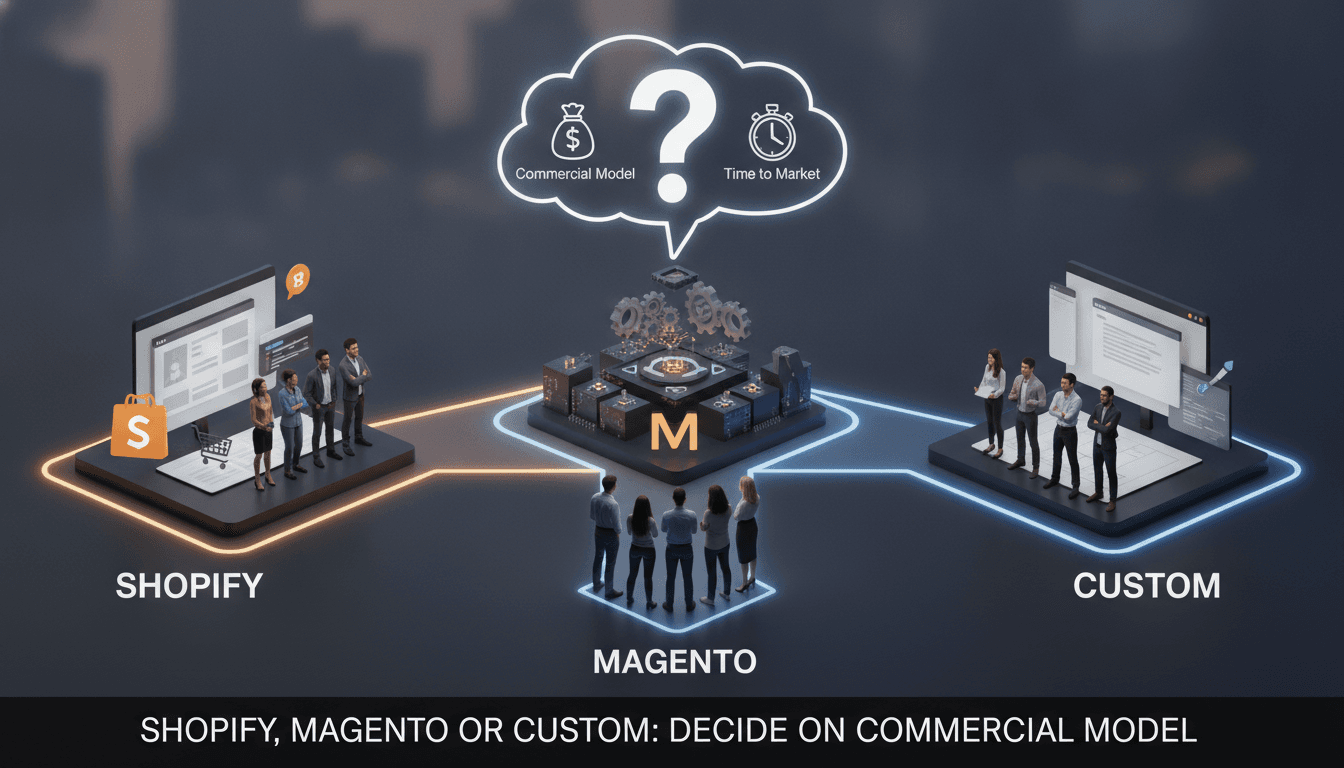
Choosing the wrong commerce platform early costs more than money. It costs six to eighteen months of re-platforming work at exactly the point when you should be scaling.
What the Commercial Model Question Is Really Asking
Platform choice is not primarily a technology decision. It is a commercial model decision. The question is: where do you want friction, and where do you want control?
Shopify puts friction at customisation and removes it from operations. Magento (Adobe Commerce) puts friction at infrastructure and removes it from flexibility. A custom build removes friction from both, but puts it squarely on your engineering team, permanently.
Get clear on that trade-off before you look at a single feature comparison.
How Do Shopify, Magento and Custom Builds Actually Differ at Scale?
| Dimension | Shopify / Shopify Plus | Magento / Adobe Commerce | Custom Build |
|---|---|---|---|
| Hosting & infra | Fully managed | Self-managed or Adobe Cloud | Fully self-managed |
| Checkout customisation | Limited (Plus gives checkout extensibility via UI extensions) | Full control | Full control |
| App ecosystem | 8,000+ apps | ~5,000 extensions | Whatever you build |
| Licensing cost | £25–£2,300/month (Plus starts ~£2,000/month) | Community free; Commerce ~$22,000–$190,000/year | No licence; engineering cost instead |
| Typical time to first sale | Days to weeks | 3–6 months | 6–18 months |
| PCI DSS responsibility | Shopify handles it | Your team handles it | Your team handles it |
| Multi-store / multi-region | Shopify Markets (reasonable) | Strong natively | As designed |
| Headless support | Storefront API + Hydrogen | GraphQL / PWA Studio | Full |
The numbers above are approximate and change with negotiated contracts, but the order of magnitude is right. Shopify Plus at £2,000/month sounds expensive until you price a 3-person DevOps team for Magento.
Where Shopify Breaks Down
Shopify's checkout is the product. That is a feature until your business model requires something the checkout cannot do: subscription billing with mid-cycle upgrades, complex B2B quoting workflows, or a marketplace where payout logic sits inside the order flow. Shopify Plus added checkout extensibility in 2023 via checkout UI extensions, but you are still operating inside Shopify's state machine. If your checkout logic would take a senior engineer two weeks to model, it probably does not fit.
Shopify also imposes transaction fees (0.5–2% on non-Shopify Payments) that compound at volume. At £10M GMV with a 1% fee, that is £100,000 per year straight off margin.
Where Magento Gets Expensive Fast
Magento Open Source is free. The total cost of ownership is not. A production Magento 2 instance needs Elasticsearch (or OpenSearch), Redis, a CDN, a PHP environment tuned to its specific memory profile, and a deployment pipeline. That is real infrastructure cost before a single developer writes custom code. Adobe Commerce Cloud includes more of this, but the licence cost then rivals the infrastructure saving.
The extension ecosystem is also a liability as much as an asset. Many Magento extensions are poorly maintained. Conflicts between extensions at upgrade time are a known failure mode, not an edge case.
What Makes a Custom Build Worth the Cost?
A custom build makes sense when your commerce logic is genuinely differentiated. Not "we have unusual requirements" (every business says that), but when the requirements actually cannot be expressed in the constraint model of an existing platform without building so many workarounds that you are maintaining a fork anyway.
Specific signals:
- Your pricing engine needs rules that depend on more than five input variables and changes weekly
- You are a marketplace, not a retailer (two-sided money flow, split payouts, seller onboarding)
- Your product catalogue has attributes that do not map to SKUs (configured-to-order manufacturing, for example)
- You need deep ERP integration where the commerce layer is a front-end to a system of record, not the system of record itself
/// Not sure where to start?
Get the architecture before you commit
Tell us what you're building and we'll map the technical approach, stack, and rough timeline. No cost, no obligation, no sales call required.
Custom builds also make sense when you have a long enough runway and a permanent engineering team. A custom commerce platform is not a project you finish. It is a system you run. If your plan is to build it and hand it to a non-technical team, the economics almost never work.
Should You Consider a Hybrid Architecture?
Yes, and more projects are going this way. The pattern is: Shopify or Medusa.js (open-source, Node-based) as the commerce engine, a headless front-end in Next.js, and custom services for the parts that do not fit.
This gives you Shopify's checkout compliance and payment infrastructure without being locked into Liquid templates. The Storefront API and Hydrogen framework are mature enough now that this is a reasonable production choice, not an experiment.
The risk is organisational. A headless architecture with three vendors and a custom middleware layer requires someone who owns the integration points. If that person leaves, the system becomes difficult to reason about quickly.
Medusa.js is worth evaluating if Shopify's commercial terms are a problem but you want a maintained open-source core. It is not as battle-tested at £50M+ GMV, but it is growing quickly and gives you full control over the data layer.
Making the Call: A Decision Framework
Work through these in order:
- What is your GMV target in 24 months? Below £2M, Shopify's transaction fees are noise. Above £20M, they become a budget line.
- Do you have checkout logic that cannot be expressed in Shopify's extension model? If yes, rule it out.
- Do you have a permanent engineering team who will own infrastructure? If no, rule out custom.
- Is your catalogue and pricing model standard enough for Magento's attribute and tier-pricing system? If yes, Magento is a serious option.
- Do you need a headless front-end regardless? If yes, the back-end platform choice matters less, and a composable architecture gives you room to swap later.
The honest answer for most early-stage product companies is Shopify, even with its constraints. The honest answer for complex B2B or marketplace businesses is either Magento with a clear infra budget or a custom core with a realistic timeline.
Conclusion
Pick the platform whose constraints you can live with, not the one with the most impressive feature list.
If you are on Shopify and hitting checkout limitations, map exactly which flows are blocked before concluding you need to re-platform. Sometimes the answer is a Shopify app or a checkout UI extension. Sometimes it genuinely is not. Custom builds are appropriate in a smaller percentage of cases than engineers tend to assume, and more appropriate than non-technical founders tend to assume.
If you want to pressure-test your current platform choice against your actual requirements, that is a conversation worth having before you commit six months of engineering time.
FAQ
When does Shopify Plus become cost-effective over Magento? Shopify Plus makes financial sense when your team would otherwise spend £10,000+ per month in engineering time managing Magento's infrastructure, upgrades and extension conflicts. That threshold is typically reached around £3M–£5M GMV for a team without a dedicated platform engineer already on payroll.
Can you run a B2B business on Shopify? Yes. Shopify's B2B features (released 2022, expanded since) cover customer-specific pricing, net payment terms, and company accounts. They work for straightforward wholesale. They do not work well for complex quoting workflows, contract-based pricing with approval chains, or ERP-driven catalogues where Shopify is not the system of record.
How long does a custom e-commerce build actually take? A minimum viable custom commerce platform, meaning product catalogue, cart, checkout, payment integration and order management, takes four to six months with a team of four to five engineers. A full-featured platform with admin tooling, promotions engine and multi-warehouse inventory takes twelve to eighteen months. These are realistic figures, not pessimistic ones.
Is Magento still a viable choice in 2025? Adobe Commerce (Magento 2) is actively maintained and has a large ecosystem. The risk is not abandonment but complexity cost. If your team has experience running PHP infrastructure and the catalogue/pricing model fits Magento's native constructs, it remains a strong choice. The concern is projects where teams underestimate the ongoing maintenance burden.
What is the biggest mistake teams make when choosing a platform? Choosing based on the happy path. Every platform demo shows simple product pages and clean checkouts. The decision should be made by mapping your three most complex commerce flows, then checking whether the platform can express them without custom workarounds. If it cannot, no amount of good documentation changes that.
Have a project in mind? Contact Sodio Technologies to discuss your requirements and explore the right technology solution for your business.
/// Work with us
Talk to the engineers who'd build it
You'll get a technical scope, timeline and cost estimate from the people doing the work, not an account manager. In-house team, no subcontracting, since 2016.