

Social Services Management: Enhancing Community Support
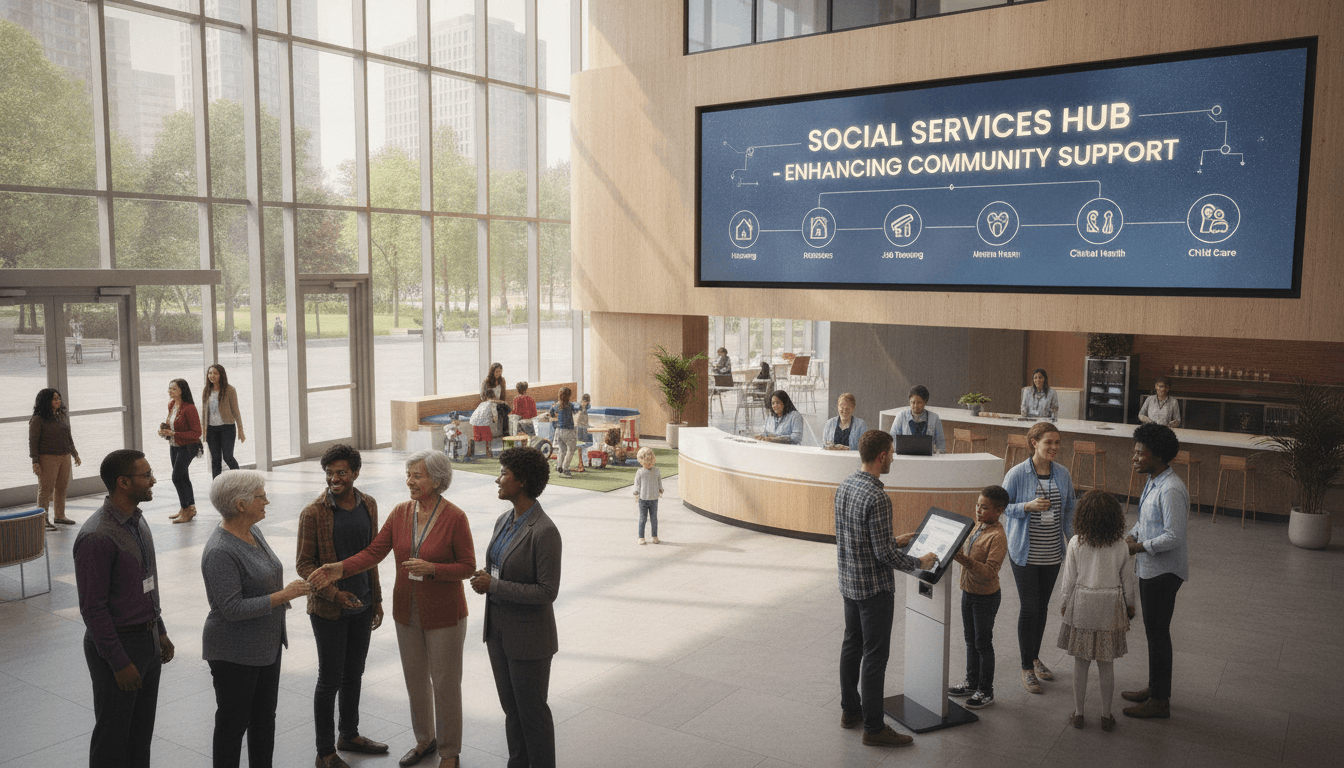
Social services agencies manage extraordinarily complex workloads: case assignments, eligibility checks, benefit disbursement, inter-agency referrals, compliance reporting, and outcome tracking, all simultaneously, often with understaffed teams running on legacy systems. If you're a technical lead at a public sector agency or a govtech company, you already know the problem. This post is about how modern software architecture actually addresses it, what the trade-offs are, and where the hard problems still sit.
What Does a Modern Social Services Platform Actually Need to Do?
The scope is wider than most people expect when they first start designing these systems.
At minimum, a platform needs to handle:
- Case lifecycle management: intake, assessment, assignment, intervention, closure, and re-opening
- Eligibility determination: rules engines that reflect programme-specific criteria, which change with policy
- Document management: ingestion, classification, and retention of supporting documents with audit trails
- Multi-agency coordination: referrals, shared case access, and data sharing agreements
- Reporting and compliance: outputs for federal or state bodies, often in specific XML or JSON schemas
Beyond that, you have real-time safeguarding alerts, integration with court systems, benefit payment triggers, and increasingly, predictive risk scoring for early intervention.
The technical challenge is not any one of these in isolation. It is the fact that they all need to talk to each other, reflect changing policy, and remain auditable over a 10-to-20-year data lifecycle.
How Do You Model Case State Without It Becoming a Mess?
Case state is where most platforms go wrong in year two or three. Teams typically start with a simple status field: open, closed, pending. Within 18 months, they have 40 statuses and nobody can explain the transition rules.
The right approach is an explicit finite state machine, defined in code, not a database column. Tools like XState (v5 as of late 2024) let you model states and transitions declaratively. Every state transition is an event. Every event is logged. Illegal transitions are rejected at the application layer, not the database constraint layer, which gives you meaningful error messages and audit entries.
For more complex cases that span multiple agencies, you need to think in terms of distributed state. A child protection case involving a school, a housing authority, and a health provider does not have a single owner. Choreography-based event flows (rather than orchestration with a central coordinator) tend to hold up better here because they reduce tight coupling between agency systems.
One practical note: if you are using PostgreSQL, the pg_audit extension gives you row-level audit logs without application code changes. That alone saves significant compliance overhead.
Rules Engines and Policy Change: The Part Nobody Talks About Enough
Eligibility rules change. A new administration passes a regulation. A funding stream expires. Income thresholds shift with inflation indices. Whatever eligibility logic you bake into application code will be wrong within 12 months of go-live.
The standard answer is a rules engine. The two most-used in this space are Drools (Java, mature, heavy) and Open Policy Agent (OPA, Go, lightweight, WASM-compatible). Drools gives you a richer authoring environment for non-technical policy analysts. OPA gives you a simpler policy language (Rego) and better fit with microservice architectures.
The honest trade-off: OPA policies written in Rego are not easy for policy analysts to maintain without training. Drools decision tables are easier for non-engineers, but the operational overhead of running a Drools KIE server is real. There is no perfect answer here; it depends on whether your bottleneck is developer time or policy analyst access.
A third option, one we have used in govtech contexts at Sodio, is a custom rule DSL stored in a database and interpreted at runtime. It has higher build cost upfront but gives you exactly the authoring interface your users actually need.
/// Not sure where to start?
Get the architecture before you commit
Tell us what you're building and we'll map the technical approach, stack, and rough timeline. No cost, no obligation, no sales call required.
Interoperability: Connecting Systems That Were Never Meant to Talk
Most social services agencies have a patchwork of systems: a legacy case management tool from the early 2000s, a separate benefits payment platform, a court integration built on a bespoke SOAP API, and a new mobile intake tool. Getting them to share data reliably is the bulk of the integration work.
The HL7 FHIR standard (R4, now R5 in draft) is relevant when health data is involved. For broader social care data exchange, the NIEM (National Information Exchange Model) framework is the US standard. In the UK, the Local Government Application Programme Interface Catalogue (LGAP) is increasingly referenced.
What to Expose and What to Keep Internal
A common mistake is building a single large API that both internal modules and external agency systems consume. When an external agency's system triggers your case assignment logic directly, you lose control of when and how that logic changes.
The better model is an internal API surface (not publicly documented, versioned aggressively) and a stable external API surface that acts as a translation layer. The external API changes slowly and deliberately. Internal refactors do not break partner integrations.
Event Streaming for Near-Real-Time Coordination
Apache Kafka works well here if you need near-real-time event propagation across agencies. A safeguarding alert raised in a housing system should appear in a child protection worker's queue within seconds, not overnight via a batch file. Kafka topics partitioned by case ID give you ordering guarantees within a case without sacrificing throughput.
What About AI and Predictive Risk Scoring?
Predictive risk tools exist, and several US counties have deployed them for child welfare (Allegheny County's AFST being the most studied). The results are genuinely contested. Independent audits have found racial disparity in outputs, and the ethical accountability questions are not resolved.
If you are building or procuring a risk-scoring component, a few hard requirements apply:
- The model's features must be fully documented and approved by a governance body before deployment
- Every score shown to a caseworker must be accompanied by an explanation (SHAP values are the standard approach)
- Scores must be logged with the model version that produced them, so retrospective audits are possible
- There must be a documented human override process, and override rates must be monitored
A model that a caseworker cannot interrogate or override is not a tool; it is a black box making decisions about vulnerable people. That is a compliance problem and an ethical one.
Conclusion
The systems that support social services have real complexity at the data model, integration, and governance layers. Getting the state machine right, separating internal from external APIs, choosing a rules engine that your policy team can actually use, and treating AI risk tools as accountable artefacts rather than magic, these are the decisions that determine whether a platform holds up five years after launch.
If you are scoping a rebuild or a greenfield platform in this space, start with a data and integration audit of your current systems before writing a line of new code. The constraints you discover there will shape your architecture more than any framework choice.
FAQ
What is the biggest technical mistake in social services platform builds? Embedding eligibility rules directly in application code. Policy changes frequently, and when rules live in code, every policy update requires a deployment cycle. A separate rules engine or interpreted DSL, with a proper authoring interface, keeps policy changes out of the release pipeline and reduces the risk of logic drift over time.
Is a microservices architecture always the right choice for case management systems? No. If your team has fewer than 15 engineers or your agency has limited DevOps maturity, a well-structured monolith is easier to maintain and audit. Microservices add operational complexity: service discovery, distributed tracing, and network failure modes. The case for splitting services is strongest when different modules have genuinely different scaling or deployment requirements.
How do you handle data sharing between agencies without violating privacy law? Through data sharing agreements that specify exactly which fields are shared, under which legal basis, and with what retention limits. Technically, attribute-based access control (ABAC) at the API layer enforces these agreements at runtime. Every cross-agency data access should be logged with the requesting system's identity, the fields accessed, and the timestamp.
Can off-the-shelf case management platforms replace custom builds? Sometimes. Platforms like Salesforce Public Sector Solutions or Microsoft Cloud for Government cover common workflows well and are worth evaluating before committing to a custom build. They tend to fall short when eligibility logic is highly specific, when legacy integration requirements are unusual, or when data sovereignty rules restrict cloud hosting options.
How long does it realistically take to build a social services platform from scratch? A minimum viable platform covering intake, case assignment, document management, and basic reporting typically takes 12 to 18 months with a team of 8 to 12 engineers. Full-featured platforms with multi-agency integration, a production-ready rules engine, and compliance reporting pipelines are closer to 24 to 36 months. Scope discipline in year one is the single biggest factor in staying on that timeline.
Have a project in mind? Contact Sodio Technologies to discuss your requirements and explore the right technology solution for your business.
/// Work with us
Talk to the engineers who'd build it
You'll get a technical scope, timeline and cost estimate from the people doing the work, not an account manager. In-house team, no subcontracting, since 2016.