

Stock Accuracy: When the System and the Shelf Disagree
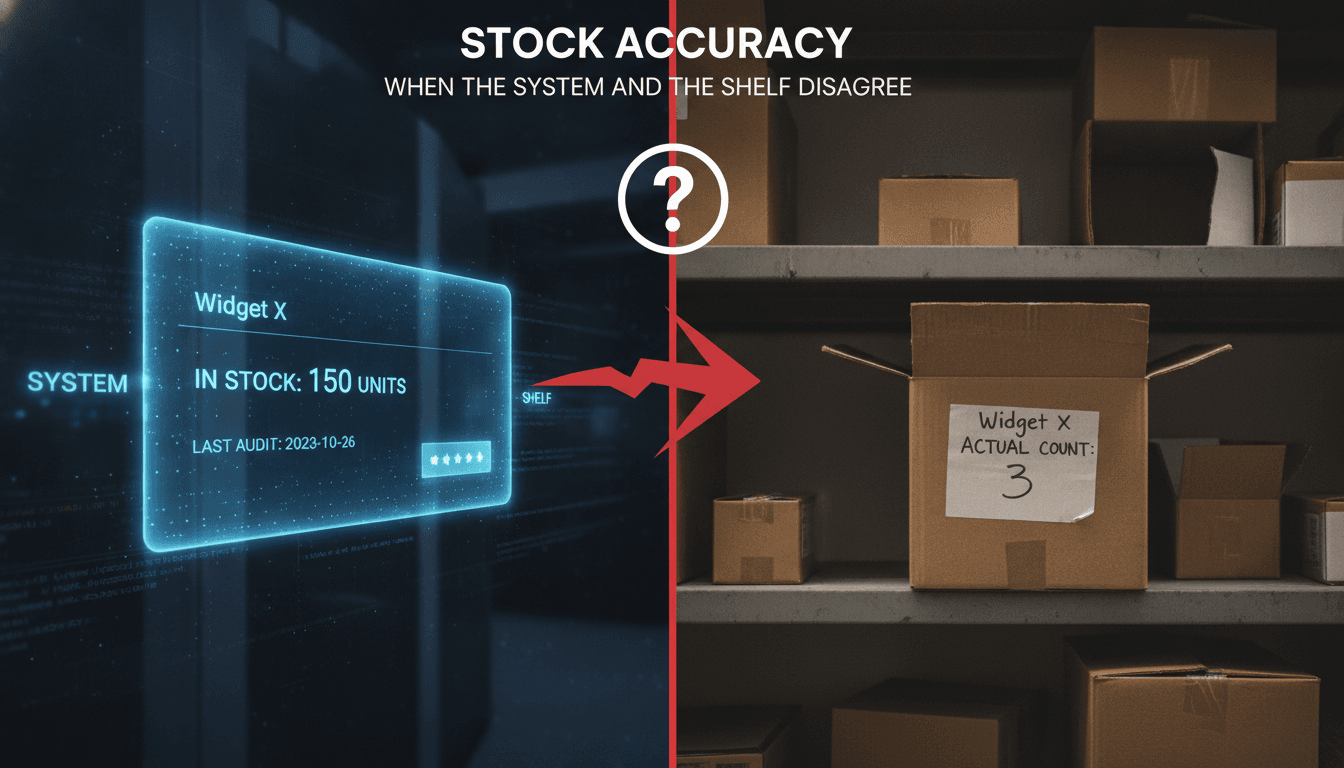
Your WMS says 240 units. The picker finds 31. Somewhere between the last inventory count and this moment, reality and the database parted ways. This post breaks down why that gap exists, how the data flows that cause it actually work, and what it takes to close it.
Why Stock Records Drift Away From Physical Reality
Inventory records are not a single number. They are the running result of every transaction that touched a SKU: receipts, picks, adjustments, transfers, write-offs, returns. Each transaction is an opportunity for a discrepancy to enter the system.
The most common sources are not dramatic failures. They are mundane ones.
A goods-in team receives 96 units instead of 100 and the WMS gets told 100 because the receiving clerk rounded up. A picker pulls from the wrong bin and confirms the right one. A return gets scanned against the wrong order. A manual adjustment gets applied in the wrong direction. None of these feel catastrophic individually. They compound.
There is also a timing problem. Most systems record demand at pick confirmation, not at the moment the stock moves. If a picker walks to a bin, finds it short, picks what is there, and then confirms the original quantity, the system does not know it has a problem until the next cycle count. That lag can span days.
The phantom stock problem specifically
Phantom stock is the version that causes the most downstream pain: the system shows positive inventory, a customer order is accepted, the order is allocated, a pick task is created, and then the picker cannot fulfil it. At that point you have a live order with no stock, a frustrated picker, and a customer expectation you cannot meet.
The root cause is almost always a failed write or a missed transaction. An item was shipped without a dispatch note being scanned. A location was emptied during a transfer and the source decrement never hit the database. A historical adjustment corrected the wrong field.
How the Data Actually Flows (and Where It Breaks)
A typical warehouse management stack involves at minimum: a WMS, a barcode or RFID scanner layer, an ERP or OMS sitting above it, and some kind of reporting layer. Transactions flow upward. Corrections flow downward. The problem is that this chain has multiple points where messages can fail silently.
API and integration failure modes
Most WMS integrations use REST or SOAP endpoints with synchronous confirmation. If the scanner app gets a timeout, the operator sees an error and re-scans. That re-scan creates a duplicate transaction. Depending on whether the WMS has idempotency keys implemented, you either end up with a double decrement or the second transaction fails silently and no decrement happens at all.
Message queue architectures (RabbitMQ, Kafka) solve the delivery problem but not the ordering problem. If a receipt and an adjustment for the same SKU arrive out of order, the final stock figure depends on which one commits last. This is not hypothetical. In high-throughput environments with multiple scanner devices hitting the same queue, out-of-order delivery is regular.
The cycle count cadence problem
Cycle counting is the accepted mitigation. The standard approach is ABC analysis: A-class SKUs counted weekly, B-class monthly, C-class quarterly. This works well when the classification is correct and maintained. It works poorly when SKU velocity changes seasonally and the classification does not update with it.
A SKU that was C-class in January can become A-class in November. If it is still on a quarterly count cycle, a discrepancy that entered in October will not be caught until January. That is three months of phantom stock or stockouts, depending on the direction of the error.
/// Not sure where to start?
Get the architecture before you commit
Tell us what you're building and we'll map the technical approach, stack, and rough timeline. No cost, no obligation, no sales call required.
What Does "Acceptable" Accuracy Actually Mean?
The industry benchmark most cited is 95%. The Warehouse Education and Research Council (WERC) puts median inventory accuracy for distribution centres at around 95-98% depending on vertical. That sounds high. It is not, when you consider the maths.
If you have 10,000 SKUs and 97% accuracy, 300 of those SKUs have records that do not match the shelf. If your order lines draw from a broad catalogue, you will hit a discrepancy on a meaningful fraction of orders. At scale, 97% accuracy with poor SKU distribution can produce more fulfilment failures than 93% accuracy with discrepancies concentrated in slow-moving stock.
The metric that matters more than headline accuracy is where the discrepancies are. Accuracy by SKU velocity tier is a better signal than blended accuracy.
Can RFID Actually Fix This?
RFID is the solution vendors lead with. The honest answer is: it fixes some things and introduces others.
Passive UHF RFID (ISO 18000-63, EPC Gen 2) allows bulk reads without line-of-sight. A reader gate at a dock door can process a pallet of 500 tagged items in under two seconds. Compared to per-item barcode scanning, that is a meaningful reduction in the manual steps where errors enter.
| Factor | Barcode | Passive UHF RFID |
|---|---|---|
| Read rate per item | 1 scan | ~500 items in 1-2 sec |
| Line-of-sight required | Yes | No |
| Tag cost (2024 estimates) | Negligible (label) | $0.08–$0.20 per tag |
| Read reliability in dense metal environments | High | 60–85% without tuning |
| Implementation complexity | Low | High |
The read reliability figure is the one that matters. RFID in a warehouse with metal racking and dense pack configurations routinely drops below 90% without careful antenna placement and tag orientation testing. If your read rate is 88%, you have not solved the discrepancy problem; you have changed its character from manual error to RF error.
RFID is the right call for high-value, low-density stock where tag cost is a small fraction of item value and the environment is controlled. It is the wrong call for a frozen food warehouse where tags fail below -20°C, or for a fashion retailer where tag placement on garments varies by supplier.
What Actually Works: A Practical Stack
The highest-accuracy warehouses are not the ones with the most expensive technology. They are the ones with the shortest feedback loops between a discrepancy occurring and a human knowing about it.
Concretely, that means:
- Scan confirmation at every state transition (receive, putaway, pick, pack, dispatch), not just at the endpoints
- Negative pick prevention enforced at the WMS level, not just reported after the fact: if a pick would take a location below zero, the system blocks it and raises an exception task
- Real-time discrepancy alerting when a pick exception is logged, rather than batching exceptions into an end-of-day report
- Directed counting triggered by exception events, not just scheduled cycles: if three picks from location A4-B2 have raised shorts in 48 hours, count A4-B2 today, not next Tuesday
None of this requires RFID. It requires a WMS that surfaces exceptions as events rather than log entries, and an operations team that treats those events as immediate work rather than data to review later.
Conclusion
Stock accuracy is an operational discipline problem as much as a technology problem. The technology enables the discipline, but it cannot replace it. If you are seeing persistent discrepancies above 3-4% on your A-class SKUs, the investigation usually reveals one of four things: a gap in scan coverage at a specific process step, a silent integration failure on a specific transaction type, a cycle count cadence that no longer matches SKU velocity, or a team culture where confirmations are routine taps rather than genuine verifications.
Start with a transaction audit on your highest-discrepancy SKUs. Map every system event against the physical movement log for a two-week window. The gap in the sequence is usually obvious once you look for it.
If you are building or re-architecting a warehouse operations system and want to talk through the data model, we are happy to get into the specifics.
FAQ
Why does my WMS show positive stock when the shelf is empty? The system records a decrement only when a transaction fires. If a pick, transfer, or write-off was not scanned or the API call failed silently, the decrement never happened. The physical stock moved; the record did not. Auditing transaction logs for gaps in the sequence on affected SKUs usually pinpoints the missing event.
What inventory accuracy rate should I be targeting? For A-class SKUs, 99% or above is achievable with tight scan discipline. Blended accuracy across all SKUs at a well-run facility sits between 97-99%. Below 95% blended is a signal that a process step is missing scan coverage or that an integration is failing on a specific transaction type.
Is a full stock count better than cycle counting? A full physical inventory count gives you a clean baseline, but it is operationally disruptive and typically accurate only at the moment it is taken. Cycle counting with proper ABC classification and exception-triggered counts keeps accuracy higher continuously. Most operations benefit from an annual full count for audit purposes combined with ongoing cycle counting.
Can we fix stock accuracy without replacing the WMS? Often, yes. The majority of discrepancy problems are process gaps rather than system limitations. Adding scan steps at uncovered transitions, enabling negative pick prevention if the WMS supports it, and shortening the exception review cycle can improve accuracy significantly without a system replacement. A system replacement is warranted when the WMS cannot surface exceptions as real-time events.
How do returns affect stock accuracy specifically? Returns are disproportionately represented in discrepancy root causes because the transaction flow is less standardised than outbound. A return received without a quality inspection step, or credited to the wrong SKU, creates a ghost increment in the wrong location or for the wrong item. Dedicated return processing workflows with mandatory inspection scan steps are the standard fix.
Have a project in mind? Contact Sodio Technologies to discuss your requirements and explore the right technology solution for your business.
/// Work with us
Talk to the engineers who'd build it
You'll get a technical scope, timeline and cost estimate from the people doing the work, not an account manager. In-house team, no subcontracting, since 2016.