

Telemedicine Scheduling Across Clinician Availability and Regulation
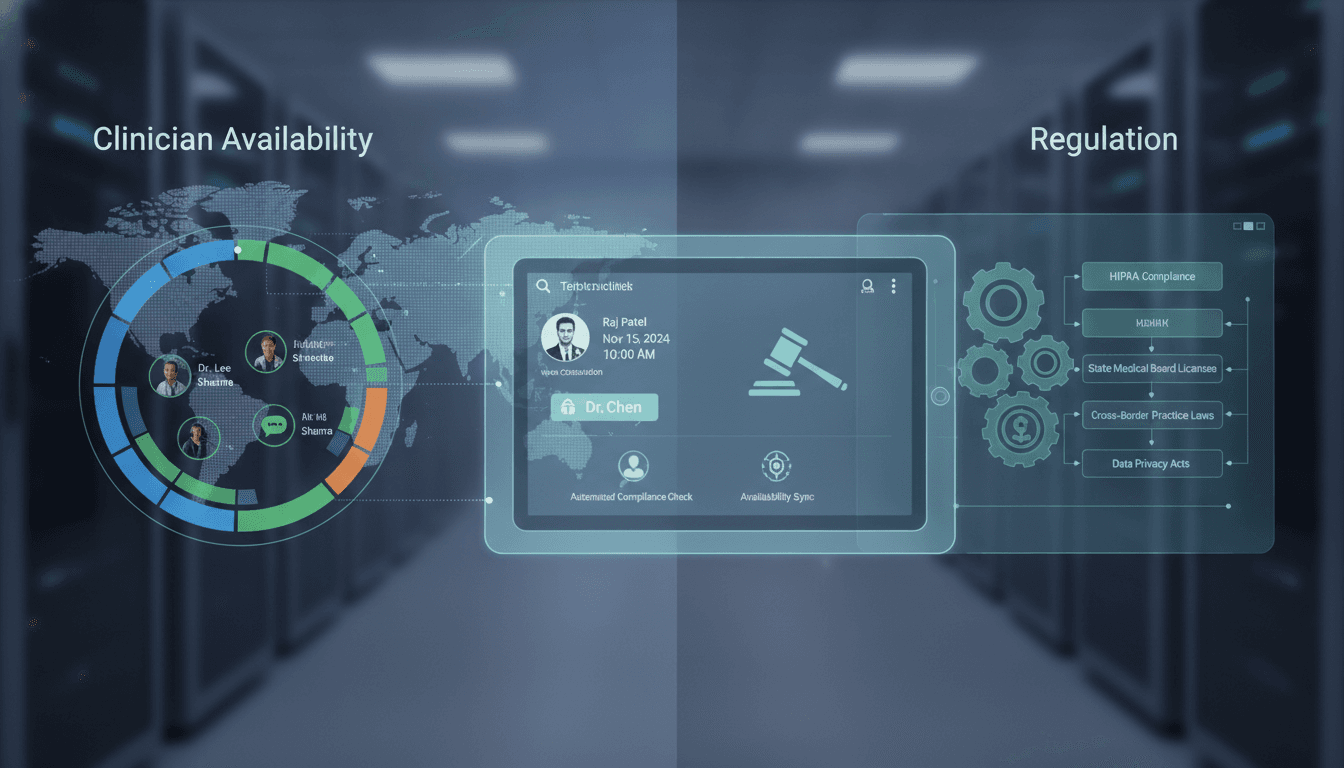
Scheduling in telemedicine is harder than it looks. The surface problem is calendar management. The real problem is a three-way constraint: clinician availability, patient time zones, and a regulatory matrix that changes by state, country, and licence type. Get any one of these wrong and you're either breaking the law or burning out your doctors.
Why Availability Modelling Is More Complicated Than a Calendar
Most scheduling systems treat availability as a binary: the slot is open or it isn't. That works for a barbershop. It doesn't work for a multi-state telehealth platform where a clinician's effective availability depends on who they're allowed to see, not just when they're free.
Licence Jurisdiction as a First-Class Data Field
A physician licensed in California and New York is not available to a patient in Texas, regardless of what their calendar says. That jurisdiction check has to happen before a slot is ever surfaced to a patient. If you're building this yourself, licence state needs to be a first-class attribute on the clinician record, indexed and queryable, not a note in a profile field.
The data model looks roughly like this:
clinician_id: uuid
licences: [
  { state: "CA", licence_number: "...", expiry: "2026-03-01", status: "active" },
  { state: "NY", licence_number: "...", expiry: "2025-11-15", status: "active" }
]
Expiry matters. A licence that lapses mid-appointment cycle is a compliance incident. You want a background job checking expiry dates and flagging or suppressing availability at least 30 days ahead.
Time Zone Normalisation
Store everything in UTC. Surface times in the patient's local zone and the clinician's local zone independently. Sounds obvious. In practice, a surprising number of platforms store local times, which creates bugs the moment a clinician crosses a time zone or a patient books from a different region than their profile suggests. Use IANA timezone identifiers, not UTC offsets; offsets change with DST.
What Does Real-Time Availability Actually Require?
Real-time availability in telemedicine means the slot a patient sees is accurate within seconds, not minutes. At scale, that's a genuine engineering problem.
The standard approach is an availability service that maintains a cache (Redis works well here) keyed on clinician_id + date. Writes happen when a clinician updates their schedule, when an appointment is booked, cancelled, or modified. Reads are served from cache. You invalidate on write.
The edge case that breaks this: double-booking during high-traffic periods when two patients hit "confirm" on the same slot simultaneously. You solve this with an optimistic lock at the database layer. PostgreSQL's SELECT FOR UPDATE SKIP LOCKED is purpose-built for this. Grab the lock, confirm the slot is still free, write the booking, release. If the lock fails, return a "slot taken" response and re-fetch available times.
At very high volume (thousands of bookings per minute), you move to a queue-based model: patients submit booking intents, a worker processes them serially per clinician. This adds latency but eliminates race conditions entirely.
How Do You Handle Cross-State and Cross-Country Regulation?
This is where most platforms hit a wall. In the US alone, prescribing rules, controlled substance regulations, and informed consent requirements vary by state. Internationally, the complexity multiplies.
The Interstate Medical Licensure Compact
The IMLC (Interstate Medical Licensure Compact) as of 2024 covers 40 US states and territories. Physicians who qualify can practice across member states under a single application. If your platform serves US patients and your clinicians are IMLC participants, you can model this as an expanded licence set rather than individual state licences. The caveat: IMLC covers medical doctors and osteopathic physicians. Nurse practitioners, PAs, and psychologists have separate compacts (NLC, APRN Compact) with different member states. Your data model needs to handle these separately.
Rule Engines for Prescribing Constraints
Prescribing rules are not a static lookup table. They depend on the clinician's licence type, the patient's state, the drug category, and sometimes the diagnosis. A rule engine (we've used Drools and also custom-built JSON-rule interpreters for lighter cases) lets you encode these constraints in a maintainable way without hardcoding them into application logic.
A minimal rule structure:
{
  "rule_id": "rx-controlled-telehealth-de",
  "jurisdiction": "DE",
  "licence_types": ["MD", "DO"],
  "condition": "patient_state == 'DE' AND drug_schedule IN [2,3,4,5]",
  "action": "require_prior_in_person_visit",
  "citation": "16 Del. C. § 4798"
}
Rules like this need a governance process, not just a developer. Someone with legal or compliance expertise has to own the rule set and review it when statutes change.
/// Not sure where to start?
Get the architecture before you commit
Tell us what you're building and we'll map the technical approach, stack, and rough timeline. No cost, no obligation, no sales call required.
International Platforms
For platforms operating across multiple countries, the regulatory surface area is enormous. The EU's approach under the Cross-Border Healthcare Directive (2011/24/EU) is different from the UK's post-Brexit GMC framework, which is again different from how India's Telemedicine Practice Guidelines (2020) work. There is no shortcut here. You need jurisdiction-specific compliance review for each market you enter. Technology can enforce rules, but lawyers have to write them.
Matching Algorithms: Beyond First-Available
Pure first-available scheduling optimises for speed. It often produces poor outcomes for both patients and clinicians. A patient with a specific condition routed to a generalist, or a clinician with ten back-to-back video calls followed by three hours of nothing, is a scheduling failure even if the slots were technically available.
Better approaches layer in:
- Specialisation matching: route based on clinical speciality and, where the data exists, sub-speciality or condition history.
- Continuity scoring: weight returning patients toward their previous clinician, which improves care quality and reduces time-to-appointment since the clinician already has context.
- Load balancing: distribute bookings across clinicians with equivalent qualifications to prevent burnout concentration.
- Appointment type routing: a 10-minute medication review has different slot requirements than a 45-minute initial consultation. These shouldn't compete for the same calendar blocks.
You can model this as a weighted scoring function across available slots, with weights configurable per platform. It's not machine learning at first. A deterministic scoring function is easier to audit, easier to explain to clinicians, and easier to debug when something goes wrong.
What Infrastructure Decisions Matter Most Early On?
If you're building this from scratch, a few decisions have disproportionate long-term impact.
Event-driven architecture from day one. Availability changes, bookings, cancellations, licence updates and appointment state transitions are all events. If you build on an event bus (Kafka, AWS EventBridge, or even RabbitMQ for smaller scale) from the start, you can add new consumers, like a notification service or an analytics pipeline, without changing core scheduling logic.
Separate read and write paths. Your availability query volume will dwarf your booking write volume. Design for that asymmetry. Read replicas, caching, and denormalised availability views are not premature optimisations in telehealth; they're baseline requirements at any meaningful scale.
Audit logging as infrastructure. Every booking event, every availability change, every rule evaluation needs to be logged with enough context to reconstruct what happened and why. This is a regulatory requirement in most jurisdictions, and it's also how you debug patient complaints. Log immutably, with timestamps in UTC, and retain for at minimum the period required by the most stringent jurisdiction you operate in. In the US, HIPAA requires medical records retention for six years from creation or last effective date.
Conclusion
The scheduling layer in a telemedicine platform is where regulatory compliance, clinical workflow, and distributed systems engineering all intersect. The teams that get this right treat licence jurisdiction as infrastructure, not configuration, and build rule governance processes alongside the technology.
If you're at the point of choosing between building this in-house and working with a team that's already done it, the honest answer is: the scheduling and compliance engine is the part most worth getting external input on, even if you build everything else yourself. The regulatory debt from getting it wrong is expensive and slow to unwind.
The next concrete step is to map your target jurisdictions and licence types before writing any scheduling code. Everything downstream, data models, rule engines, matching logic, depends on that map being correct.
FAQ
Does using IMLC mean a clinician can see patients in all 40 member states? Not automatically. IMLC allows a qualifying physician to obtain licences in member states more easily, but they still need a licence per state. It reduces paperwork and processing time, not the legal requirement itself. Always verify a clinician's active licence list against the states where your patients are located.
How do we handle a booking if a clinician's licence lapses mid-series for a patient in ongoing care? This needs a human-in-the-loop escalation, not an automated reassignment. Automated reassignment risks continuity of care issues. The right approach is to flag the gap at least 30 days ahead, give the clinician time to renew, and only escalate to care coordination staff if renewal doesn't happen. Document everything.
What's the simplest database schema for multi-jurisdiction availability? A clinician table, a licences table (clinician_id, jurisdiction, licence_type, status, expiry), and a slots table (clinician_id, start_utc, end_utc, appointment_type, status). The availability query joins licences to filter slots by patient jurisdiction before returning results. You can build a correct MVP on this structure.
Can a rule engine handle regulations that change frequently? Yes, if the rule engine reads from a database rather than compiled config. Rules stored as JSON or in a dedicated rules table can be updated without a deployment. The governance question is harder: who reviews and approves changes, and how do you test a new rule against historical booking data before going live?
Is HIPAA the only compliance framework we need to worry about for a US telehealth platform? No. HIPAA covers protected health information, but you also need to consider state-specific telehealth parity laws, the Ryan Haight Act for controlled substance prescribing, CMS conditions of participation if you're billing Medicare or Medicaid, and state medical board regulations. HIPAA is the floor, not the ceiling.
Have a project in mind? Contact Sodio Technologies to discuss your requirements and explore the right technology solution for your business.
/// Work with us
Talk to the engineers who'd build it
You'll get a technical scope, timeline and cost estimate from the people doing the work, not an account manager. In-house team, no subcontracting, since 2016.