

The Claims Handoff Problem: Where Insurance Cost Hides
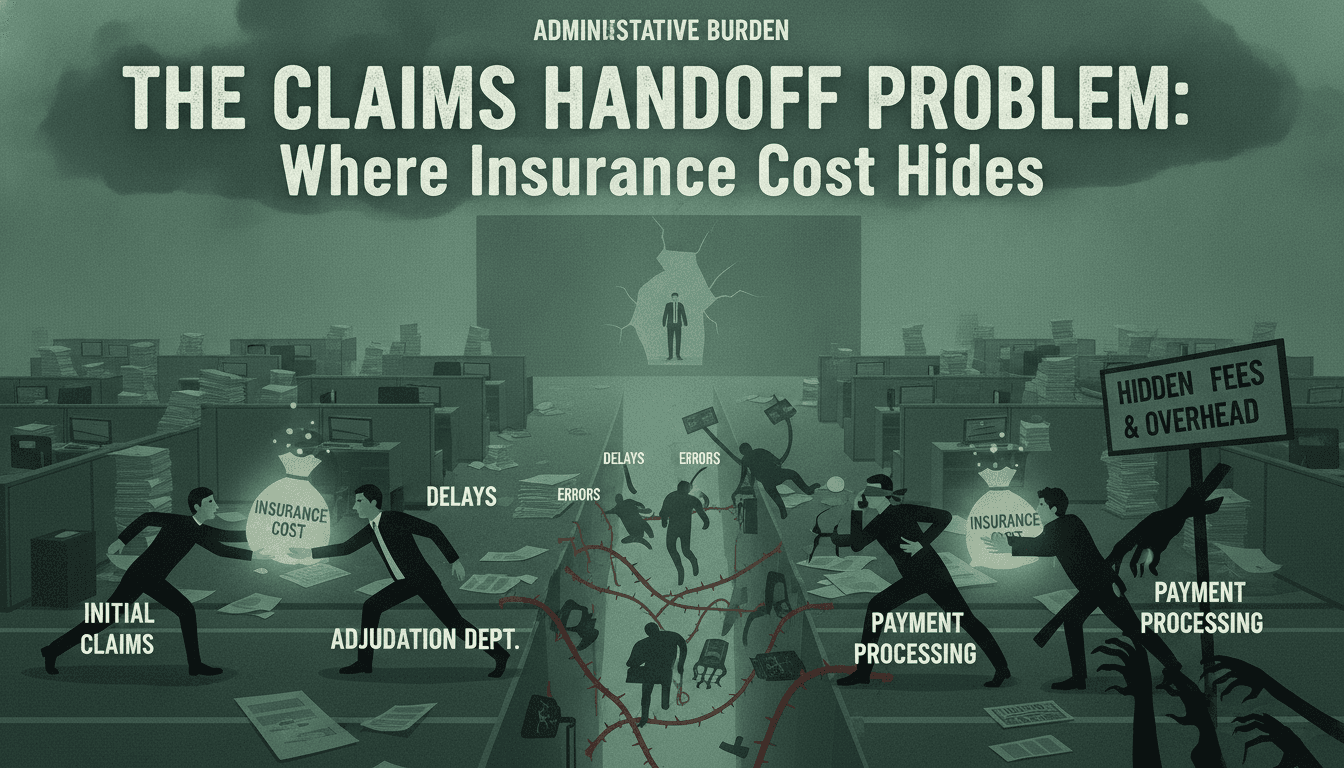
Claims handoffs between insurers, TPAs, repairers, and medical networks are where the real cost lives — not in the claims themselves. Here's how the architecture of that handoff determines whether you're haemorrhaging money or not.
Why Does the Handoff Moment Break So Many Claims Systems?
A claim doesn't fail at intake. It doesn't fail at settlement. It fails in the middle, when ownership transfers from one system or team to another and the receiving party has incomplete context.
In a typical non-life insurance workflow, a claim touches between four and nine distinct systems before it closes: the FNOL portal, the core policy admin system, the reserve calculator, the repairer or medical network's own platform, the TPA's case management tool, the fraud scoring engine, and the payment gateway. Each transition is a potential gap. Each gap costs money in one of three ways: manual re-entry that adds time, missing data that delays decisions, or incorrect data that triggers rework.
Industry benchmarks put claims handling expense ratios at 8–12% of earned premium for personal lines and 15–20% for commercial lines. A significant portion of that is friction at the handoff, not the actual cost of adjusting or settling the claim.
The Data Model Is Usually the Root Cause
Most claims platforms are built around the claim as a document, not as a process. The claim object gets created, fields get filled in, and systems query or update it as needed. That model works fine for simple, single-party claims. It breaks the moment you have concurrent workflows touching the same claim.
Consider a motor claim where the repairer is updating repair status, the TPA is updating reserve, and the fraud engine is running a background check simultaneously. If your data model doesn't handle concurrent writes with event sourcing or at minimum optimistic locking, you get silent data collisions. The claim closes with a stale reserve or an unsurfaced fraud flag.
The better model treats a claim as an ordered log of events rather than a mutable document. Each party appends to the log; nothing overwrites. This is not a novel idea: it's the same principle behind Apache Kafka's log-compaction, CQRS patterns in claims audit trails, and the HL7 FHIR resource model in health claims. The implementation cost is real but the debuggability alone pays for it.
FNOL to Assessment: The First and Worst Gap
First Notice of Loss to assessment assignment is where the most time is lost. The claimant submits via web, app, or call centre. That data then needs to reach an assessor who may be on a completely separate system, possibly at a TPA. If the FNOL data isn't structured at source, every downstream system re-structures it.
Structured FNOL means enforcing a schema at intake, not parsing free text later. If you're using a conversational intake flow, the output still needs to map to a fixed claims schema before it leaves the intake service. Anything that exits the intake layer as unstructured text is going to cost you downstream.
/// Not sure where to start?
Get the architecture before you commit
Tell us what you're building and we'll map the technical approach, stack, and rough timeline. No cost, no obligation, no sales call required.
Assessment to Repair or Medical Network: Where SLAs Go Quiet
Once an assessor authorises work, the claim moves to a repairer, hospital, or other third party. This is typically where insurers lose visibility. The third party has their own job management or hospital information system. Status updates come back via email, phone, or a flat-file batch feed that runs once a day.
Real-time status requires an integration layer with write-back capability. That means either the third party exposes a webhook endpoint you can subscribe to, or you poll their API on a short interval (under five minutes is workable; daily batches are not). If neither is possible, you build a thin translation service that converts their batch files into events and publishes them to your internal event bus. It adds latency but it's better than no visibility.
What Does Good Integration Architecture Actually Look Like?
| Layer | Pattern | Technology options |
|---|---|---|
| Intake | Schema-validated structured FNOL | JSON Schema, Avro, Protobuf |
| Event bus | Ordered, durable, replayable | Apache Kafka, AWS EventBridge, Google Pub/Sub |
| Third-party integration | Webhook or API with retry and DLQ | REST/OpenAPI, AS2 for legacy EDI |
| State management | Event-sourced claim log | EventStoreDB, Kafka with log compaction |
| Reserve and payment | Two-phase commit or saga pattern | Temporal.io, AWS Step Functions |
| Fraud scoring | Async, non-blocking | Separate microservice, result appended as event |
The saga pattern for reserve updates matters more than most teams appreciate. If your reserve service and your payment gateway are separate, you need a compensating transaction mechanism. Without it, a payment can succeed while the reserve update fails, and your actuarial data is now wrong. That compounds over thousands of claims.
Is Blockchain Actually Useful for Claims Data Sharing?
Sometimes. The case for a distributed ledger in claims is genuine when you have multiple insurers sharing liability on a single risk, such as co-insurance or reinsurance arrangements. In those cases, all parties need a single source of truth that none of them controls. A permissioned ledger like Hyperledger Fabric or a consortium Ethereum network with private transactions handles that reasonably well.
It is the wrong tool when there is one insurer and the problem is internal data inconsistency. A blockchain does not fix a bad FNOL schema. It does not fix a TPA that sends daily CSV files. Applying a ledger to an internal integration problem adds infrastructure cost without solving the actual issue.
The honest answer: distributed ledger is worth evaluating when you have three or more independent parties who need shared state and no single party should be the system of record. In bilateral insurer-TPA relationships, a well-designed API contract with a signed event log is simpler and achieves the same auditability.
Conclusion
The claims handoff problem is solvable, but it requires treating the claim as a process with explicit state transitions rather than a document with fields. Fix the FNOL schema first. Build an event log that all parties append to. Invest in real-time integration with your repair and medical networks even when that means writing a translation layer. Reserve the more complex patterns like distributed ledgers for the problems they actually fit.
If you're currently auditing your claims expense ratio and a significant chunk is unexplained, map your handoff points before you change your headcount or your settlement guidelines. The cost is almost certainly in the transitions.
FAQ
What is the claims handoff problem? It refers to the cost and errors introduced when a claim moves between systems, teams, or third parties during its lifecycle. Each transition is a point where data can be lost, duplicated, or delayed. Most claims expense ratio overruns trace back to these handoffs rather than to the settlement amount itself.
Why do insurers lose visibility once a claim reaches a repairer or hospital? Third-party service providers operate their own systems and rarely push real-time status updates to insurers. Without webhook integrations or short-interval API polling, insurers rely on daily batch files or phone calls. Building a translation service that converts those batch feeds into internal events is a practical fix when native API access isn't available.
Is event sourcing overkill for a claims platform? For simple, single-party claims with low volume, probably yes. For anything involving concurrent updates from multiple parties, it pays for itself quickly in debuggability and audit compliance. The ability to replay the event log to find where a reserve or fraud flag was lost is worth more than most teams expect until they need it.
When does a blockchain actually help in insurance? When three or more independent parties share liability on the same risk and no single party should control the record, a permissioned ledger is a reasonable choice. Co-insurance and reinsurance settlements are the clearest use cases. For internal data consistency between an insurer and a single TPA, a standard API with a signed event log is simpler and equally auditable.
What's the fastest way to reduce claims handling expense ratio? Audit your FNOL-to-assessment handoff first. Unstructured intake data that gets re-processed downstream is the highest-leverage fix because every claim passes through it. Enforcing a schema at intake and eliminating free-text fields that require manual interpretation typically reduces re-entry and rework across the entire downstream workflow.
Have a project in mind? Contact Sodio Technologies to discuss your requirements and explore the right technology solution for your business.
/// Work with us
Talk to the engineers who'd build it
You'll get a technical scope, timeline and cost estimate from the people doing the work, not an account manager. In-house team, no subcontracting, since 2016.