

Utility Billing Systems: Streamlining Billing Processes
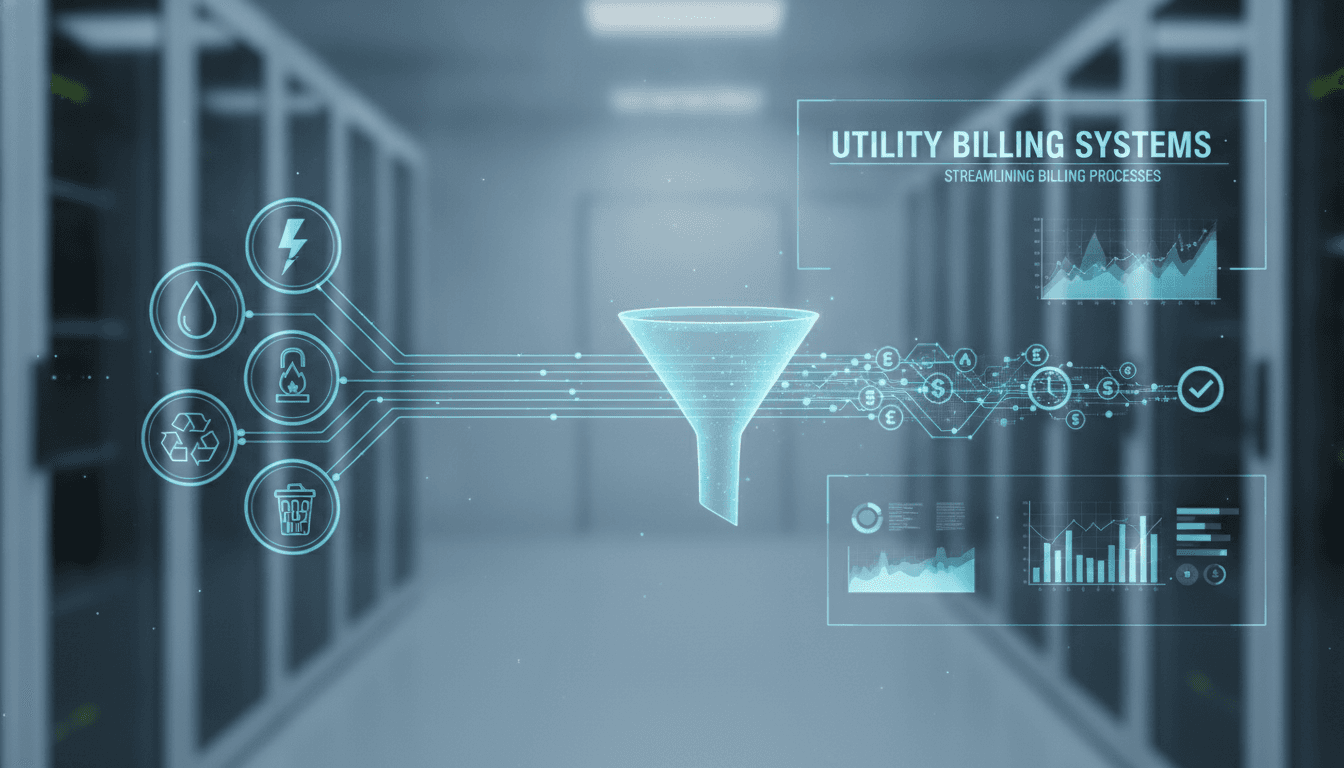
Utility billing is older than most software paradigms. Yet the systems running it are often a patchwork of legacy code, manual reconciliation steps, and Excel sheets doing jobs that a database should be doing. If you're evaluating whether to build or buy a billing system for a utility operation, this post covers what the architecture actually looks like, where things tend to break, and what trade-offs matter.
What Makes Utility Billing Harder Than Standard SaaS Billing
Most billing systems handle a fixed price per seat, or a simple usage tier. Utility billing is different in structure. You're dealing with consumption data collected at irregular intervals, tariff rules that change per region or season, demand charges that look back 15 or 30 days, and regulatory requirements that vary by jurisdiction.
Meter Data and Its Quirks
The data pipeline starts at the meter. AMI (Advanced Metering Infrastructure) systems push reads at 15-minute or hourly intervals. That's a lot of rows. A mid-sized water utility with 200,000 connections generates roughly 700 million meter reads per year at 15-minute granularity. Your database schema and ingestion pipeline need to be designed around this from day one, not retrofitted.
Common problems at this layer:
- Missed reads due to communication failure (RF mesh dropout, cellular signal loss)
- Clock drift on older meters causing timestamp misalignment
- Negative consumption values from meter replacement events
- Multiplier errors when a meter is swapped and the register factor isn't updated in the MDM
Most teams underestimate how much logic sits in the Meter Data Management (MDM) layer before a read is even eligible to be billed. VEE (Validation, Estimation, and Editing) rules alone can represent weeks of engineering work.
Tariff Modelling
Tariff structures in utilities are not simple. A residential electricity tariff might include:
- A fixed service charge
- Tiered volumetric rates that reset monthly
- Time-of-use (TOU) pricing with peak, off-peak, and super-off-peak windows
- A demand charge based on the highest 15-minute interval in the billing period
- Seasonal rate adjustments
- Low-income rate assistance programme discounts
Modelling this in a general-purpose billing engine is painful. Most teams end up either writing a rule engine from scratch or encoding tariff logic directly in application code, which makes future rate case changes expensive.
A cleaner approach is to represent tariffs as data, not code. This means a tariff configuration schema that can express rate components, their interdependencies, and effective date ranges. You can then apply a rate engine that reads config at bill calculation time. This is how platforms like OpenADR-adjacent systems and some MDM vendors approach it, and it dramatically reduces the cost of regulatory updates.
/// Not sure where to start?
Get the architecture before you commit
Tell us what you're building and we'll map the technical approach, stack, and rough timeline. No cost, no obligation, no sales call required.
How Does the Bill Calculation Engine Actually Work?
At its core, a bill engine does three things: it reads consumption data for a billing period, applies the applicable tariff, and produces a line-item charge record. The complexity is in the details.
Interval Data vs Register Data
Some tariffs require interval-level data (TOU, demand charges). Others only need a total consumption figure from a register read. Your engine needs to handle both, and it needs to know which to use for which customer account based on their rate code.
For TOU calculations, you're mapping each interval to a rate period, multiplying consumption by the applicable rate, and summing. This sounds straightforward until you hit daylight saving transitions, billing period boundaries that don't align with interval boundaries, and accounts that switch tariffs mid-period.
Pro-ration and Period Alignment
Billing periods rarely align perfectly with calendar months. When a customer moves in on the 14th, you're billing a partial period. When a tariff change takes effect on the 1st but the last meter read was on the 28th, you need to split the usage across two rate structures. Pro-ration logic is where a lot of billing accuracy issues originate.
A common approach is to use daily usage estimates when exact interval data isn't available for the split point. The estimation method matters: straight-line interpolation works for most residential accounts, but for C&I (commercial and industrial) accounts with high demand variability, you want to use historical load profiles.
What Does a Modern Architecture Look Like?
A production utility billing system typically has these layers:
| Layer | Responsibility | Common Tech |
|---|---|---|
| Meter Data Ingestion | Receive, parse, store raw interval data | Kafka, TimescaleDB, InfluxDB |
| MDM / VEE | Validate, estimate, edit reads | Custom rule engine or vendor MDM |
| Tariff Engine | Apply rate structures to consumption | Rule engine, config-driven calculator |
| Bill Engine | Produce bill records and line items | PostgreSQL, batch job orchestration |
| CIS (Customer Information System) | Account, premise, service data | Custom or vendor (e.g., Oracle CC&B) |
| Payment Processing | Apply payments, manage AR | Stripe, custom AR module |
| Presentment | Generate bill documents, portal | PDF generation, customer-facing web app |
The integration surface between these layers is where most projects get into trouble. If the CIS and the bill engine have separate account identifiers that aren't kept in sync, you get orphaned bill records. If the tariff engine doesn't receive effective-date changes from the rate management system before a bill run, accounts get billed on the wrong rate.
Event-driven architecture helps here. Having the CIS emit events on account changes (new service, rate code update, move-out) that the billing system consumes asynchronously reduces the coupling and gives you an audit trail.
Should You Build This In-House or Buy?
This is a real decision with real trade-offs, and the answer depends on your scale, your regulatory environment, and how differentiated your billing logic is.
Off-the-shelf platforms like Oracle CC&B, SAP IS-U, and Itineris UMAX cover a lot of ground. They handle the core billing and CIS functions and have been hardened across many utility deployments. The cost is high, implementation timelines are long (18 to 36 months is common), and customisation is expensive because these systems have rigid extension models.
Building in-house gives you control over the data model, the integration layer, and the pace of change. It makes sense when your tariff structures are unusual enough that a standard platform can't express them without deep customisation, or when you need tight integration with other proprietary systems. The risk is underestimating the long-term maintenance burden.
A hybrid approach works for many mid-market utilities: use a vendor CIS for customer and account management, but build a custom rate engine and bill calculator that sits alongside it. This keeps the complex, change-prone tariff logic under your direct control while offloading commodity functions.
Conclusion
Utility billing systems aren't especially glamorous engineering, but they're consequential. Errors in bill calculation erode customer trust and create regulatory exposure. The investment in getting the data model, VEE logic, and tariff engine right upfront pays off significantly over time.
If you're at the point of deciding on architecture or evaluating whether to build a custom rate engine alongside a vendor CIS, that's a specific enough problem to warrant a detailed technical conversation rather than a generic vendor demo. At Sodio, we've built custom billing and metering data pipelines for energy and utilities clients. Get in touch if you want to talk through your specific constraints.
Frequently Asked Questions
What database is best for storing utility meter interval data? TimescaleDB is a strong choice for interval data because it's built on PostgreSQL and handles time-series queries efficiently. InfluxDB works well for pure telemetry. If you're already invested in a relational stack and your read volume is below roughly 50 million rows, PostgreSQL with proper partitioning and indexing on timestamp and meter ID can be sufficient.
How do you handle estimated reads in billing? When a meter read is missing, the MDM layer generates an estimated value using a configured method, typically straight-line interpolation between the last actual read and the next one, or a historical load profile for that account. The estimated read is flagged in the bill record. When the next actual read arrives, the system calculates a true-up adjustment and applies it to the following bill.
What is a rate engine and why is it separate from the bill engine? A rate engine takes a consumption quantity and a tariff configuration and returns a charge amount. The bill engine orchestrates the overall bill calculation: it assembles consumption data, calls the rate engine, aggregates line items, and produces the final bill record. Separating them means you can unit-test tariff logic independently and swap or update rate configurations without touching the billing orchestration code.
How long does a utility billing system implementation typically take? For a custom build covering MDM, tariff engine, bill engine, and a basic CIS, budget 12 to 18 months for a mid-sized utility. Off-the-shelf platforms like Oracle CC&B typically run 18 to 36 months to full production. The longest phase is usually data migration from the legacy system and UAT of the bill calculation logic against historical bill samples.
What are the most common causes of billing errors in utility systems? The top causes in most audits are: incorrect multiplier on a meter after a swap, pro-ration logic failing on partial periods, tariff effective dates not applied correctly, and VEE rules letting through anomalous reads that inflate consumption. A structured bill reconciliation process that compares a sample of new bills against re-calculated expected values before each bill run catches most of these before they reach customers.
Have a project in mind? Contact Sodio Technologies to discuss your requirements and explore the right technology solution for your business.
/// Work with us
Talk to the engineers who'd build it
You'll get a technical scope, timeline and cost estimate from the people doing the work, not an account manager. In-house team, no subcontracting, since 2016.