

What a Healthcare App Costs Once Compliance Is Included
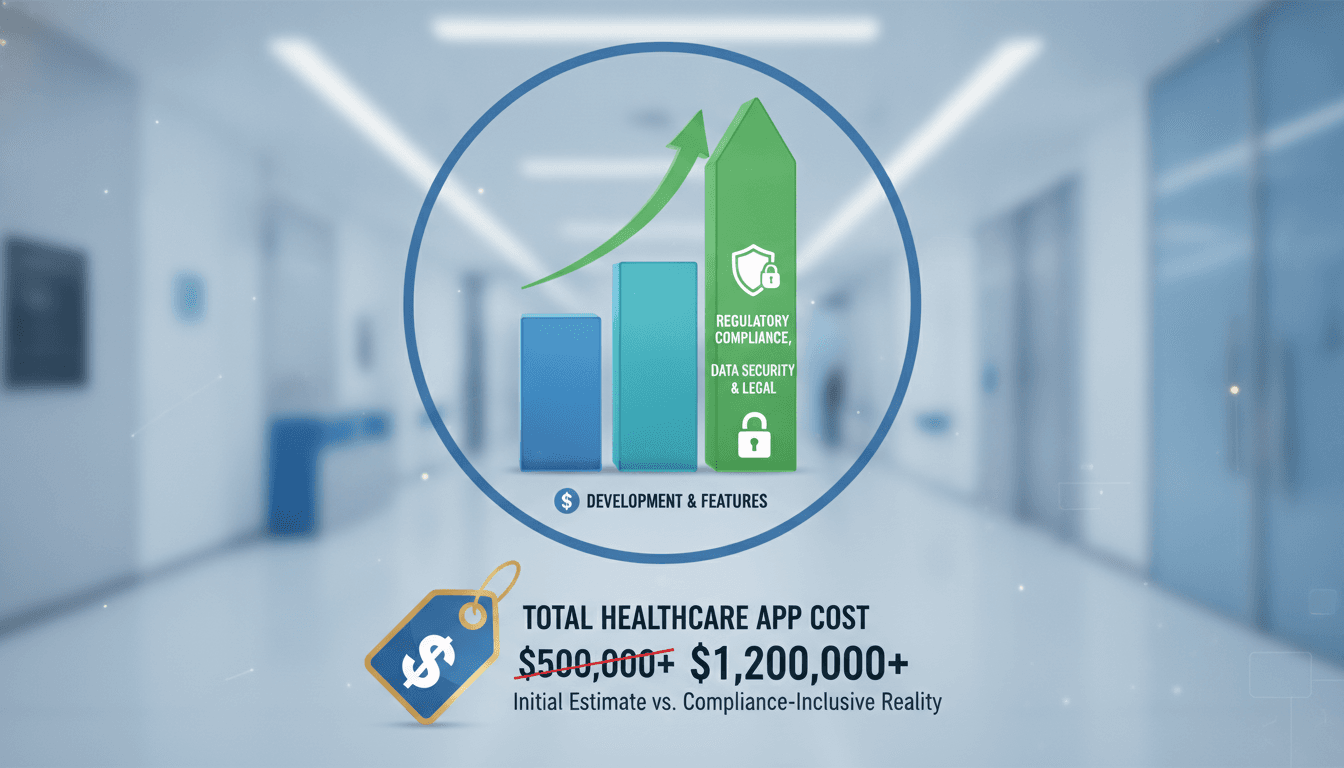
Building a healthcare app without accounting for compliance is like pricing a house without counting the roof. The number looks manageable until you add what actually keeps the thing standing.
This post breaks down where the real cost sits, what decisions drive it up or down, and what teams typically underestimate when they first scope a healthcare product.
The Baseline Build Is Only Half the Number
A typical healthcare app, say a patient-facing mobile product with appointment scheduling, messaging, and a basic health record view, might cost £80,000–£150,000 to build in a standard commercial context. Add compliance, and that number climbs by 40–80% depending on geography and what the app actually touches.
That uplift is not padding. It reflects real engineering work that wouldn't exist in a non-regulated product.
Here's where the additional spend goes:
- Audit logging. Every data access event needs to be immutable and queryable. That means purpose-built logging infrastructure, not just application logs piped to CloudWatch. You are looking at a separate data store, retention policies, and tooling to surface those logs during an audit.
- Encryption at rest and in transit. TLS 1.2 minimum is table stakes. HIPAA and NHS DSP Toolkit both push you toward field-level encryption for certain data classes, which means rethinking how your ORM layer works and where keys are managed. AWS KMS or HashiCorp Vault are common choices; neither is free to implement correctly.
- Access control architecture. RBAC is usually not enough. Healthcare data often requires ABAC (attribute-based access control) where a clinician's access to a record depends on whether they are actively treating that patient. Building and testing that logic correctly takes time.
- Business Associate Agreements (BAAs) and data processing agreements. Your cloud provider, your analytics vendor, your notification service, your SMS gateway — each one needs a signed BAA if it touches PHI in the US, or a DPA under UK/EU GDPR. Chasing these down and reviewing them with legal is not a developer task, but developers often have to identify which vendors are in scope.
What Does HIPAA Actually Cost to Build For?
HIPAA compliance is not a certification. There is no body that stamps your app "HIPAA compliant." What exists is a set of technical and administrative safeguards you implement and document, and then defend if you are audited or breached.
The technical safeguards that land on engineering are:
| Safeguard | Typical engineering cost uplift |
|---|---|
| Unique user identification and audit controls | 8–15% of backend dev time |
| Automatic logoff and session management | 3–5% |
| Encryption (field-level + transport) | 10–20% |
| Emergency access procedures | 2–5% |
| Integrity controls (tamper detection on PHI) | 5–10% |
On top of engineering, a HIPAA-ready product needs a Security Risk Analysis (SRA) before go-live. A credible third-party SRA runs £8,000–£25,000 depending on scope. You can do it internally if you have qualified staff, but most early-stage teams don't.
Penetration testing is expected annually. Budget £5,000–£15,000 per engagement for a scoped healthcare app. Some enterprise buyers will run their own pen test before signing a contract, so this cost can double.
How Does NHS Compliance Compare?
If you are building for NHS deployment or integration in England, the primary framework is the Data Security and Protection (DSP) Toolkit, assessed against NHS England's standards derived from the National Data Guardian's 10 data security standards.
The DSP Toolkit assessment is self-reported, but "self-reported" does not mean easy. It requires evidence against around 100 assertions covering everything from staff training records to encryption standards to incident response procedures. For a software supplier, you are completing it as a supplier organisation, not as a trust.
Key differences from HIPAA:
- IG (Information Governance) lead required. You need a named individual responsible for data governance. This is an organisational requirement, not just a technical one.
- Cyber Essentials Plus. NHS contracts increasingly require Cyber Essentials Plus certification, which involves an external vulnerability assessment. Cost: £2,000–£5,000 for the assessment, plus remediation work.
- Clinical Safety. If your app presents clinical information or supports clinical decisions, DCB0129 (manufacturer standard) applies. This requires a Clinical Safety Officer (CSO), a Hazard Log, and a Clinical Safety Case. Depending on the risk classification, this can add £15,000–£40,000 to a project.
DCB0129 is where many teams get blindsided. A symptom checker, a medication reminder, a triage tool — all of these can fall under the clinical safety standards even if the development team considers them "informational."
/// Not sure where to start?
Get the architecture before you commit
Tell us what you're building and we'll map the technical approach, stack, and rough timeline. No cost, no obligation, no sales call required.
What Are the Hidden Costs Teams Miss?
The compliance costs above are the ones that show up in a reasonably thorough scoping exercise. These are the ones that tend not to:
Ongoing operational compliance. A HIPAA-ready app at launch is not automatically HIPAA-ready in 18 months. Policies need reviewing, access logs need auditing, staff need annual training, and your SRA needs updating when you add new features or vendors. Budget £10,000–£20,000 per year for a small team doing this seriously.
Incident response planning and testing. HIPAA requires a documented incident response plan. The NHS DSP Toolkit requires evidence of breach reporting procedures aligned to ICO timelines (72 hours under UK GDPR). Writing the plan is one thing; tabletop testing it with your team is another, and it has to happen before you are in a real incident.
Subprocessor management. Every time a developer adds a new third-party library that phones home, or a PM wants to add a new analytics tool, someone has to assess whether PHI could reach that vendor. This is a recurring process cost, not a one-time check.
Data residency. NHS contracts often require UK data residency. That constrains your cloud provider choices and sometimes your SaaS vendor stack. AWS UK South (London) and Azure UK South cover this, but you need to verify region pinning at the service level, not just the account level.
A Note on Shortcuts
Some teams try to reduce compliance cost by minimising the data they handle. This is actually a sound architectural strategy. If your app can pass PHI to an EHR system via HL7 FHIR R4 without storing it, you reduce your attack surface and your compliance surface simultaneously. The integration cost is real, but so is the reduction in ongoing liability.
So What Does the Total Number Look Like?
For a mid-complexity patient-facing app targeting NHS deployment in England:
| Cost category | Estimated range |
|---|---|
| Core product build | £120,000–£200,000 |
| Compliance engineering uplift | £50,000–£100,000 |
| Third-party security assessment | £10,000–£25,000 |
| Cyber Essentials Plus | £5,000–£10,000 |
| DCB0129 (if applicable) | £15,000–£40,000 |
| Year-one operational compliance | £10,000–£20,000 |
| Total year-one cost | £210,000–£395,000 |
For a HIPAA-scoped US product at similar complexity, the range is comparable in USD terms, with pen testing and legal (BAA review) replacing the DCB0129 clinical safety work.
These are real-world ranges. The lower end assumes a team that knows what they are doing and makes no significant architecture mistakes. The upper end assumes some rework, external legal review, and a product that touches clinical decision support.
Conclusion
Compliance cost is engineering cost. The sooner it goes into the architecture, the cheaper it is. Retrofitting audit logging, re-keying a database for field-level encryption, or restructuring access control after the core product is built costs two to three times what it would have cost to build it in from day one.
If you are scoping a healthcare product now, the right next step is a compliance-informed architecture review before any code is written. That review should identify the regulatory frameworks that apply, the data flows that bring PHI into scope, and the vendors that will need BAAs or DPAs. It takes a few days and saves months.
Sodio runs these reviews as a standalone engagement. If you want to talk through what applies to your specific product, get in touch.
FAQ
Does HIPAA compliance cost the same regardless of app size? No. The safeguards are the same, but the effort to implement them scales with architectural complexity. A single-purpose app with one data flow is cheaper to make compliant than a platform with multiple integrations. Small apps can achieve HIPAA-ready architecture for under £30,000 in compliance uplift; complex platforms can exceed £150,000.
Is NHS DSP Toolkit certification mandatory for all health apps? Not automatically. It is required if you are contracting directly with an NHS organisation or accessing NHS systems. Consumer health apps that don't integrate with NHS infrastructure may not need DSP Toolkit, but UK GDPR and, depending on classification, MHRA software as a medical device regulations may still apply.
Can you build a HIPAA-compliant app on AWS or GCP? Yes. Both AWS and Google Cloud will sign a BAA, and both have HIPAA-eligible services. The BAA does not make your app compliant by itself — it means the provider takes on their share of responsibility. You are still responsible for how you configure those services and what you store.
What is the difference between being HIPAA-compliant and HIPAA-certified? There is no HIPAA certification issued by a government body. "HIPAA-compliant" means you have implemented the required safeguards and documented them. Third-party auditors can assess and attest to your controls, which is useful for enterprise sales, but no organisation officially certifies compliance.
When does DCB0129 apply to a health app? DCB0129 applies when software is intended to be used in the direct care of patients in England and could affect patient safety if it fails or gives incorrect information. If your app displays medication dosages, supports triage decisions, or presents diagnostic information, assume it applies and get a Clinical Safety Officer involved early.
Have a project in mind? Contact Sodio Technologies to discuss your requirements and explore the right technology solution for your business.
/// Work with us
Talk to the engineers who'd build it
You'll get a technical scope, timeline and cost estimate from the people doing the work, not an account manager. In-house team, no subcontracting, since 2016.