

Why a Working MVP Beats a Clickable Prototype for Fundraising
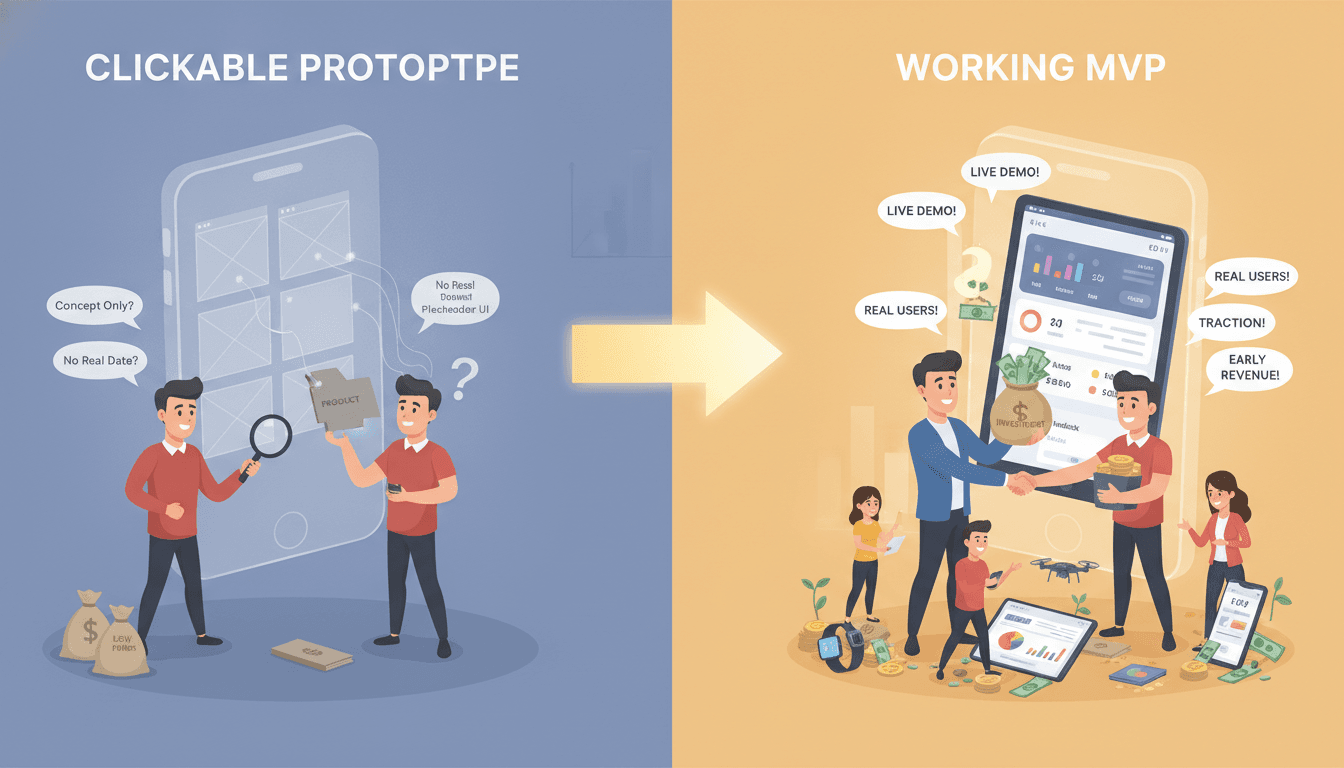
Investors see hundreds of decks a year. A clickable prototype is table stakes. A working MVP tells a different story — one that's harder to dismiss.
What's the actual difference between a prototype and an MVP?
A clickable prototype is a simulation. It's a Figma file dressed up to look like a product. Tapping a button triggers a pre-set transition. There's no backend, no real data, no error handling. It answers the question "does this look right?" It cannot answer "does this work?"
An MVP is software that runs. It has a database, an API layer, authentication, and at least one complete user journey that a real person can complete without a script. It may be rough. It may cover only one use case. But it executes real logic against real inputs and produces real outputs.
The confusion between the two is common because both cost money and both get called "early stage." The difference matters enormously when you're talking to investors.
Why investors respond differently to each
A prototype demonstrates intent. An MVP demonstrates execution.
When a founder walks into a seed or pre-Series A meeting with a Figma prototype, the investor's mental model is: "I'm betting on the team and the idea." The product is a visualisation of a hypothesis. That's a valid bet at very early stages, but it puts the entire weight of the investment on trust.
A working MVP shifts the calculus. The investor can now ask: how long did it take to build this? What tech stack did you choose and why? What did you learn from the first ten users? These are questions about execution history, not future intent. They are easier to evaluate and they reveal a great deal about the founding team's judgement.
There's also a simpler psychological point. A demo that runs live in the room, with real data, where someone in the audience can type in their own email address and see a result, is more persuasive than any slide. The investor knows you can't fake it on the spot.
/// Not sure where to start?
Get the architecture before you commit
Tell us what you're building and we'll map the technical approach, stack, and rough timeline. No cost, no obligation, no sales call required.
What should your MVP actually contain?
This is where most technical teams get it wrong. They either overbuild, trying to reach feature parity with a mature product, or they underbuild, producing something so stripped down that it can't complete a meaningful transaction.
A useful rule: an MVP should support exactly one core user journey end to end. Not two. Not a dashboard that shows data but can't ingest it. One loop that works completely.
For a B2B SaaS product targeting logistics, that might mean: a user logs in, uploads a CSV of shipments, sees a cost optimisation output, and can export it. That's the whole product for now. No integrations, no custom branding, no team management. Just that loop.
Choosing your stack for speed without regret
Speed matters, but your stack choice also signals something to technical investors and the engineers they'll ask to evaluate your code.
A quick guide to trade-offs:
| Choice | Speed | Signal to investors | Long-term cost |
|---|---|---|---|
| Next.js + Supabase | Fast | Mainstream, safe | Low |
| Django + PostgreSQL | Medium | Solid, backend-focused | Low |
| Laravel | Fast | Depends on investor's network | Low |
| Firebase (NoSQL) | Very fast | Can raise scaling questions | Medium if you outgrow it |
| Custom microservices from day one | Slow | Overengineered for this stage | High |
For most MVPs, a monolith is the right call. Microservices add coordination overhead that a five-person team doesn't need. You can always decompose later; premature decomposition is harder to undo than you think.
On AI features specifically
If your product includes an AI component, resist the urge to build a custom model for the MVP. Fine-tuned models on small datasets often perform worse than GPT-4o or Claude 3.5 Sonnet used with a well-constructed prompt and retrieval layer. Use the API, prove the use case, then evaluate whether a custom model is worth the compute and data cost.
Does timeline actually matter to investors?
Yes, and more than most founders expect.
If your MVP took 14 months to build with a team of six and it only does one thing, that's a signal about execution pace and prioritisation. If it took six weeks with two engineers, that's a different story entirely.
Speed to MVP is a proxy for team efficiency. Investors know that building a company means making hundreds of prioritisation decisions under uncertainty. How you built your first product tells them something about how you'll spend their money.
This doesn't mean rushing and shipping broken software. It means having a clear answer to the question: "what's the smallest thing that proves the hypothesis?" and then building exactly that.
How do you actually run the investor demo?
Plan for failure. Not rhetorically — literally. Run the demo on a device you've tested that day. Have a fallback recording in case the internet drops. Use seeded data that looks real but can't expose any actual users.
A few practical points:
- Don't narrate every click. State what you're about to show, then show it.
- Let the investor interact if they ask. If they type something unexpected and it breaks, that's useful information for you and it's recoverable.
- Have metrics ready. Even at MVP stage, you should know your week-one retention, average session length, and any conversion event you're tracking.
- Know your error states. Investors sometimes probe edge cases deliberately. Knowing your own product's failure modes is reassuring, not damaging.
The worst demos are ones where the founder is clearly nervous that it might break. If you've built something real, own it.
Conclusion
Build the MVP before you start the fundraising round, not during it. The process of building it will force decisions that sharpen your pitch: what's the core use case, who's the first user, what does success look like in week one? Those answers are worth more than any slide.
If you're deciding whether to build in-house or bring in an external team, the relevant question is: which path gets you to a working, demonstrable product in eight to twelve weeks? That's the timeline investors at seed and pre-Series A are implicitly expecting. Plan backwards from that constraint.
FAQ
Is a no-code MVP a legitimate option for fundraising? It depends on the product. If your core differentiation is a novel algorithm or a proprietary data pipeline, a no-code tool can't represent that. If the differentiation is the workflow and the user experience, tools like Bubble or Webflow can get you to a demonstrable product quickly. Be honest with investors about what it is.
How much should an MVP cost to build? Highly variable, but a focused MVP for a B2B SaaS product — one core journey, real backend, basic auth — typically takes four to ten weeks with two experienced engineers. Cost follows from that. If you're being quoted six months for an MVP, the scope has crept or the team is hedging.
Can we raise a seed round on a prototype alone? Some teams do, particularly when the founders have a strong prior track record. At pre-seed, a prototype plus a clear hypothesis is sometimes enough. At seed, especially post-2022 when valuations compressed, most investors want to see something running. The bar has shifted.
What's the minimum user testing required before an investor demo? You should have at least five to ten real users who completed the core journey without hand-holding from you. Their feedback should have influenced at least one product decision you made. That's the difference between a demo and a product.
Should the MVP be production-grade code? No. It should be deployable, secure enough that you're not exposing user data, and maintainable by a new engineer who joins later. It doesn't need test coverage above 60%, perfect CI/CD pipelines, or horizontal scaling. Those come after you've validated that people want the thing.
Have a project in mind? Contact Sodio Technologies to discuss your requirements and explore the right technology solution for your business.
/// Work with us
Talk to the engineers who'd build it
You'll get a technical scope, timeline and cost estimate from the people doing the work, not an account manager. In-house team, no subcontracting, since 2016.