

Your Chatbot Is Not an AI Strategy
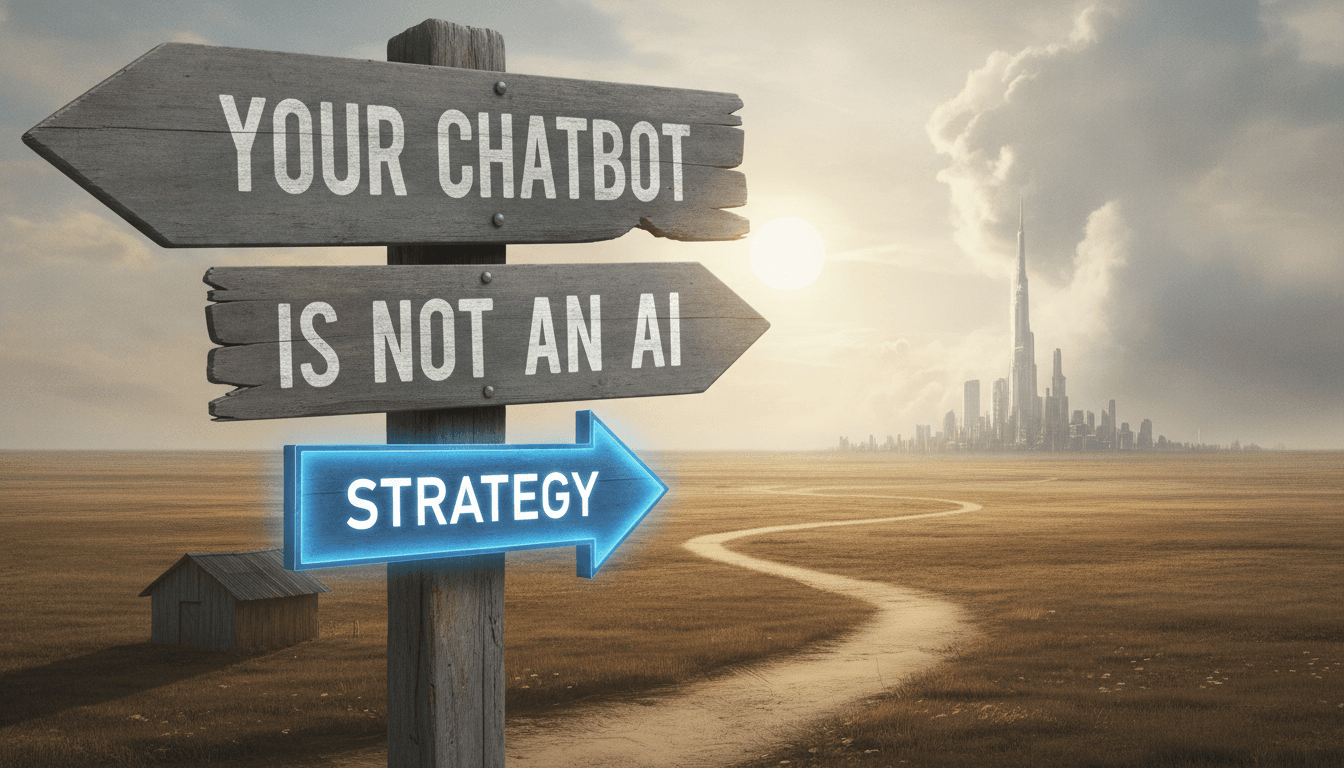
Most companies deploying AI right now are deploying a chatbot. They've connected GPT-4o or Claude to their internal docs, wrapped it in a UI, and called it their AI initiative. The chatbot answers questions, sometimes correctly. Leadership is happy. The slide deck has a screenshot. Job done.
Except it isn't. A chatbot is a UI pattern, the same way a dashboard is a UI pattern. Nobody says "we have a dashboard strategy." The underlying question, what the system is actually deciding, predicting, or automating, is where the strategy lives. And most organisations haven't answered that question yet.
What an AI Strategy Actually Consists Of
An AI strategy is a set of decisions about where machine learning, statistical modelling, or large language model inference will replace or augment a business process, paired with a plan to get the data, infrastructure, and feedback loops to make that work in production.
That's it. No buzzwords needed.
The decisions that matter are:
- Which processes have enough structured historical data to train or fine-tune a model?
- Where does a wrong prediction cost you more than a missed prediction?
- What does the human-in-the-loop look like at each failure mode?
- How do you measure model performance after deployment, not just on your eval set?
A chatbot sidesteps most of these questions because it outsources the "intelligence" to a foundation model. That's fine for certain use cases. But it also means you haven't built anything proprietary, and you haven't answered any of the hard questions about your own data or processes.
What Does "Production AI" Actually Look Like?
This is where most technical teams underestimate the gap. There's a significant difference between a prototype that works in a demo and a system that holds up in production.
A real production ML system typically involves:
- A feature store (Feast, Tecton, or a custom implementation) that ensures training and serving data are consistent
- A model registry (MLflow, Weights & Biases, or SageMaker Model Registry) that versions every artefact
- A CI/CD pipeline for model retraining, not just code deployment
- Monitoring for data drift using something like Evidently AI or Arize
- Shadow deployment or canary releases before full traffic promotion
Most chatbot implementations have none of this. They have a prompt, an API call, and maybe a RAG pipeline using LangChain or LlamaIndex. That's a starting point, not infrastructure.
The gap matters because models degrade. Your RAG retrieval quality drops as your document corpus grows and becomes inconsistent. Your fine-tuned model drifts as user behaviour shifts. Without the infrastructure to detect and respond to this, you're flying blind six months after launch.
/// Not sure where to start?
Get the architecture before you commit
Tell us what you're building and we'll map the technical approach, stack, and rough timeline. No cost, no obligation, no sales call required.
Is a RAG Pipeline a Real AI Investment?
Retrieval-Augmented Generation is genuinely useful. If you have a large, high-quality internal knowledge base and your users need accurate, sourced answers, RAG built on something like pgvector, Pinecone, or Weaviate is a reasonable choice. The retrieval quality depends heavily on your chunking strategy, embedding model selection (text-embedding-3-large vs. a fine-tuned domain-specific model), and re-ranking (Cohere Rerank is commonly used here).
But RAG is not a strategy. It's a retrieval pattern bolted onto a generative model.
The organisations that are actually ahead on AI have something different: proprietary signals. That means clickstream data tied to outcomes, internal transaction histories that reflect domain-specific logic, or labelled datasets that no foundation model was trained on because they don't exist publicly. If your AI system is only as good as the public internet, you have no moat.
When RAG Is the Right Call
RAG makes sense when your primary problem is recall over a private corpus and when the acceptable failure mode is a slightly wrong answer rather than a costly automated action. Customer support over a product manual, internal HR policy lookups, engineering documentation search: these are good fits.
It's the wrong choice when you need a system that makes decisions, not answers questions. A fraud detection model, a dynamic pricing engine, a churn prediction pipeline: none of these should be RAG.
Why Most AI Projects Fail After the First 90 Days
Failure is rarely about the model. It's almost always about data and organisational process.
The common failure patterns:
- Training data that doesn't reflect production distribution (your demo data was clean; production data isn't)
- No feedback loop from end users back to the model, so errors accumulate silently
- A model owner who leaves, taking institutional knowledge of the feature engineering with them
- Eval metrics that measure what was easy to measure, not what the business actually cares about
The 90-day cliff happens because most teams optimise for a successful demo, not for production operations. The demo uses curated data, careful prompts, and a favourable evaluation set. Production has none of that.
If you're building in-house, budget for the operational layer from day one. If you're outsourcing, ask your vendor specifically how they handle post-launch model monitoring and retraining. If they don't have a concrete answer, that's informative.
Should You Build In-House or Work with a Specialist?
This is a real trade-off, not a rhetorical one.
| Factor | Build In-House | Work with a Specialist |
|---|---|---|
| Data is your core IP | Strong fit | Risk of dependency |
| Speed to first production model | Slower, 6–12 months typical | Faster, 2–4 months typical |
| You need ongoing iteration | Strong fit once team is hired | Requires retainer or transfer |
| Domain is niche (e.g., agri-logistics) | Depends on hiring market | Specialist may not exist |
| Budget for ML engineering salaries | $180k–$250k per engineer/yr in US | Project-based, often lower upfront |
| Long-term ML capability matters | Build | Hybrid: build with transfer |
The honest answer is that most Series A and B companies shouldn't be building a full ML platform from scratch. The infrastructure cost is high and the talent is expensive. The better pattern is to work with an external team to get the first two or three models into production, establish the data pipelines, and then hire for iteration once you know what you actually need.
Conclusion
The chatbot isn't the problem. The problem is treating it as an endpoint rather than a starting point.
If you want an AI system that actually creates defensible value, start with the process question: what decision are you automating, and what data do you have to support it? Everything else, the model choice, the infrastructure, the team structure, follows from that.
The next step is a data audit. Before you write another prompt or spin up another vector database, map what structured data you have, what it covers, and where the gaps are. That audit will tell you more about your AI options than any vendor demo.
FAQ
Is a chatbot a waste of money? Not necessarily. A well-scoped chatbot with a proper RAG pipeline can reduce support ticket volume significantly for the right use case. The problem is when it's treated as a substitute for a broader AI strategy. It's one tool, with a narrow set of appropriate applications, not a foundation for competitive advantage.
What's the difference between an LLM application and a real ML system? An LLM application calls a foundation model API, often with retrieval or prompt engineering on top. A real ML system trains or fine-tunes on proprietary data, has a feedback loop from production, and operates inside a model lifecycle framework with monitoring and retraining. The infrastructure complexity and the potential for proprietary advantage are both significantly higher in the latter.
How long does it realistically take to get a production ML model live? For a well-scoped problem with clean, available data, a team of three to four engineers can get a first model into production in eight to twelve weeks. That excludes the data preparation phase, which often takes as long as the modelling itself. Expect four to six months end-to-end for the first model in a new domain.
When should a company start building an internal ML team? When you have at least one model in production and you understand the retraining and monitoring requirements. Hiring before that means your ML engineers spend their time on infrastructure without a clear production target. Get one system live with outside help first, then hire to operate and extend it.
What's the single biggest mistake teams make with AI projects? Starting with the technology instead of the problem. Teams pick a model, build around it, and then look for a use case. The correct order is: identify a process with a measurable outcome, confirm you have the data to support a model, then choose the architecture. Working backwards from a foundation model almost always produces a chatbot.
Have a project in mind? Contact Sodio Technologies to discuss your requirements and explore the right technology solution for your business.
/// Work with us
Talk to the engineers who'd build it
You'll get a technical scope, timeline and cost estimate from the people doing the work, not an account manager. In-house team, no subcontracting, since 2016.