

 Restaurant
Restaurant Software Development
Cloud POS, billing, reservations, kitchen display and guest apps, built for service — where the order changes mid-conversation and the system cannot stop working.

TRUSTED BY TEAMS






Sodio builds restaurant software development covering cloud POS, billing, table reservations, kitchen display systems, QR ordering, recipe costing and multi-outlet management, plus restaurant AI for voice ordering, menu engineering and prep forecasting.
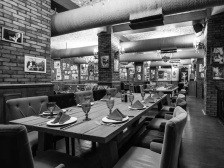
Restaurant software differs from general retail systems in two specific ways: an order is a conversation with modifiers, substitutions and course timing rather than a flat basket of items, and the system runs during service where a few minutes of downtime is unrecoverable.
/// WHAT MAKES RESTAURANT SOFTWARE DIFFERENT
Restaurant Software Runs During Service

Failure Happens During Service
Restaurant systems fail in a way that most business software does not: in front of a full room, during the two hours that pay for the day.
Restaurant Orders Are Not Retail Baskets
The order is the first difference. Retail sells a basket of fixed items. A restaurant order is a dish with substitutions, cooking preferences, allergen flags and course sequencing, modified twice before it reaches the kitchen and split four ways at the end. Software built around SKUs does not survive contact with a real table.
Service Must Continue Offline
Offline capability is the second. Service cannot pause because connectivity dropped. Orders have to be written locally, payment has to keep working through the terminal, kitchen tickets have to keep printing, and reconciliation has to resolve cleanly afterwards. Cloud-first systems without offline handling fail at exactly the wrong moment.
Kitchens Run on Timing, Not Queues
Timing is the third, and it is the one most software ignores. A kitchen does not process a queue — it sequences courses across multiple tables so that dishes arrive together and nothing sits under a lamp. A kitchen display system that treats orders as a first-in-first-out list makes the kitchen work around it.
Interfaces Must Work Mid-Service
And the user is a member of staff mid-service, standing, holding plates, trained briefly. Interfaces designed for a seated head-office user get abandoned within a week.
/// RESTAURANT SOLUTIONS
Restaurant Software We Build

Restaurant Software Development

Cloud POS for Restaurants

Restaurant App Development

Restaurant Mobile App Development

Restaurant Billing Software

Table Reservation & Booking

Kitchen Display Systems

QR Ordering & Contactless Menus

Inventory & Recipe Costing

Multi-Outlet & Chain Management

Waitlist & Queue Management

Restaurant Loyalty & CRM

///AI FOR RESTAURANTS
AI for Restaurant Operations
Every model here attaches to a number an operator already reports weekly: food cost percentage, labour percentage, covers per shift, waste, average spend per head.

AI Voice Ordering
Phone and drive-thru orders taken by AI, with menu grounding, modifier handling and handoff to staff. Unanswered phone orders are lost revenue.

Menu Engineering AI
Profitability and popularity by dish, driving what gets promoted, repriced, reworked or removed from the menu.

Demand Forecasting & Prep Planning
Prep-ahead prediction by dish and hour, cutting ticket times at peak without over-prepping into waste.

Food Waste Reduction AI
Waste typically runs four to ten percent of food cost. Models that tie over-prep and spoilage back to specific decisions.

Dynamic Menu Pricing
Time-of-day, channel and outlet pricing with margin floors the commercial team controls, not an opaque algorithm.

Table Turn Optimisation
Seating, pacing and course timing decisions that raise covers per shift without rushing the guest experience.
Review Analysis & Sentiment AI
Google, TripAdvisor and delivery platform reviews aggregated into operational actions by outlet, dish and shift.

AI Staff Scheduling
Rosters built against forecast covers, so labour spend matches the shifts that actually need cover.
Phone and drive-thru orders taken by AI, with menu grounding, modifier handling and handoff to staff. Unanswered phone orders are lost revenue.
Learn MoreProfitability and popularity by dish, driving what gets promoted, repriced, reworked or removed from the menu.
Learn MorePrep-ahead prediction by dish and hour, cutting ticket times at peak without over-prepping into waste.
Learn MoreWaste typically runs four to ten percent of food cost. Models that tie over-prep and spoilage back to specific decisions.
Learn MoreTime-of-day, channel and outlet pricing with margin floors the commercial team controls, not an opaque algorithm.
Learn MoreSeating, pacing and course timing decisions that raise covers per shift without rushing the guest experience.
Learn MoreGoogle, TripAdvisor and delivery platform reviews aggregated into operational actions by outlet, dish and shift.
Learn MoreRosters built against forecast covers, so labour spend matches the shifts that actually need cover.
Learn More///RELATED SOLUTIONS
Related Solutions
Cloud Kitchen Management Software
Multi-brand order aggregation and kitchen routing for delivery-only operations


Restaurant Delivery Apps
Delivery built on an existing restaurant operation, own-fleet or third-party courier

Multi-brand order aggregation and kitchen routing for delivery-only operations
Learn MoreGeneric and retail point of sale, hardware and payment integration
Learn MoreDelivery built on an existing restaurant operation, own-fleet or third-party courier
Learn MoreHotels, travel and wider hospitality AI
Learn More///SYSTEMS & INTEGRATIONS
Systems and Hardware We Integrate With


/// HOW WE WORK
How We Work on Restaurant Projects
Service observation and systems audit
We watch a service as well as reading the spec. How orders are taken and modified, how the kitchen sequences, where the current system slows staff down, and what the existing POS actually exposes.
Free solution architecture
Components, POS and aggregator integrations, offline strategy, hardware compatibility and a costed delivery plan including outlet rollout. Yours to keep whether or not you build with us.
Pilot in one outlet
A working system in a single site, used during real service by real staff. Training time, hardware behaviour and edge cases get tested here rather than across the estate.
Phased rollout
Deployment outlet by outlet with a rollback path, training material and support cover during the first services. Estates are never switched over in one release.
///FEATURED CASES
Future-Proof Software for Your Business
At Sodio, we deliver mobile apps, web apps, blockchain (DApps), AI integrations, SaaS platforms, and custom software development. Our innovative solutions are scalable, secure, and user-friendly, designed to drive growth and efficiency, keeping your business ahead in the competitive landscape. Trust Sodio for your digital transformation needs.
OrderOK - Restaurant Management System
A smart solution to streamline orders, table management, and restaurant operations.
OrderOK - Restaurant Management System
A smart solution to streamline orders, table management, and restaurant operations.
/// FAQ
Frequently Asked Questions
Modifier handling, mostly. A restaurant order is rarely a flat item list — it is a dish with substitutions, cooking preferences, allergen flags, course sequencing and split payment across a table. Generic retail POS handles a basket of SKUs. Restaurant POS has to handle a conversation that changes mid-service, then route the right parts of it to the right kitchen station at the right time.
It has to. A restaurant cannot stop taking orders mid-service because a line dropped. That means orders written locally, payment handled through a terminal that can operate offline, kitchen tickets still printing, and clean reconciliation when connectivity returns. Cloud-first systems built without offline handling fail precisely during service, which is the worst possible moment.
Yes. Common integrations include Square, Lightspeed, Toast, Oracle Micros and Petpooja on the POS side, and the major delivery aggregators for order injection. The engineering question is which system owns the order at each stage and what happens when an aggregator API is unavailable mid-service. We establish that during discovery rather than assuming parity across platforms.
By grounding the model in your actual live menu rather than letting it improvise. It handles modifiers, substitutions and upsells, confirms the order back, and hands off to a staff member when it hits something it cannot resolve. The commercial case is simple: phone orders that ring out during service are revenue that never arrives, and most operators have no idea how many they miss.
Both, though the problems differ. A single site usually needs a workable POS, reservations and a loyalty mechanism without enterprise complexity. Chains need central menu and price control with local overrides, consolidated reporting and consistency across outlets. The engineering discipline is shared; the integration surface is not.
For a defined scope we target a working MVP in 30 days and a core production build in 90. Restaurant projects extend when payment certification, kitchen hardware integration or a phased outlet rollout are involved. We pilot in one site before rolling out to an estate rather than switching everything at once.
/// RELATED SERVICES
Related Services
Internal linking back into the main service tree.
/// GET STARTED
Start With One Service
Tell us where the current system slows down service and what is on the counter today. We will prepare a free solution architecture covering integrations, offline strategy, hardware compatibility and outlet rollout, so you can judge the approach before committing.