

Energy Management Systems: Optimizing Energy Use
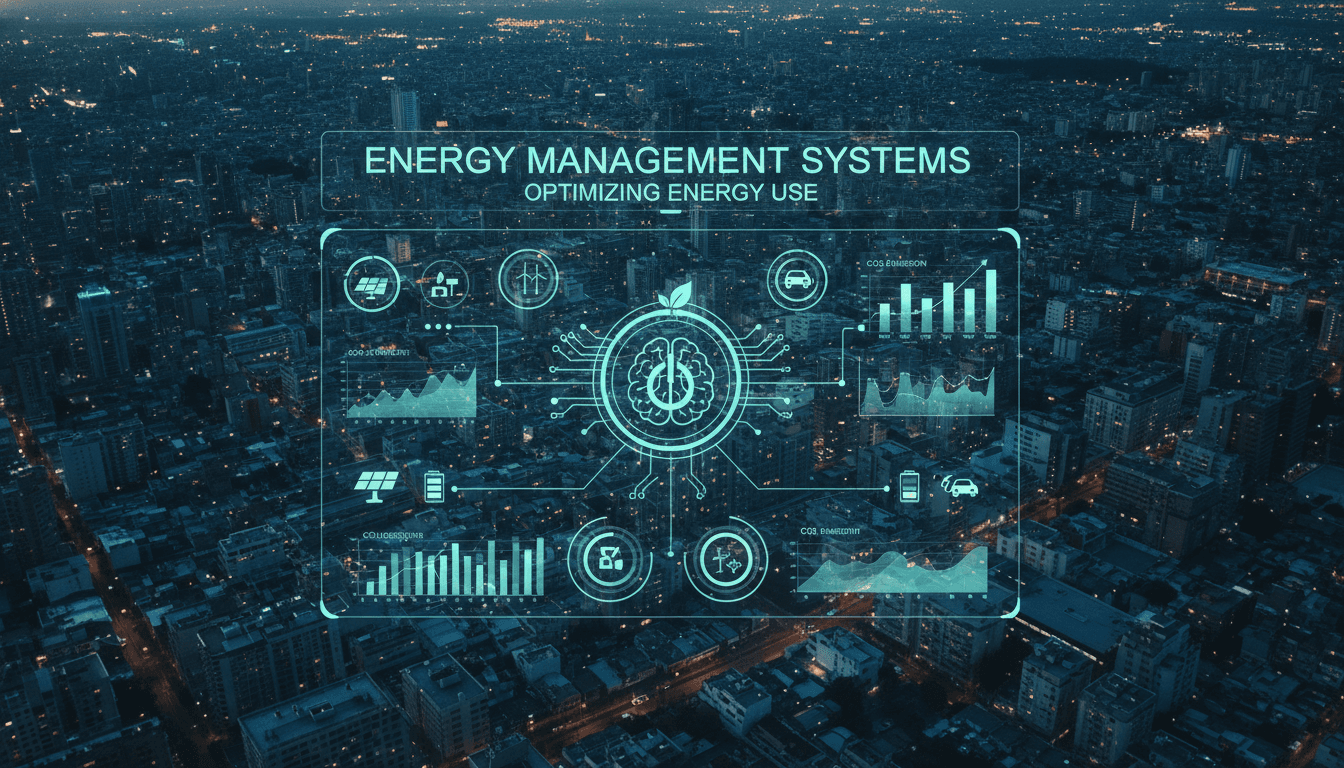
Energy waste is expensive and largely invisible until you instrument for it. Most facilities — manufacturing plants, data centres, commercial buildings — bleed 20–30% of their energy budget through inefficiencies that only show up when you measure at sufficient granularity. This post covers how modern Energy Management Systems are built, where the hard engineering problems actually live, and what trade-offs matter when you are deciding how to architect one.
What Does an Energy Management System Actually Do?
At its core, an EMS collects real-time consumption data, runs it through analytical models, and either surfaces actionable insight or closes the loop automatically by controlling loads. That sounds simple. The complexity is in the data pipeline.
Sensors — typically smart meters, CT clamps, or IoT edge devices running protocols like Modbus RTU, BACnet/IP, or IEC 61850 — push readings at intervals anywhere from 100ms to 15 minutes depending on the use case. Demand forecasting needs sub-minute granularity. Billing reconciliation is fine at 15 minutes. Getting this wrong in either direction costs you: over-sampling saturates your message broker; under-sampling hides peaks that trigger demand charges.
The Data Ingestion Layer
For high-frequency telemetry, MQTT over TLS is the most practical transport. It is lightweight, handles unreliable networks gracefully, and has broad hardware support. AMQP is an alternative if you need stronger message ordering guarantees, but most EMS deployments do not.
Time-series storage is the next decision. InfluxDB is the most widely deployed option. TimescaleDB (PostgreSQL extension) is worth considering if you want to keep your analytical queries in SQL and your team already lives in Postgres. Apache Cassandra scales better at extreme write volumes but operational overhead is meaningfully higher. For a facility with fewer than 500 meters, InfluxDB plus Grafana covers most dashboarding needs without significant infrastructure cost.
Edge vs. Cloud Processing
Raw sensor data rarely needs to travel to the cloud unprocessed. Pushing aggregation and anomaly detection to the edge — using something like AWS Greengrass, Azure IoT Edge, or a bare Linux device running Python — cuts bandwidth costs and keeps the system functional during connectivity loss. The trade-off is that edge hardware complicates firmware management. If you are deploying across 50 sites, a proper OTA update pipeline (something like Mender or Balena) becomes non-negotiable before you go to production.
How Do You Model Energy Demand Accurately?
Demand forecasting is where EMS software earns its complexity. The naive approach is a moving average over historical consumption. It is wrong often enough to be dangerous for anything tied to tariff optimisation or battery dispatch scheduling.
The standard baseline model is ARIMA or its seasonal variant SARIMA. These work well when consumption patterns are stable and exogenous variables are limited. When you have weather sensitivity (HVAC-heavy buildings), occupancy variation, or production schedule changes (manufacturing), you need covariates. Facebook's Prophet handles seasonality and holiday effects well out of the box and is far easier to tune than a raw SARIMA model for teams without deep time-series experience.
For real-time anomaly detection, Isolation Forest performs well on multivariate consumption data with minimal labelling overhead. If you have labelled fault data, an LSTM-based classifier will outperform it, but labelled fault datasets in energy are rare and expensive to build.
One number worth keeping in mind: a 1% improvement in demand forecast accuracy in a facility spending £500k/year on energy typically translates to £3,000–£8,000 in avoided demand charges, depending on your utility tariff structure. That is not transformational, but it compounds across a fleet.
/// Not sure where to start?
Get the architecture before you commit
Tell us what you're building and we'll map the technical approach, stack, and rough timeline. No cost, no obligation, no sales call required.
What Does Integration With Renewable Sources and Storage Actually Look Like?
A solar-plus-storage integration is a control problem, not just a data problem. You are optimising dispatch across at least three variables: grid import price (time-of-use tariffs), battery state of charge, and solar forecast. Add EV charging or a CHP unit and the problem grows.
The standard approach is Model Predictive Control (MPC). You define an objective function (minimise cost or carbon, subject to constraints) and a prediction horizon, typically 24 hours, and solve it at each timestep. For smaller systems, a linear programming formulation using Python's scipy.optimize.linprog or the PuLP library is sufficient. For larger sites with non-linear constraints (battery degradation curves, for example), you need a solver like CVXPY with a commercial backend such as Gurobi or MOSEK.
ISO 50001 is the relevant energy management standard here. It does not dictate technical architecture, but it specifies a plan-do-check-act management framework that any serious industrial deployment will need to demonstrate compliance with. If your client is pursuing ISO 50001 certification, your data logging and audit trail requirements are substantially heavier than a typical monitoring-only deployment.
Building In-House vs. Using a Platform
This is where most engineering teams spend the least time thinking and the most time regretting.
| Factor | Build in-house | Use a platform (e.g. EcoStruxure, Siemens Desigo CC) |
|---|---|---|
| Customisation | Full control | Limited to vendor APIs |
| Time to first insight | 3–9 months | 2–8 weeks |
| Protocol support | You own it | Broad but fixed |
| Ongoing cost | Engineering headcount | Licence fees (often $30k–$150k/year) |
| Data ownership | Clear | Contractually complex |
| Edge case handling | Build it yourself | Raise a support ticket |
Building makes sense when your consumption patterns, tariff structures, or control requirements are genuinely unusual. If your facility runs standard HVAC and lighting loads on a flat tariff, a commercial platform will get you to value faster at lower total cost. The honest answer is that most facilities are closer to standard than their operators believe.
Sodio's approach has been to build custom EMS infrastructure when the data pipeline or control logic cannot be served by existing platforms, and to avoid reinventing dashboarding or reporting when tools like Grafana or Metabase cover the requirement adequately.
Security and Compliance Considerations
OT (Operational Technology) networks connected to IT systems are the fastest-growing attack surface in industrial environments. The 2021 Oldsmar water treatment incident and the 2015 Ukraine power grid attack both exploited gaps between OT and IT security postures. An EMS that controls physical loads needs to be designed with that in mind from the start, not retrofitted.
Minimum baseline: network segmentation between sensor networks and corporate IT using a DMZ architecture, certificate-based device authentication (X.509), encrypted transport (TLS 1.2 or later), and role-based access control on the management interface. IEC 62443 is the relevant standard for industrial cybersecurity. It is more operationally specific than ISO 27001 and more applicable to EMS deployments.
Conclusion
If you are architecting an EMS, the two decisions that will most constrain everything else are your data granularity requirements and whether you need closed-loop control or monitoring only. Get those answered with actual tariff data and facility load profiles before you make any technology choices. Everything else follows from there.
A useful next step: pull 12 months of 15-minute interval meter data from your facility, plot peak demand by hour and day of week, and see whether your consumption pattern is actually as complex as you think. Most optimisation opportunities are visible in that single chart.
FAQ
What communication protocols should an EMS support? For industrial and commercial buildings, Modbus RTU and BACnet/IP cover the majority of existing hardware. IEC 61850 is standard for substation-level integration. MQTT is the right choice for IP-connected IoT sensors. If you are integrating with utility APIs, look for DNP3 or OpenADR 2.0 support.
How accurate do energy forecasts need to be for battery dispatch to be worthwhile? In practice, MAPE (Mean Absolute Percentage Error) below 5% on a 24-hour horizon is sufficient for most time-of-use optimisation scenarios. Below 10% is workable if your battery is large relative to load variance. Tighter accuracy matters more when you are bidding into frequency response or capacity markets.
Is ISO 50001 certification worth pursuing? For large industrial consumers (above 10 GWh/year), it often unlocks exemptions from UK Climate Change Levy charges. For smaller facilities, the audit overhead may outweigh the benefit. The standard itself is sound and aligns with good engineering practice, so implementing it without formal certification is a reasonable middle ground.
What is the realistic payback period for an EMS deployment? For a facility spending £1m or more annually on energy, a well-implemented EMS typically achieves 10–20% savings, putting payback at 1–3 years depending on implementation cost. Smaller facilities see proportionally lower savings in absolute terms but similar percentage improvements. These figures assume the facility has not already done significant efficiency work.
When does machine learning actually improve on rule-based control? When consumption patterns have enough variability that static rules require constant manual updating. If your facility runs the same production schedule year-round, a well-tuned rule set will match ML performance at far lower complexity. ML earns its cost when you have multiple interacting variables — weather, occupancy, production volume, spot prices — that make manual rule maintenance impractical.
Have a project in mind? Contact Sodio Technologies to discuss your requirements and explore the right technology solution for your business.
/// Work with us
Talk to the engineers who'd build it
You'll get a technical scope, timeline and cost estimate from the people doing the work, not an account manager. In-house team, no subcontracting, since 2016.