

Hotel Management Systems: Improving Guest Experience
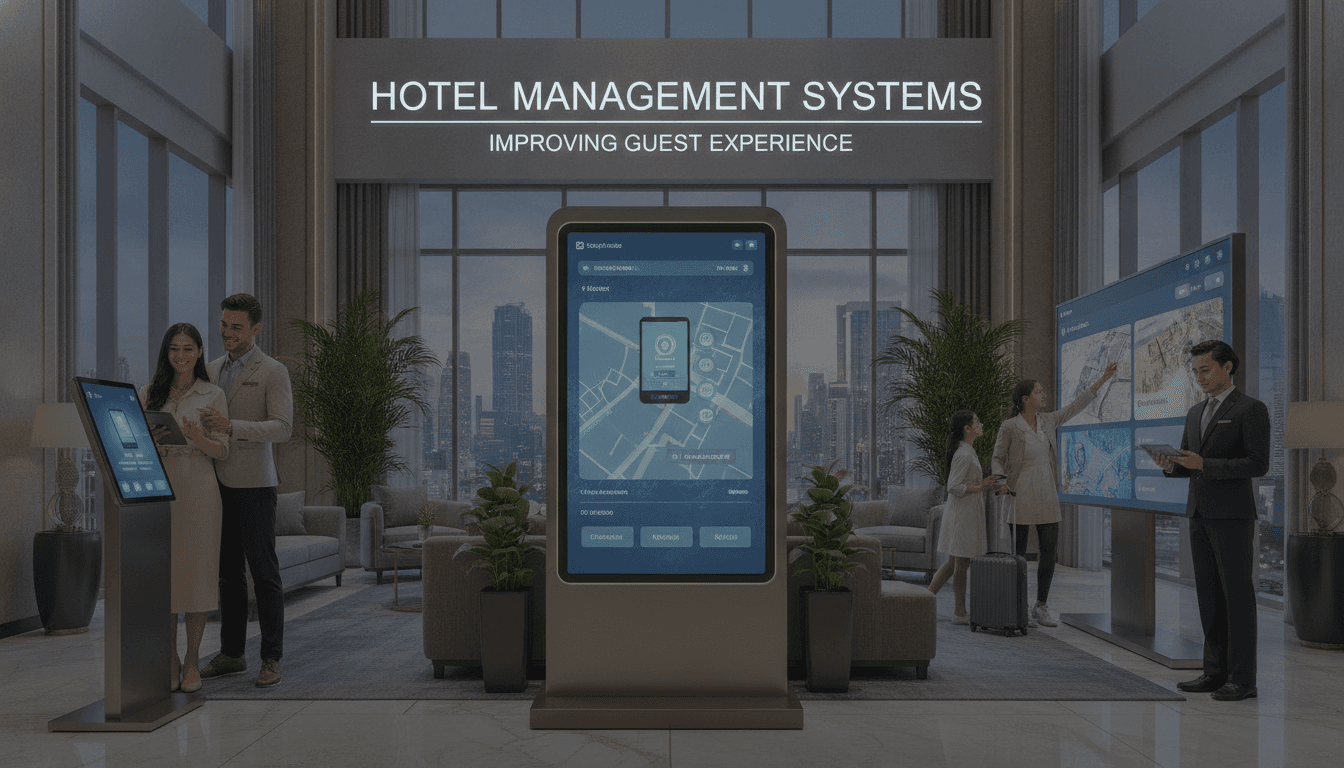
A practical look at how modern hotel management systems are built, where they break, and what it actually takes to improve guest experience through better software architecture.
What Does a Hotel Management System Actually Do Under the Hood?
Most engineers who haven't worked in hospitality assume a Property Management System (PMS) is glorified booking software. It isn't. A modern PMS sits at the centre of a web of integrations: the Central Reservation System (CRS), Channel Manager, Revenue Management System (RMS), Point of Sale (POS), door-lock controllers, housekeeping apps, and increasingly, guest-facing mobile clients. Each of these talks to the PMS via a mix of protocols, some modern REST APIs, some legacy XML-based standards like OTA (Open Travel Alliance) 2003 schemas that have barely changed in 20 years.
The core data model is a reservation lifecycle: inquiry, booking, pre-arrival, check-in, in-stay, checkout, and post-stay. Every guest touchpoint maps to a state in that lifecycle. Problems in guest experience almost always trace back to state mismatches, stale data, or integration failures between these systems rather than a bug in the UI.
Where Data Actually Lives
Room availability is a shared mutable state problem. The PMS holds the source of truth, but the Channel Manager pulls from it and pushes availability to OTAs like Booking.com and Expedia via the HTNG (Hospitality Technology Next Generation) 2.0 standard or proprietary APIs. Latency in this sync, even 90 seconds, can cause overbooking. Most mid-market hotels tolerate this because fixing it requires either a tighter sync loop or an event-driven architecture, both of which cost engineering time.
Guest profile data is typically stored in a CRM layer, sometimes embedded in the PMS, sometimes external (Salesforce, HubSpot, or hospitality-specific tools like Revinate). The profile holds preferences, past stay history, loyalty points, and communication opt-ins. This data is what makes personalisation possible, but it's only useful if it's clean and accessible at check-in time.
How Do You Actually Personalise the Guest Experience at Scale?
Personalisation in hospitality is overused as a marketing word and underdelivered as an engineering capability. Real personalisation requires three things to work simultaneously: accurate guest profile data, a system that reads it at the right moment, and a staff-facing interface that surfaces it clearly.
The "right moment" is the key constraint. If a returning guest's preference for a high-floor room is buried in a CRM record that the front desk has to search for manually, it doesn't get actioned. The integration between the PMS and the front desk terminal needs to surface relevant profile data automatically when a reservation is pulled up.
The more interesting work is pre-arrival automation. A well-architected pre-arrival flow looks like this:
- Booking confirmed, webhook fires to a messaging service.
- T-minus 48 hours: guest receives a pre-arrival email with upsell options (room upgrades, early check-in, restaurant reservations) pulled dynamically from the RMS based on current availability and willingness-to-pay models.
- T-minus 24 hours: digital check-in link sent, guest completes ID verification, selects room from a visual floor plan, and receives a mobile key provisioned via the door-lock API (ASSA ABLOY, Dormakaba, or SALTO are the common vendors).
- On arrival: no queue, no paperwork.
This flow is straightforward to describe but non-trivial to build reliably. The failure points are ID verification latency, mobile key provisioning failures, and upsell inventory that doesn't reflect real-time PMS state. You need idempotent retry logic at each step and a fallback path for every automated action.
/// Not sure where to start?
Get the architecture before you commit
Tell us what you're building and we'll map the technical approach, stack, and rough timeline. No cost, no obligation, no sales call required.
The Integration Problem Nobody Talks About Enough
OTA (over-the-air) mobile key delivery alone involves the PMS, the door-lock middleware (often a separate vendor), the mobile app, and the physical lock firmware. If the guest's phone model doesn't support BLE 4.0 or higher, or if the lock firmware is on an old version, the key fails silently. Guests end up at the front desk anyway.
The honest assessment: mobile keys work reliably for roughly 85-90% of guests in a well-maintained deployment. For the remaining 10-15%, you need a fallback that doesn't feel broken.
Here's a comparison of the common guest-facing check-in approaches and their real-world trade-offs:
| Approach | Guest friction | Integration complexity | Failure mode |
|---|---|---|---|
| Traditional front desk | High (queues) | Low | Staff availability |
| Kiosk check-in | Medium | Medium | Hardware failure, ID reader |
| Mobile key (BLE) | Low | High | Device compatibility, lock firmware |
| QR code + physical key locker | Low-Medium | Medium | Locker hardware, code delivery |
| Web-based check-in + card pickup | Low | Low-Medium | Card encoder reliability |
No single approach works for every property type. A 400-room city-centre hotel has different constraints than a 20-room boutique.
What Does Good Housekeeping and Operations Integration Look Like?
Guest experience isn't just the reservation and check-in. A room that isn't cleaned on time, or a maintenance issue that goes unresolved, breaks the stay regardless of how smooth the digital check-in was.
Modern housekeeping management runs on task assignment apps (HotSOS, Knowcross, or custom-built) that receive room status updates from the PMS in real time. When a guest checks out, the PMS pushes a dirty-room event, the housekeeping system assigns it to the next available attendant, and when the attendant marks it clean, the PMS updates availability. The loop should close in under 5 minutes in a well-integrated system.
Maintenance follows a similar pattern via a work order system. The guest-facing side is a messaging layer: most modern hotels use SMS or WhatsApp-based request handling, with the messages routing into the PMS or a dedicated guest messaging platform like Whistle or ALICE. Requests that require a work order get escalated automatically.
IoT in the Room
In-room IoT is gaining real traction. Smart thermostats (typically KNX or BACnet protocol, sometimes Zigbee for mid-market), automated curtains, and occupancy sensors are being integrated with the PMS to reduce energy consumption. Some systems cut HVAC to a set-back temperature 30 minutes after checkout is detected via the door-lock sensor. The ROI on this is measurable: properties report 15-20% reductions in energy spend with full room automation.
The data from these sensors also feeds guest preference profiles. If a guest consistently sets the thermostat to 19°C, that can be pre-set for their next stay.
Building In-House vs. Buying a PMS Platform
The question most hotel tech leads face isn't which PMS to buy. It's how much to build on top of a purchased platform versus replacing it.
The dominant PMS platforms are Oracle OPERA (enterprise, on-premise and cloud), Mews (cloud-native, modern API), Apaleo (API-first, best integration story), and Cloudbeds (mid-market, strong channel management). Apaleo and Mews are the most developer-friendly; Oracle OPERA's API surface is functional but the documentation and support are frustrating to work with.
If you're building on top of a PMS, the integration work you'll spend the most time on is:
- Webhooks and event consistency (not all platforms emit events reliably)
- Rate plan and availability sync with channel managers
- Folio and billing integration with accounting systems
- Guest profile deduplication across PMS, CRM, and loyalty systems
Building a PMS from scratch makes sense only if you have very unusual requirements (multi-property groups with complex inter-property inventory, for instance) and a long-term engineering commitment. For most properties, the right answer is a modern cloud PMS with a well-documented API, plus custom-built layers for the differentiated guest experience features.
Conclusion
The gap between average and good guest experience usually isn't a product decision. It's an engineering decision. Clean data, reliable integrations, and event-driven state management solve more guest complaints than any new feature.
If you're evaluating your current PMS setup or planning a custom layer on top of it, start with an integration audit: map every data flow, identify where sync is polling-based rather than event-driven, and find the failure modes you're papering over with manual processes. That map will tell you where to invest engineering effort first.
FAQ
What is the most common cause of overbooking in hotel systems? Overbooking almost always comes from slow availability sync between the PMS and the Channel Manager. When a booking comes in through an OTA and takes more than 60-90 seconds to reflect in the PMS, another booking can come through the same channel for the same room. Event-driven sync over webhooks reduces this significantly compared to polling-based integrations.
How long does it take to integrate a mobile key system into an existing hotel? A typical deployment, covering PMS integration, door-lock middleware, and the guest-facing mobile app, takes 8-16 weeks depending on the lock hardware vendor and the quality of the PMS API. ASSA ABLOY and Dormakaba have well-documented SDKs. Proprietary lock systems from smaller vendors can add significant time.
Is a custom-built PMS ever the right choice? Rarely, and only for large multi-property groups with complex inventory or pricing logic that off-the-shelf systems can't handle. The maintenance overhead of a custom PMS is substantial. For most properties, building on top of Apaleo or Mews with custom integration layers is the more defensible engineering decision.
What data is most valuable for personalising the guest experience? Past stay history, room preference patterns, and communication opt-ins give you the most actionable signal. Dietary preferences and special occasion flags matter operationally. The challenge is keeping this data clean across multiple stays and properties, especially when guests book through different channels each time.
How do in-room IoT systems connect to the PMS? Typically through a middleware layer, either the lock vendor's platform or a building management system (BMS) gateway. The PMS sends checkout events to the middleware, which triggers room automation. KNX and BACnet are the most common protocols at the hardware level. Direct PMS-to-device integration without middleware is rare and hard to maintain.
Have a project in mind? Contact Sodio Technologies to discuss your requirements and explore the right technology solution for your business.
/// Work with us
Talk to the engineers who'd build it
You'll get a technical scope, timeline and cost estimate from the people doing the work, not an account manager. In-house team, no subcontracting, since 2016.