

How to Make an App Like HotelTonight
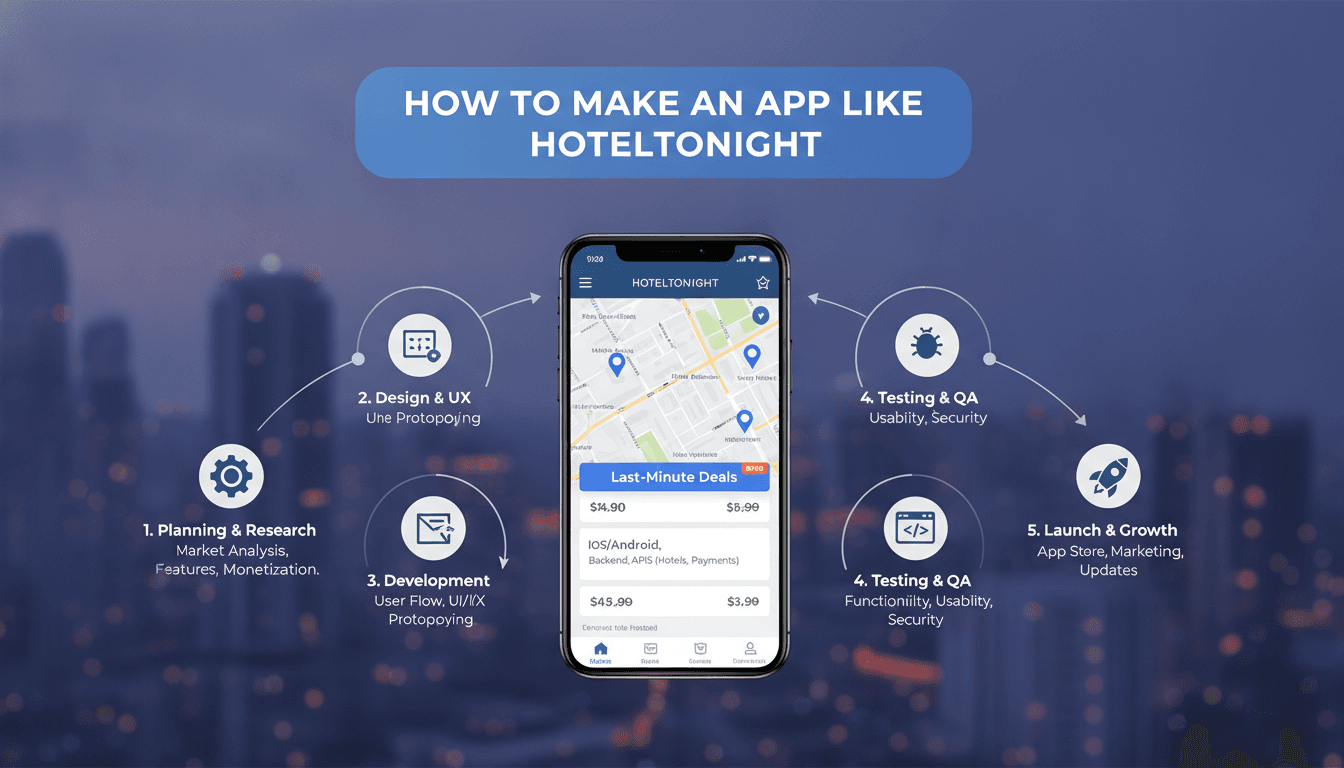
A practical breakdown of the architecture, cost drivers, and engineering decisions behind last-minute hotel booking apps — written for teams who are about to build one.
What Makes HotelTonight Different From a Standard Booking App?
Most travel apps are inventory aggregators. HotelTonight started with a specific constraint: same-day bookings only, for a curated set of hotels. That constraint shaped everything — the UX, the backend, the pricing engine, the payment flow.
When you remove that constraint (as HotelTonight itself later did by expanding to 7-day advance bookings), you add complexity fast. If you're building something in this space, you need to decide early whether you're building a pure last-minute app or a general short-stay platform. The architecture differs meaningfully.
The core technical pieces are:
- Real-time inventory sync with hotel property management systems (PMS)
- A dynamic pricing engine that adjusts rates as check-in time approaches
- A payment layer with minimal friction (ideally single-tap for returning users)
- A booking confirmation flow that completes in under 10 seconds
- A hotel-facing dashboard for managing room blocks and rates
None of these are particularly exotic in isolation. The difficulty is getting them to work reliably together at scale.
How Does the Real-Time Inventory System Work?
This is where most teams underestimate the work.
Hotels use a range of PMS platforms: Opera, Cloudbeds, Mews, Apaleo, and dozens of smaller regional systems. Almost none of them expose clean, well-documented REST APIs. The industry standard for distribution is still OTA Connect / OpenTravel Alliance XML, which is verbose and inconsistently implemented across vendors.
You have two practical options:
Channel managers like SiteMinder, STAAH, or Cloudbeds' own channel manager sit between your platform and the hotels. They handle the PMS integrations and expose a single API to you. This is the right call for most teams building v1. You pay a per-property or per-booking fee, but you avoid maintaining 40+ individual integrations.
Direct PMS integrations make sense once you have volume and specific hotels you want tighter control over. Apaleo, for instance, has a proper RESTful API and webhooks, making it a good first candidate for a direct integration.
For real-time availability, you need to think in two modes:
- Push: the hotel's system sends you updates when inventory changes
- Pull: you poll for availability when a user searches
A hybrid approach works best. Cache the last-known inventory state from push updates, then do a live availability check at the point of booking confirmation. This reduces API calls by roughly 60-70% while still protecting you from double-bookings.
The booking confirmation flow itself should be idempotent. Use a unique booking reference generated on the client side and treat all retries as the same request. This matters more than most teams expect when mobile connections are unreliable.
What Does the Dynamic Pricing Engine Look Like?
Last-minute pricing is not just "discount as check-in approaches." The logic is more nuanced.
A basic model factors in:
- Base rate set by the hotel
- Occupancy at the time of request (requires real-time availability data)
- Day of week and local event calendar
- Time remaining until check-in cutoff (typically 2am local time for same-day)
- Competitor rates (requires rate-shopping integration or a third-party feed)
A more sophisticated model uses a gradient boosting model (XGBoost or LightGBM are common choices here) trained on historical booking and cancellation data. The model predicts the probability of a room selling at the current rate and suggests a floor price. Hotels set a minimum acceptable rate; the engine works within that floor.
You don't need to build this on day one. Start with a rule-based engine. Move to ML once you have 6-12 months of transaction data to train on.
One thing to get right from the start: the pricing engine should be a separate service with its own API. Coupling it to the booking service creates a bottleneck and makes A/B testing pricing strategies nearly impossible.
/// Not sure where to start?
Get the architecture before you commit
Tell us what you're building and we'll map the technical approach, stack, and rough timeline. No cost, no obligation, no sales call required.
How Should You Structure the Tech Stack?
There is no single right answer, but there are common patterns among apps in this space that handle reasonable scale.
| Layer | Common Choices | Notes |
|---|---|---|
| Mobile | React Native or Flutter | React Native has a larger talent pool; Flutter gives better rendering performance |
| API Gateway | Kong, AWS API Gateway | Rate limiting and auth belong here, not in individual services |
| Core Services | Node.js or Go | Go is worth the trade-off if latency is a priority at scale |
| Pricing Engine | Python (FastAPI) | Most ML tooling is Python-native; keep it separate |
| Database | PostgreSQL + Redis | Postgres for transactional data; Redis for session state and inventory cache |
| Search | Elasticsearch or Typesense | Typesense is simpler to operate for smaller teams |
| Payments | Stripe or Adyen | Adyen if you need multi-currency settlement across markets |
| Push Notifications | Firebase Cloud Messaging | Covers both iOS and Android |
| Hosting | AWS or GCP | Neither is wrong; pick what your team knows |
For a v1 targeting a single city or region, a monolith with clear internal module boundaries is fine. Splitting into microservices before you understand your load patterns adds operational overhead without much benefit.
Authentication and Guest Experience
One thing HotelTonight got right early: minimal sign-up friction. Allow booking as a guest with just an email and phone number. Add account creation as a post-booking step, not a pre-booking gate.
For returning users, store payment methods using Stripe's SetupIntent API or Adyen's token vault. A single-tap checkout for returning users meaningfully improves conversion, especially on mobile.
What Does This Actually Cost to Build?
Rough estimates for an MVP covering the guest-facing mobile app, a web-based hotel dashboard, and the core backend services:
- Design (UX/UI): 3-5 weeks
- Mobile app (iOS + Android via React Native): 14-20 weeks
- Backend services: 16-22 weeks (overlaps with mobile)
- Hotel dashboard: 6-10 weeks
- QA and integration testing: 4-6 weeks
Total calendar time: roughly 6-9 months with a team of 5-7 engineers. Budget range varies significantly by location and team composition, but for a product-quality MVP (not a prototype), expect a minimum of $120,000-$200,000 USD.
The biggest hidden cost is the channel manager integration and testing. Getting inventory sync to behave correctly across different PMS configurations takes longer than most roadmaps allow for.
Ongoing infrastructure costs at low volume (under 10,000 monthly bookings) are modest, typically $1,500-$4,000/month on AWS. The cost curve is relatively flat until you hit serious search and notification volume.
Conclusion
The hardest part of building an app like HotelTonight is not the mobile UI or the payment integration. It is the inventory layer. Getting real-time availability data that you can trust, at the moment a user taps "Book," is an unsolved problem for most teams until they've lived through a few double-booking incidents.
Start with a channel manager to abstract PMS complexity. Build the pricing engine as a separate service from day one, even if it starts simple. Keep the booking confirmation flow fast and idempotent. Everything else can be iterated on.
If you're scoping this out and want a technical opinion on your specific architecture choices, talk to the engineering team at Sodio.
FAQ
How long does it take to build an app like HotelTonight? A production-quality MVP with a guest mobile app, hotel dashboard, and core backend services typically takes 6-9 months with a team of 5-7 engineers. That includes design, development, integration with a channel manager for inventory, and QA. Prototype timelines are shorter but rarely useful for testing real booking flows.
Do you need to build a custom pricing engine from scratch? Not at first. A rule-based engine with hotel-set floors and simple time-to-checkin decay logic is sufficient for v1. Move to a machine learning model once you have enough historical transaction data — usually after 6-12 months of live bookings — to train it meaningfully.
What is the biggest technical risk in a last-minute booking app? Double-bookings caused by stale inventory data. The fix is a hybrid push/pull inventory strategy: cache push updates for browsing, then do a live availability check at booking confirmation before charging the user. This also requires idempotent booking references to handle retry scenarios on flaky mobile connections.
Should you build for iOS and Android separately or use a cross-platform framework? React Native or Flutter cover the majority of use cases here and halve the mobile development effort. Separate native builds are worth considering only if you need very low-latency animations or deep OS-level integrations that the cross-platform layer doesn't support well — which last-minute booking apps generally do not.
What payment provider works best for this type of app? Stripe is the right default for teams building in a single market. It handles card vaulting, 3DS2 authentication, and guest vs. returning-user flows cleanly. Adyen is a better fit if you're launching across multiple countries and need consolidated multi-currency settlement from day one, though its integration complexity is meaningfully higher.
Have a project in mind? Contact Sodio Technologies to discuss your requirements and explore the right technology solution for your business.
/// Work with us
Talk to the engineers who'd build it
You'll get a technical scope, timeline and cost estimate from the people doing the work, not an account manager. In-house team, no subcontracting, since 2016.