

How Much Does AI Agent Development Cost in 2027?
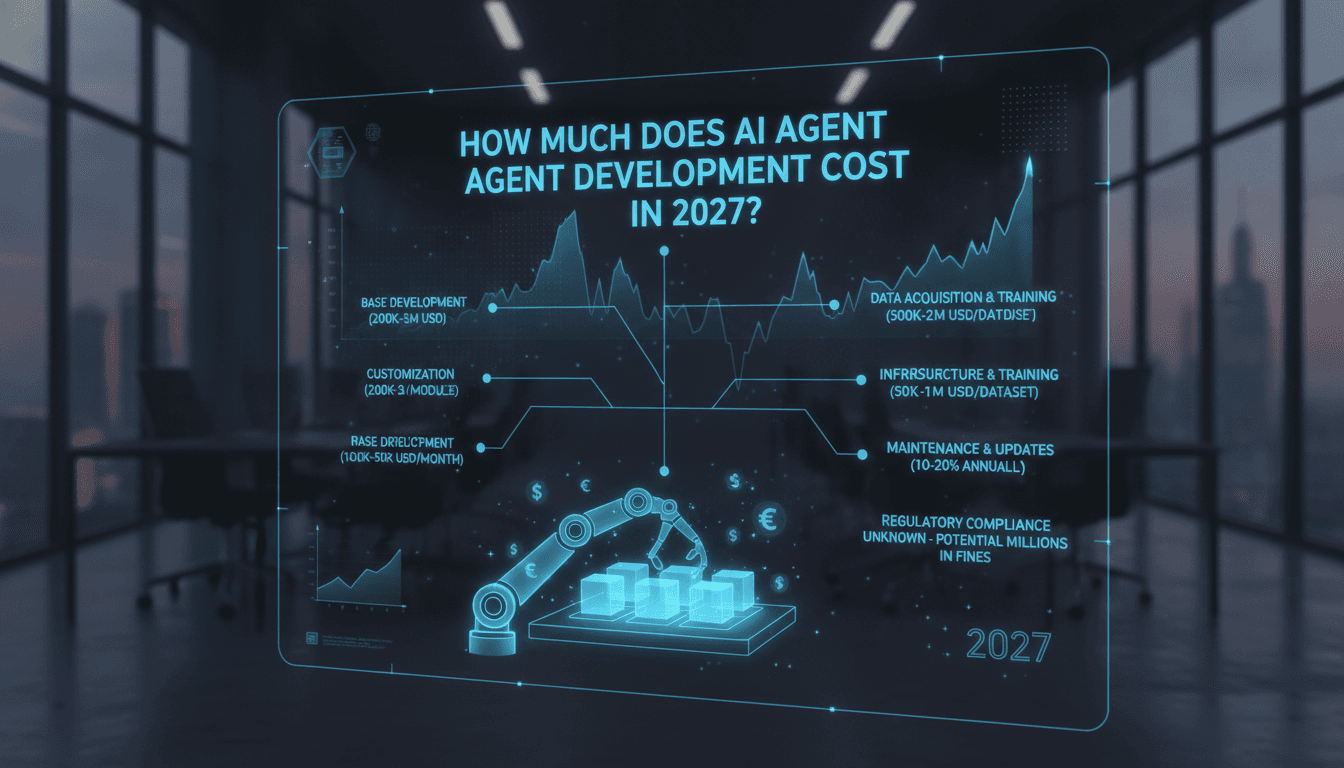
Pricing AI agent work is harder than pricing a standard web application. The scope is fuzzier, the infrastructure costs are variable, and the difference between a prototype and a production-grade system is significant. Here is a practical breakdown of what actually drives cost in 2027, based on the kinds of systems engineers are building now.
What Is an AI Agent, Technically Speaking?
Before discussing cost, it helps to be precise about what is being built. An AI agent, in the sense most teams mean today, is a system that uses an LLM (typically GPT-4o, Claude 3.5 Sonnet, Gemini 1.5 Pro, or an open-source model like Llama 3.1) as a reasoning core, wraps it with a tool-calling loop, and connects it to external actions: APIs, databases, code execution environments, or other agents.
We cover a closely related subject in When an AI Agent Is the Wrong Answer.
The complexity tiers are roughly:
- Single-agent, single-tool: One model, one integration, narrow task scope. Think a support bot that can look up order status via one REST endpoint.
- Single-agent, multi-tool: One model orchestrating several tools, with memory (short-term via context window, long-term via a vector store like Pinecone or pgvector). This is where most production deployments sit in 2027.
- Multi-agent systems: Multiple specialised agents coordinating via a framework like LangGraph, AutoGen, or CrewAI. Higher capability ceiling, significantly higher engineering cost.
Each tier has a different cost profile. Conflating them is the most common reason for budget surprises.
What Actually Drives the Cost?
Model inference costs
Inference is a running cost, not a one-time fee. In mid-2027, GPT-4o runs at roughly $5 per million input tokens and $15 per million output tokens via the OpenAI API. Claude 3.5 Sonnet is comparable. If your agent processes 10,000 tasks per day, each requiring 2,000 tokens in and 500 tokens out, you are looking at $100/day in inference alone before any infrastructure. Open-source models self-hosted on AWS Inferentia2 or NVIDIA A10G instances can reduce this by 60–80%, but add DevOps overhead.
The token budget per task is therefore a core architectural decision, not an afterthought.
Orchestration and tooling complexity
A simple ReAct loop with two tools can be scaffolded in a day using LangChain or the OpenAI Assistants API. A stateful multi-step workflow with conditional branching, human-in-the-loop approval steps, retry logic, and audit trails is a different proposition entirely. Teams routinely underestimate this layer. The orchestration layer is where most of the engineering time actually goes.
Memory architecture
Short-term memory (in-context) is free but bounded by context window size. Long-term memory requires a retrieval pipeline: chunking strategy, embedding model (text-embedding-3-large at $0.13 per million tokens, or a self-hosted BGE model), a vector store, and a re-ranking step if precision matters. Building this properly takes 1–3 weeks depending on data volume and retrieval quality requirements.
Evaluation and testing infrastructure
This is the line item that gets cut first and causes the most pain later. LLM outputs are non-deterministic. You need an eval harness — typically using a framework like RAGAS, DeepEval, or a custom suite — to catch regressions when you swap model versions or change prompts. Budget at least 15% of total development time here if the agent is customer-facing.
Related reading: How to Make an App Like Gemini.
Integration depth
Connecting to an internal system via a well-documented REST API takes a day. Connecting to a legacy ERP with inconsistent data formats, rate limits, and no sandbox environment can take two weeks. The integration surface area is often the biggest variable in a real project.
Typical Cost Ranges in 2027
These are build costs, not including ongoing inference or hosting:
| System type | Typical build cost (USD) | Timeline |
|---|---|---|
| Single-agent, 1–2 tools, narrow scope | $8,000 – $20,000 | 3–6 weeks |
| Single-agent, 3–6 tools, with memory | $25,000 – $60,000 | 6–12 weeks |
| Multi-agent system, custom orchestration | $70,000 – $200,000+ | 3–6 months |
| Enterprise-grade with eval, observability, RBAC | $150,000 – $400,000+ | 5–9 months |
These ranges assume a team of 2–4 engineers. Costs shift significantly based on geography, seniority mix, and whether you are using a fixed-scope contract or time-and-materials.
/// Not sure where to start?
Get the architecture before you commit
Tell us what you're building and we'll map the technical approach, stack, and rough timeline. No cost, no obligation, no sales call required.
Should You Build In-House or Outsource?
This depends on two things: how central the agent is to your product, and how mature your ML engineering capability is.
If the agent is your product (or a core differentiating feature), you want the IP and iteration speed that comes with an in-house team. The trade-off is that hiring ML engineers with agent development experience in 2027 is expensive. A mid-senior ML engineer in Bengaluru costs ₹30–50 LPA. In London or San Francisco, $160,000–$220,000 per year.
For a closer look at a related topic, read our guide on What an AI Feature Costs After Launch.
If the agent is an internal productivity tool or a well-defined workflow automation, outsourcing to a specialist team is usually faster and cheaper on a total-cost basis. A good external team brings reusable infrastructure (eval harnesses, deployment templates, observability tooling) that would take an in-house team months to build from scratch.
The honest answer: most teams should outsource the first version, build internal capability in parallel, and take ownership after the first production deployment. The learning curve is steep but not infinite.
What Does Ongoing Maintenance Actually Cost?
This is underbudgeted more often than the build cost.
Model providers release new versions frequently. GPT-4o has had four minor version updates in 2025 alone. Each update can change agent behaviour in subtle ways. You need someone running evals against new model versions before you upgrade. Budget one engineer-day per month at minimum for model version management.
Prompt drift is real. As your data or user behaviour changes, prompts that worked well degrade. Monitoring with a tool like LangSmith, Langfuse, or Helicone, and acting on what you see, is ongoing work.
Expect ongoing maintenance to run at 15–25% of the initial build cost per year for a production system.
Conclusion
AI agent development cost in 2027 is highly variable, but the variables are knowable. Define the tier (single-agent vs. multi-agent), scope the integrations honestly, and budget for eval infrastructure from day one rather than treating it as optional. The inference cost model matters as much as the build cost if you are running at any meaningful scale.
If you are scoping a system now, the most useful first step is writing down the exact task the agent needs to complete, the tools it needs to call, and what "correct" looks like. That document will tell you more about cost than any rate card.
FAQ
How long does it take to build a production-ready AI agent? A narrow single-agent system with two or three tools can reach production in four to six weeks. A multi-agent system with custom orchestration, memory, and evaluation infrastructure typically takes three to six months. The evaluation and observability layer often adds two to four weeks regardless of system complexity.
What is the biggest hidden cost in AI agent projects? Evaluation infrastructure. Teams skip it to ship faster, then spend months chasing regressions they cannot reliably reproduce. A proper eval harness using something like DeepEval or RAGAS, covering your key task types, saves far more time than it costs.
When should you use an open-source model instead of GPT-4o or Claude? When inference volume makes API costs unsustainable, or when data residency requirements prevent sending data to third-party providers. Self-hosting Llama 3.1 70B on AWS requires real DevOps capacity, but can cut per-token costs by 60–80% at scale.
Is multi-agent always better than single-agent? No. Multi-agent systems add coordination overhead, new failure modes, and significantly higher engineering cost. Use multi-agent when a single model genuinely cannot hold the full task context, or when parallel execution across specialised agents produces measurably better outcomes. Default to single-agent first.
What should a CTO ask an AI agent development firm before signing a contract? Ask how they handle model version updates in production, what their eval process looks like, and whether they use observability tooling like LangSmith or Langfuse. A team without clear answers to those questions will deliver a prototype, not a maintainable system.
Have a project in mind? Contact Sodio Technologies to discuss your requirements and explore the right technology solution for your business.
/// Work with us
Talk to the engineers who'd build it
You'll get a technical scope, timeline and cost estimate from the people doing the work, not an account manager. In-house team, no subcontracting, since 2016.