

How to Develop Scalable Web Applications with React.js
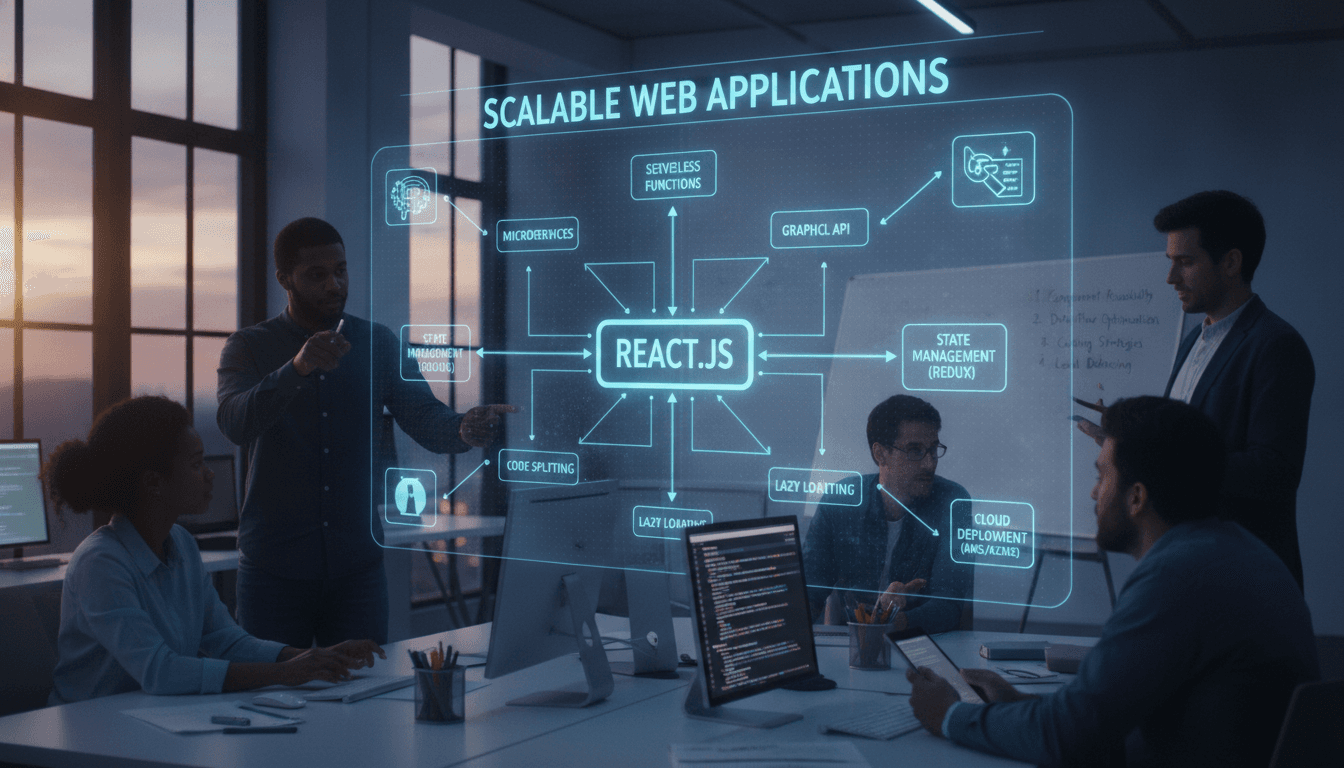
React.js has become the default choice for teams building complex web interfaces. But picking the library is the easy part. Scaling it — across teams, across traffic spikes, across years of feature additions — is where most projects run into trouble.
This post covers the architectural decisions that matter when you're building a React application you expect to still be maintaining in three years.
What Does "Scalable" Actually Mean in a React Context?
Scalability in React is not just about handling more users. It means the codebase can absorb new engineers without a six-week onboarding, that adding a feature in one module does not break three others, and that the UI remains performant as the component tree grows to several hundred nodes.
There are two axes to think about: runtime scalability (how the app performs under load) and development scalability (how the codebase behaves as the team and feature set grow). Most teams optimise for one and neglect the other.
Project Structure and State Architecture
The single biggest predictor of long-term maintainability is how you organise files and state from day one.
Feature-First Over Layer-First
A layer-first structure puts all components in one folder, all hooks in another, all services in another. It works for small apps. Once you have thirty-plus features, it becomes a navigation problem. Every change requires jumping across four directories.
Feature-first collocates everything a feature needs — its components, hooks, API calls, and local state — in one directory. You can delete a feature by deleting one folder. You can hand a feature to a new engineer with a clear boundary.
A structure worth following is the one popularised by the Bulletproof React reference architecture:
src/
  features/
    auth/
      components/
      hooks/
      api/
      stores/
    dashboard/
      ...
  shared/
    components/
    hooks/
    utils/
Shared code lives in src/shared. Feature code lives in src/features. The rule is simple: a feature can import from shared, but features must not import from each other directly. Cross-feature communication goes through global state or URL params.
Choosing a State Management Strategy
Redux Toolkit is still the right answer when you have complex, shared, server-synchronised state across many features. If your state is mostly server state with minimal local UI state, React Query (TanStack Query v5) or SWR removes a large amount of boilerplate and handles caching, background refetching, and optimistic updates out of the box.
A common pattern that works well: use TanStack Query for all server state, Zustand for lightweight global UI state (modal open/closed, sidebar collapsed), and React's own useState/useReducer for component-local state. This keeps global state minimal and explicit.
| Scenario | Recommended Tool |
|---|---|
| Server data, caching, pagination | TanStack Query v5 |
| Lightweight global UI state | Zustand |
| Complex shared business logic | Redux Toolkit |
| Component-local state | useState / useReducer |
How Do You Keep a Large React App Performant?
Performance degrades gradually. No single change tanks the app — it's the accumulation of unnecessary re-renders, unoptimised bundle sizes, and synchronous blocking work.
Code Splitting and Lazy Loading
React 18 and Next.js 14 both provide first-class support for code splitting. Use React.lazy and Suspense to split at the route level at minimum. If you're on Next.js, the next/dynamic import with { ssr: false } handles client-only heavy components like rich text editors or chart libraries.
The goal is an initial JS bundle under 200 kB compressed. Every kilobyte over that costs time on a mid-range Android device on a 4G connection.
Memoisation — Use It Surgically, Not Everywhere
React.memo, useMemo, and useCallback all come with overhead. Wrapping everything in them is a common mistake. Profile first with React DevTools Profiler. Memoisation is warranted when a component renders frequently and its props are stable, or when a computation inside a render is genuinely expensive (above roughly 1ms).
The React 19 compiler (stable as of early 2025) handles a large portion of automatic memoisation. If you're on React 19, your first step should be enabling the compiler before manually adding memo calls.
Virtualisation for Long Lists
If you're rendering lists with more than 100 items, use a windowing library. TanStack Virtual is the current best option — it supports both fixed and variable row heights and integrates cleanly with TanStack Query for infinite scroll patterns.
/// Not sure where to start?
Get the architecture before you commit
Tell us what you're building and we'll map the technical approach, stack, and rough timeline. No cost, no obligation, no sales call required.
How Should You Structure API Communication?
Centralise API communication in a dedicated layer. Do not scatter fetch calls across components. A clean approach is a typed API client generated from your OpenAPI spec using openapi-typescript or orval. This gives you type-safe API calls with zero manual interface maintenance.
If your backend is GraphQL, Apollo Client v3 or urql are both solid options. Apollo's normalised cache is powerful but adds complexity. urql is lighter and easier to reason about for most use cases.
For error handling, define a consistent error shape at the API boundary and handle it in one place. A custom Axios interceptor or a TanStack Query onError global handler avoids duplicating error logic in every query.
Testing Strategy That Doesn't Slow You Down
The classic mistake is investing heavily in Enzyme-style component unit tests that test implementation details. They break on every refactor and give false confidence.
A more durable approach:
- Integration tests with React Testing Library: test what the user sees and does, not internal component state
- End-to-end tests with Playwright: cover critical user journeys (login, checkout, form submission) — aim for 20 to 40 key flows, not exhaustive coverage
- Unit tests: for pure utility functions, custom hooks in isolation, and complex business logic
A 60/30/10 split across integration, E2E, and unit tests is more maintainable than an inverted pyramid. Playwright's component testing mode is also worth evaluating if you want component-level tests that run in a real browser.
Deployment, Monitoring, and Keeping It Running
Static React apps deploy well to Vercel, Cloudflare Pages, or AWS S3 with CloudFront. Next.js apps need a Node runtime — Vercel is the path of least resistance, but AWS App Runner or a containerised deployment on ECS gives you more control over infra costs at scale.
On the monitoring side, integrate Sentry for error tracking from day one. The React error boundary integration is straightforward, and Sentry's session replay (now available on the Team plan) is useful for debugging production issues that are hard to reproduce locally.
Track Core Web Vitals using the web-vitals library, and send metrics to your analytics pipeline. A Largest Contentful Paint above 2.5 seconds is a signal to look at image optimisation and render-blocking resources. An Interaction to Next Paint above 200ms typically points to long tasks on the main thread.
Conclusion
A scalable React application is a product of consistent decisions made early: feature-first structure, a clearly defined state management strategy, lazy loading from the start, and a centralised API layer. The patterns exist and are well-documented. The hard part is enforcing them as the team grows.
If you are starting a new React project or refactoring an existing one that has become hard to maintain, a short architecture review at the outset will save significant time later. At Sodio, we have worked through these decisions across production applications in fintech, healthtech, and logistics. If you want to talk through the right approach for your system, get in touch.
FAQ
Q: Should I use Next.js for every React project? Next.js adds server-side rendering, file-based routing, and a build pipeline on top of React. It is the right default for most production web apps. For internal dashboards or SPAs with no SEO requirement, Create React App alternatives like Vite with a plain React setup are lighter and simpler to manage.
Q: When is React the wrong choice? If your team is small, the app is mostly static content, and interactivity is limited, plain HTML with minimal JavaScript will outperform React in every metric. React's complexity pays off when you have a large interactive UI with shared state across many components. For simple marketing sites, it is often overkill.
Q: How do I handle authentication state across a React app? Store the access token in memory (not localStorage) and use a refresh token in an httpOnly cookie. On refresh, your auth provider issues a new access token. Use React Context or Zustand to expose the auth state globally, and protect routes with a wrapper component that checks the auth state before rendering.
Q: What is the right way to share code between a React web app and a React Native app? A monorepo with Turborepo or Nx is the standard approach. Shared business logic, hooks, and API clients can live in a shared package. UI components cannot be shared directly since React Native uses a different renderer, but design tokens, validation schemas, and data-fetching logic transfer cleanly.
Q: How many engineers does a React codebase need before you need a module boundary system? Around four to six engineers working on the same repository. Below that, informal conventions usually hold. Beyond that, overlapping ownership causes merge conflicts and unintended side effects. At that point, enforce module boundaries with ESLint rules (eslint-plugin-boundaries or NX's built-in module boundaries) to make cross-feature imports explicit violations.
Have a project in mind? Contact Sodio Technologies to discuss your requirements and explore the right technology solution for your business.
/// Work with us
Talk to the engineers who'd build it
You'll get a technical scope, timeline and cost estimate from the people doing the work, not an account manager. In-house team, no subcontracting, since 2016.