
How to Make an App Like Angry Birds
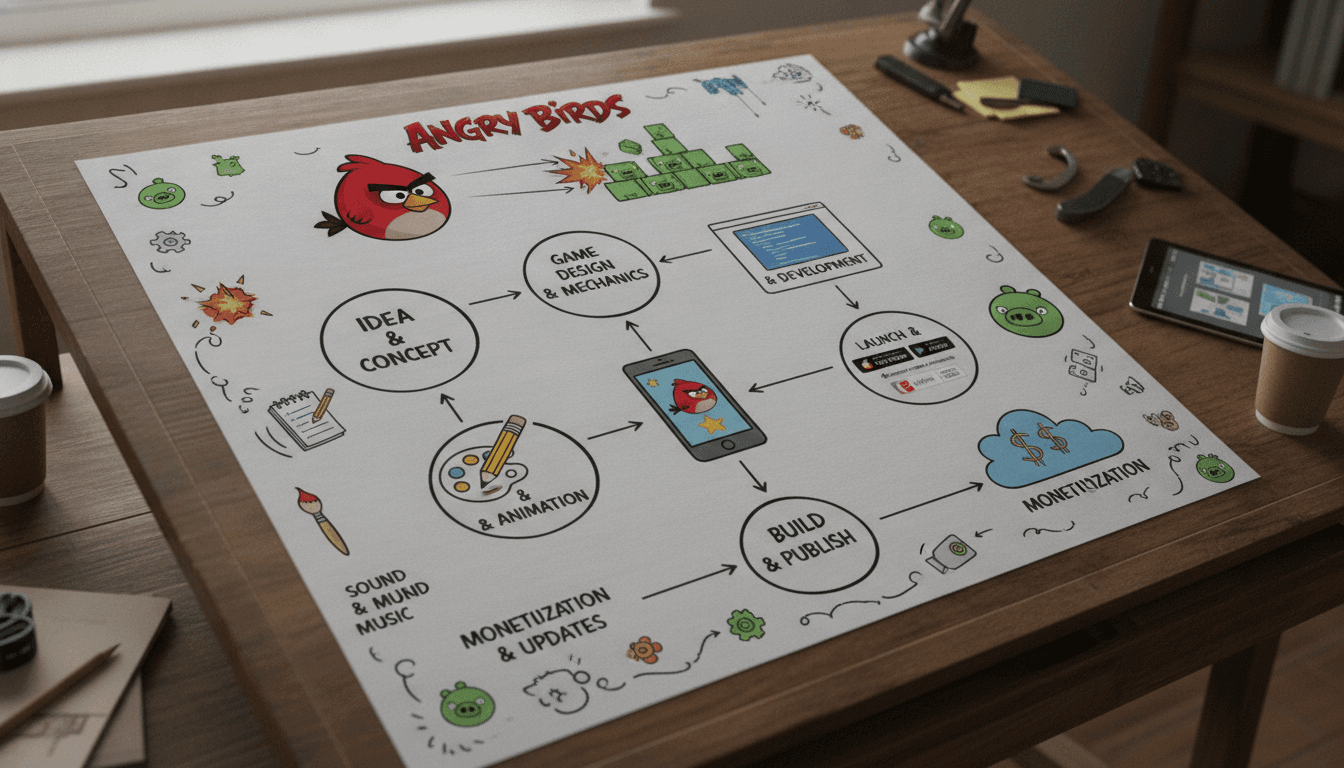
Building a physics-based mobile game from scratch is one of the more honest tests of a studio's engineering depth. Angry Birds looks simple — tap, drag, release, watch things fall. Under the hood it is anything but.
What Actually Makes Angry Birds Work?
The game's feel comes from three systems working in tight coordination: a physics engine, a renderer, and an input pipeline. Get any one of them wrong and the whole thing feels off. Players notice immediately, even if they cannot articulate why.
Related reading: How to Make an App Like AR Dragon.
The Physics Engine
Angry Birds runs on Box2D, a 2D rigid-body physics library originally written in C++ by Erin Catto. It handles collision detection, restitution (bounciness), friction, and joint constraints. The original Rovio title used a custom fork of Box2D tuned for mobile performance on the hardware of 2009.
If you are building today, you have a few credible paths:
| Engine | Physics Backend | Language | Notes |
|---|---|---|---|
| Unity | PhysX (3D), Box2D (2D) | C# | Fastest to prototype; large asset store |
| Godot 4 | GodotPhysics / Jolt | GDScript, C# | Open source; smaller community |
| Custom C++ | Box2D 3.0 | C++ | Full control; highest effort |
| Cocos2d-x | Box2D | C++ / Lua | Mature mobile game framework |
For a game with Angry Birds' interaction model, Unity's 2D physics with Box2D is the practical starting point. You get deterministic enough behaviour, good tooling, and a large pool of engineers who know the stack.
The Renderer and Art Pipeline
Angry Birds uses sprite-based rendering. Each object, bird, pig, block, background layer, is a pre-rendered image composited in real time. The parallax scrolling background (typically three to five layers moving at different speeds) creates perceived depth cheaply.
Unity's Universal Render Pipeline (URP) handles this well. Keep draw calls low. On mid-range Android hardware, aim to stay under 100 draw calls per frame. Sprite atlases (packed texture sheets) are the standard tool for this. TexturePacker is the most widely used external tool; Unity's own Sprite Atlas API works too.
How Do You Build the Slingshot Mechanic?
This is the core interaction. It looks trivial. The implementation has real edge cases.
The slingshot is a spring joint in physics terms. The player drags the bird back from an anchor point; releasing it applies an impulse proportional to pull distance and direction.
In Box2D / Unity 2D Physics terms:
- On touch-down, disable the bird's Rigidbody2D and parent it to a drag handle.
- Clamp the drag vector to a maximum radius (Rovio used roughly 1.5× the bird sprite width as a visual guide).
- On touch-up, re-enable physics and apply
AddForceusing the negated, scaled drag vector as an impulse. - The launch angle and power are read directly from that vector. No separate power meter needed.
The clamp matters more than most engineers expect. Without it, players fling birds at unintended angles from extreme drag positions, and hit detection becomes erratic.
Trajectory preview (the dotted arc) is a projectile motion calculation, not a physics simulation. Use the kinematic equations: x = v₀ₓt, y = v₀ᵧt - ½gt². Render 20 to 30 points along the arc. Recalculate every frame during drag. Do not run a physics simulation for the preview — it is too expensive and unnecessary.
/// Not sure where to start?
Get the architecture before you commit
Tell us what you're building and we'll map the technical approach, stack, and rough timeline. No cost, no obligation, no sales call required.
What Does the Destruction System Actually Require?
Angry Birds' destruction is its most satisfying feature and its most expensive to build correctly.
Each destructible block (wood, stone, glass) has a health value. Collision impact is calculated from impulse magnitude. Box2D exposes this through the OnCollisionEnter2D callback in Unity, specifically via ContactPoint2D.normalImpulse. Apply damage proportional to that value.
Structural materials behave differently:
- Glass breaks easily, low health threshold (~20 impulse units in your normalised scale).
- Wood takes moderate damage; splinters on destruction (spawn particle sprites, play audio).
- Stone is resistant and usually requires multiple hits.
Full procedural fracturing (like what you see in games using Voronoi fracture) is expensive and hard to keep deterministic. Rovio used pre-authored destruction states: an intact sprite, a damaged sprite (cracks), and a destroyed state (rubble sprites). This is the right call for most studios. It gives you authorial control over how things look when broken, keeps performance predictable, and the player cannot tell the difference.
We cover a closely related subject in How to Make an App Like Subway Surfers.
Level data should be stored in structured data files, JSON or a custom binary format, not hardcoded. Each level defines object type, position, rotation, and material. This decouples level design from engineering. A non-engineer designer can add levels without touching code.
How Do You Handle the Mobile-Specific Challenges?
Touch input on Android and iOS has different latency characteristics. Input lag on mid-range Android can be 80 to 120 ms. Design the drag mechanic so it feels responsive even with that lag by snapping the bird position directly to the touch point rather than interpolating.
Battery and thermal throttling are real on mobile. Box2D's simulation step should run at a fixed 60 Hz using Unity's FixedUpdate. Your render rate can drop to 30 FPS on thermal-throttled devices; decouple simulation from render to avoid physics breaking at lower frame rates.
Memory is the other constraint. Keep your texture atlases under 2048×2048 per sheet; many mid-range devices still choke on 4096×4096. Compress sprites using ASTC on iOS and ETC2 on Android. Unity's platform-specific texture compression settings handle this per build target.
Audio should use FMOD or Unity's built-in AudioMixer. Compress sound effects to Ogg Vorbis (Android) and AAC (iOS). Keep the total audio memory footprint under 50 MB for a casual game.
Monetisation Architecture
Angry Birds has gone through several monetisation models: paid upfront, freemium with power-ups, and ad-supported. Each has engineering implications.
If you are building ad-supported, integrate a mediation layer from day one. Google AdMob and Unity LevelPlay (formerly ironSource) both offer mediation. Do not integrate individual ad SDKs directly — mediation lets you waterfall or auction between networks and change strategy without code changes.
For in-app purchases, use Unity IAP for cross-platform receipt validation. Do server-side receipt validation regardless of platform. Client-side validation is trivially bypassed.
Related reading: How to Make an App Like Candy Crush.
Conclusion
Building a physics-based puzzle game at Angry Birds' level of polish requires getting four things right: a well-tuned physics setup, a responsive input pipeline, authored destruction states, and a mobile build that respects thermal and memory constraints.
Start with Unity and Box2D. Get the slingshot mechanic feeling right before you build anything else — if that feels off, nothing downstream will save it. Once the core loop is solid, layer in destruction, audio, and monetisation.
If you want to talk through the architecture for your specific game concept, reach out to the team at Sodio.
FAQ
How long does it take to build a game like Angry Birds? A production-quality physics-based puzzle game with 30 to 50 levels, polished art, and a working monetisation layer takes roughly 9 to 14 months for a team of five to seven people. A playable prototype of the core mechanic can be done in four to six weeks by two engineers.
Which game engine should I use for an Angry Birds-style game? Unity with its 2D Physics (Box2D backend) is the most practical choice for most teams. Godot 4 is a credible alternative if you want an open-source stack. Custom C++ with Box2D makes sense only if you have specific performance targets or platform constraints that Unity cannot meet.
How does the trajectory preview arc work?
It uses kinematic equations, not a live physics simulation. Given the launch velocity vector, you compute 20 to 30 positions along a parabolic path using y = v₀ᵧt - ½gt² and render dots at those positions. It recalculates every frame during the drag gesture and costs very little computationally.
What makes the destruction mechanic feel satisfying? Impulse-based damage thresholds, distinct visual states per damage level, and matched audio cues. The player needs immediate feedback at each hit. Pre-authored destruction sprites with particle effects and impact sounds do more for feel than procedural fracturing, and they are significantly cheaper to build and run.
Can you build this for both iOS and Android at once? Yes. Unity targets both platforms from a single codebase. The main differences are texture compression formats (ASTC vs ETC2), audio codec preferences, and IAP/ad SDK configuration. Plan for separate QA passes on each platform, particularly for input latency and thermal performance on lower-end Android devices.
Have a project in mind? Contact Sodio Technologies to discuss your requirements and explore the right technology solution for your business.
/// Work with us
Talk to the engineers who'd build it
You'll get a technical scope, timeline and cost estimate from the people doing the work, not an account manager. In-house team, no subcontracting, since 2016.