

How to Make an App Like AR Dragon
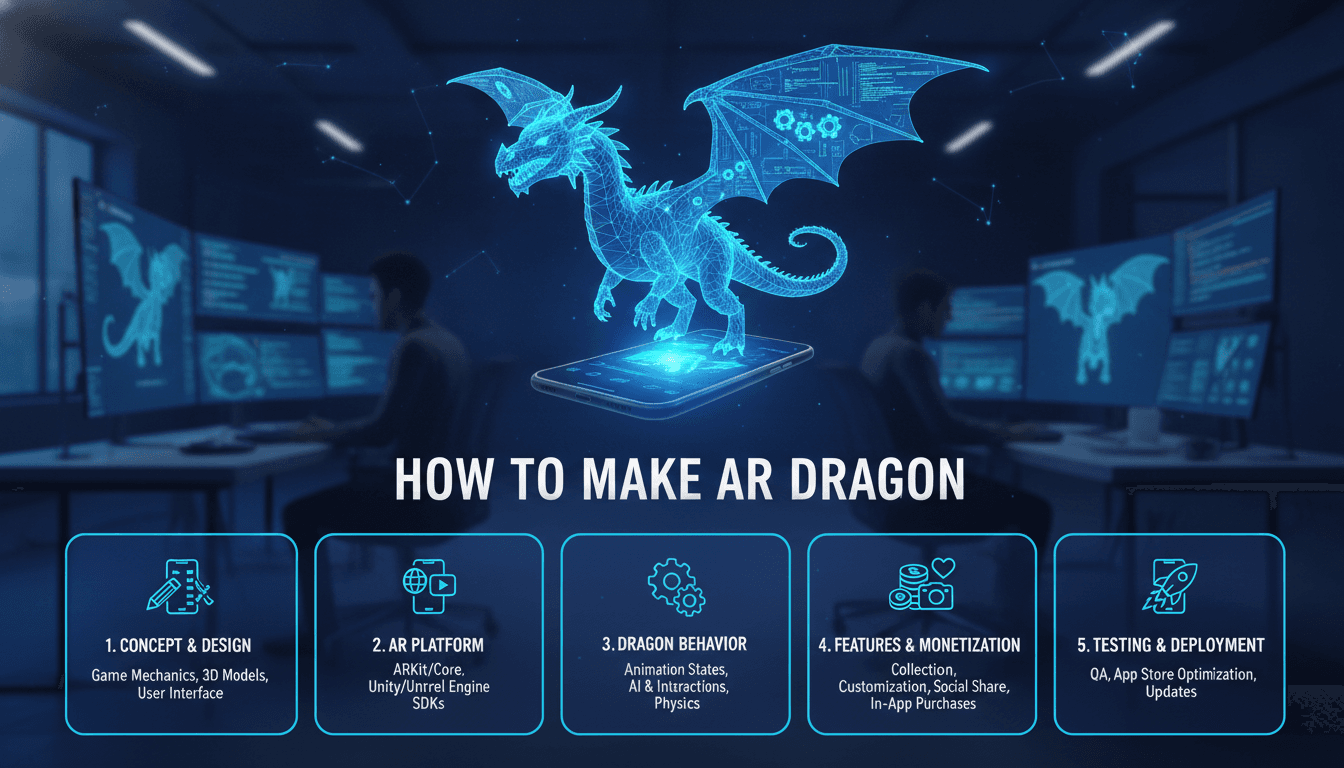
How to Make an App Like AR Dragon
AR Dragon took a simple idea — raise a virtual pet that lives in your living room — and turned it into one of the most downloaded augmented reality games on mobile. Players hatch an egg, feed and play with their dragon, watch it grow through life stages, and photograph it sitting on their coffee table. It's charming, low-friction, and technically approachable if you plan it properly.
This guide breaks down what it actually takes to build an AR virtual pet app: the features, the tech stack, the 3D and animation work, the monetisation model, and the realistic budget and timeline.
Related reading: How to Make an App Like Subway Surfers.
What Makes AR Dragon Work
Before writing a line of code, it's worth understanding why the app succeeded. Three things stand out:
Emotional attachment through routine. The dragon needs food, water, and attention. Small daily interactions create habit loops without feeling like a chore.
Progression that's visible. The dragon physically changes as it levels up — bigger, more detailed, new abilities. Players can see their investment.
Shareability. AR screenshots of a dragon in a real environment are inherently social. Every photo a user takes is free marketing.
Any clone that ignores these pillars will feel like a tech demo rather than a game.
Core Feature Set
Minimum Viable Product
- Egg hatching onboarding — a tactile first interaction (tap or swipe to crack the shell) that teaches AR placement implicitly
- AR surface detection and placement — the pet anchors to a real-world plane and stays put as the user walks around
- Pet stats — hunger, thirst, happiness, energy, decaying over real time
- Feeding and care interactions — drag-and-drop food items, petting gestures, cleaning
- Growth stages — at least three or four visually distinct evolutions
- Mini-games — simple tap or aim games that earn currency and raise happiness
- AR photo mode — capture, filters, and native share sheet
- Soft currency and shop — food, toys, accessories, skins
Phase Two Features
- Multiple pet species or breeds
- Pet customisation (colours, patterns, hats, collars)
- Cloud save and cross-device sync
- Push notifications for care reminders
- Achievements and daily login rewards
- Non-AR mode for devices without ARKit/ARCore support
- Multiplayer or social features — visiting friends' pets, trading, co-op mini-games
Ship the MVP. Resist the temptation to launch with breeding mechanics and a friend system on day one.
Choosing Your Tech Stack
Game Engine
Unity is the pragmatic default. It has mature AR tooling via AR Foundation, which wraps ARKit (iOS) and ARCore (Android) behind a single API, so you write placement and tracking logic once. The Asset Store also shortens the path to shaders, particle effects, and animation tools.
Unreal Engine offers better out-of-the-box visual fidelity and Blueprints for rapid prototyping, but the build sizes are heavier and mobile AR support is less battle-tested than Unity's.
Native (RealityKit / ARCore + SceneKit or Filament) gives you the smallest binaries and tightest platform integration, but you build and maintain two codebases. Only worth it if AR is a feature inside a larger native app.
For a standalone AR pet game, Unity with AR Foundation and the Universal Render Pipeline is the recommendation.
Supporting Services
| Need | Options |
|---|---|
| Auth and cloud save | Firebase Auth, Firestore, PlayFab |
| Analytics | Firebase Analytics, GameAnalytics, Amplitude |
| Push notifications | Firebase Cloud Messaging, OneSignal |
| Ads | AdMob, Unity Ads, IronSource mediation |
| In-app purchases | StoreKit, Google Play Billing, or Unity IAP as a wrapper |
| Remote config / A-B testing | Firebase Remote Config, PlayFab |
| Crash reporting | Crashlytics, Unity Cloud Diagnostics |
The 3D and Animation Work
This is where most AR pet projects underestimate effort. The dragon is the product.
Modelling. Build a low-to-mid poly model — realistically 8k to 20k triangles for the largest growth stage on mobile. Use a single texture atlas where possible to keep draw calls low.
Rigging. A skeletal rig with proper weight painting for the neck, wings, and tail. Blend shapes for facial expressions pay off enormously in perceived personality.
Animation library. Budget for far more clips than you'd expect:
- Idle variations (three or four, so it never looks frozen)
- Walk, run, turn
- Eat, drink, sleep, wake
- Happy, sad, angry, curious reactions
- Fly or hover, if applicable
- Growth or evolution transition
- Mini-game specific actions
LODs and scaling. Each growth stage needs its own model or a well-planned scaling and morphing system. Level-of-detail meshes keep frame rates stable.
Shaders. Mobile-friendly PBR with baked lighting. Use AR light estimation so the dragon's lighting roughly matches the real room — it's the single biggest contributor to believability.
AR Implementation Details
Plane Detection and Anchoring
Use horizontal plane detection to find floors and tables. Show a visual reticle that snaps to detected surfaces and only enable the "place" action when tracking confidence is good. Once placed, attach the pet to an ARAnchor so it doesn't drift.
You may also find our article on How to Make an App Like JigSpace useful.
Occlusion and Grounding
Two cheap wins that massively improve realism:
- Soft shadow blob or a projected shadow onto the detected plane
- People occlusion (available on newer iOS devices) so a user's hand can pass in front of the dragon
Handling Tracking Loss
Users will point the camera at a blank wall. Detect tracking state changes and show a friendly overlay ("Move your phone slowly to find a surface") rather than letting the pet jitter or teleport.
Scale and Comfort
Let users resize the pet with a pinch gesture. A dragon rendered at true-to-life scale in a small apartment is unusable.
Non-AR Fallback
A meaningful percentage of Android devices don't support ARCore. Build a simple 3D room scene as a fallback so those users can still play. Gate AR-only features rather than blocking the whole app.
We cover a closely related subject in How to Make an App Like VR Karts.
Game Design and Economy
Stat Decay Tuning
Stats should decay slowly enough that a user who checks in once or twice a day never finds a dead or miserable pet, but fast enough to create a reason to return. Never actually let the pet die — it's a permanent churn event. Let it get sad and sleepy instead.
Compute decay server-side or from timestamps, not from local ticks, or players will trivially cheat by changing the device clock.
Currency Design
Run a two-currency system:
- Soft currency (coins) earned from mini-games, daily logins, and care actions
- Hard currency (gems) purchased with real money, or earned slowly
Price shop items so a patient free player can eventually get most cosmetics, while a paying player gets them immediately.
Monetisation Mix
- Rewarded video ads — the workhorse. "Watch an ad for a free meal" or "double your mini-game coins." Highest-performing and least resented format.
- Interstitials — sparingly, after mini-game sessions only.
- IAP currency packs — tiered from roughly $0.99 to $49.99.
- Cosmetic bundles — skins, hats, environments. Pure margin, no balance impact.
- Ad-removal / premium unlock — a one-time purchase that also grants a starter bundle.
- Battle pass or season pass — worth considering post-launch once retention data exists.
Performance and Battery
AR is brutal on phones. The camera, the tracking subsystem, and the renderer all compete for the same thermal envelope.
- Target 30 FPS in AR mode, not 60
- Cap texture resolutions and use compressed formats (ASTC)
- Keep the visible poly count and draw call count tight
- Reduce update frequency for non-critical logic
- Pause rendering when the app loses focus
- Test on mid-range and three-year-old devices, not just flagships
Users will abandon an app that turns their phone into a hand warmer in four minutes.
Privacy and Compliance
AR apps request camera access, and virtual pet games attract children. Both raise obligations.
- Write a clear camera permission rationale before the system prompt appears
- Never upload camera frames unless a feature genuinely requires it, and say so explicitly
- If targeting kids, comply with COPPA (US), GDPR-K (EU), and Google Play's Families policy
- Use age gating, and serve only child-appropriate ad content to under-13 users
- Complete Apple's App Privacy questionnaire and Google Play's Data Safety form accurately
Realistic Timeline and Budget
Rough ranges for an outsourced or small in-house team:
| Phase | Duration |
|---|---|
| Discovery, design, art direction | 2–3 weeks |
| 3D modelling, rigging, animation | 5–8 weeks |
| Core AR and gameplay development | 8–12 weeks |
| Backend, IAP, ads, analytics | 3–4 weeks |
| QA, device testing, optimisation | 3–4 weeks |
| Store submission and launch | 1–2 weeks |
A polished MVP typically lands in the four-to-six month range with a team of a game developer, an AR/Unity specialist, a 3D artist/animator, a designer, a backend developer, and a QA engineer. Budgets vary enormously by region, but the art and animation line item is usually larger than clients expect — frequently 30–40% of total cost.
Common Mistakes to Avoid
- Treating art as an afterthought. The pet's personality is the product. A technically flawless app with a stiff, ugly dragon will fail.
- Requiring AR to play at all. You lose every unsupported device and every user on a bus.
- Overloading the MVP. Breeding, trading, PvP, and guilds can wait for version 1.3.
- Ignoring onboarding. Many users have never used an AR app. Teach plane scanning gently and visually.
- Aggressive ads too early. Interstitials in the first session destroy day-one retention.
- Skipping low-end device testing. Your performance budget is defined by the worst phone you support.
Launch and Growth
- Soft launch in one or two smaller English-speaking markets to tune retention and monetisation before a global push
- ASO around "virtual pet," "AR pet," "dragon game," with screenshots that show the pet in a real environment
- Creator outreach — AR pet content performs well on TikTok, YouTube Shorts, and Instagram Reels
- In-app share incentives — reward users with currency for sharing AR photos
- Live-ops cadence — seasonal events, limited-time skins, and new species keep a virtual pet game alive for years
Final Thoughts
An app like AR Dragon is technically accessible — AR Foundation has removed most of the hard tracking problems — but commercially demanding. The differentiator is character, polish, and a retention loop that respects the player's time. Build a small, beautiful, well-optimised pet first. Add the world around it once people prove they care about it.
If you're planning an AR virtual pet app and want help scoping the art pipeline, tech stack, or monetisation model, it's worth validating those decisions before development starts — they're far more expensive to change later.
Have a project in mind? Contact Sodio Technologies to discuss your requirements and explore the right technology solution for your business.
/// Work with us
Talk to the engineers who'd build it
You'll get a technical scope, timeline and cost estimate from the people doing the work, not an account manager. In-house team, no subcontracting, since 2016.