

How to Make an App Like Avis Car Rental
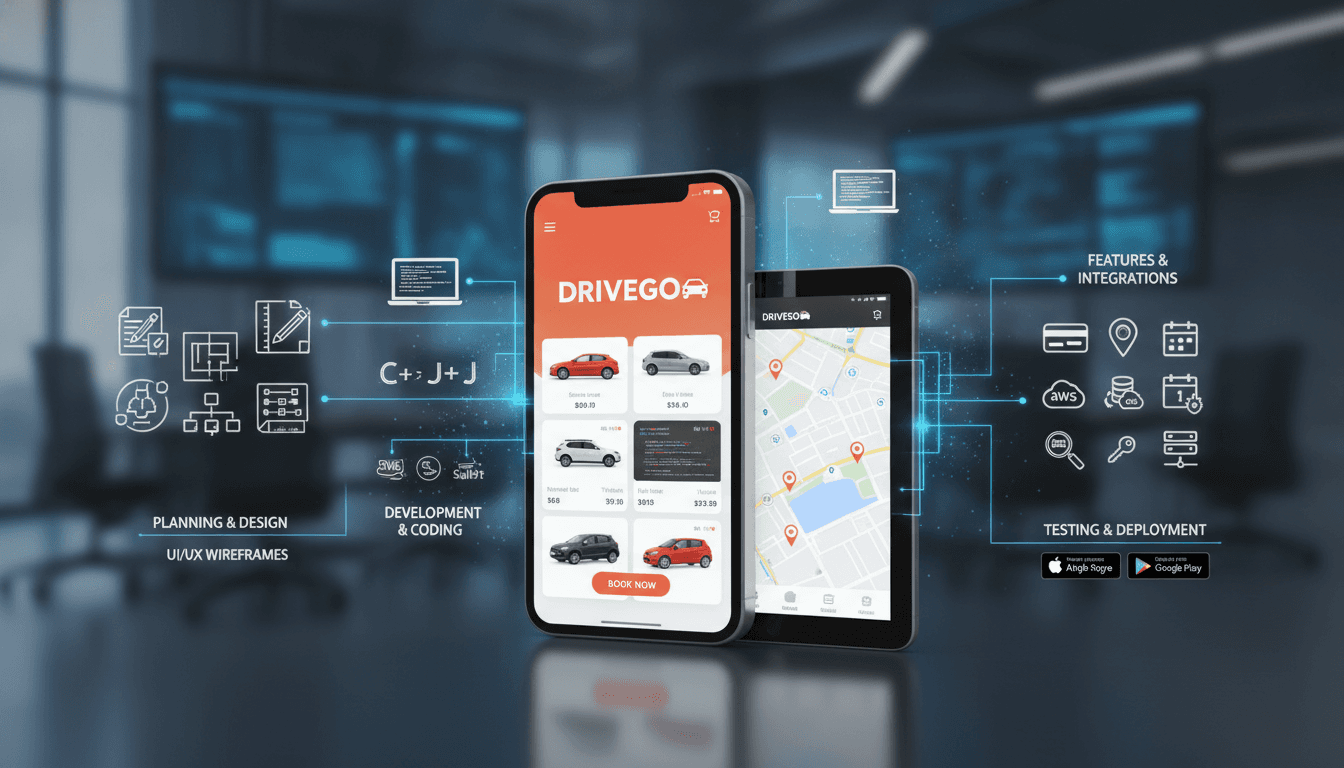
A practical breakdown of the architecture, feature set, and cost drivers behind a car rental app like Avis — written for engineering teams who need to scope and build one, not just read about it.
What Does an App Like Avis Actually Do Under the Hood?
The consumer-facing side of a car rental app looks simple: search, pick a car, pay, pick up, return. The backend is considerably less simple.
Related reading: How to Make an App Like HyreCar.
Avis and its peers run on a fleet management core that tracks vehicle availability, location, condition, and pricing across thousands of locations in real time. That core connects to a reservation engine, a payment processor, identity verification, telematics hardware in vehicles, and loyalty programme logic. Most large operators have legacy systems underneath all of this, often IBM or Oracle fleet management platforms that are 10–20 years old, wrapped in APIs to serve modern mobile clients.
If you're building from scratch, you're not recreating that legacy stack. You're making choices about which of those layers you own and which you buy.
You may also find our article on How to Make an App Like Turo useful.
The Core Modules You Must Build
These are non-negotiable if you want feature parity with a mid-tier rental platform:
- Inventory and fleet management: real-time vehicle availability by location, car category, and features (GPS, child seat, etc.)
- Reservation engine: date/time selection, pricing calculation, booking confirmation, modification, and cancellation flows
- Identity verification: driving licence scan and validation, sometimes age checks; typically a third-party API like Onfido or Jumio
- Payment processing: Stripe or Braintree for card payments; add a wallet layer if you want stored credit
- Damage and condition reporting: photo upload at pickup and return, timestamped and stored against a booking
- Notifications: push, SMS, and email at booking confirmation, pickup reminder, return reminder, and invoice
- Admin dashboard: fleet ops teams need to manage vehicle status, view bookings, handle disputes
Modules That Differentiate the Product
Avis has a few features that took years to build and genuinely affect retention:
- Avis Preferred: skip-the-counter pickup using a pre-registered profile and saved payment. This requires biometric or token-based auth tied to a verified identity record.
- Connected car integration: Avis uses telematics to track mileage, fuel level, and location via onboard diagnostics. If you want this, you're integrating with a telematics provider like Geotab or Samsara, or building a proprietary OBD-II interface.
- Dynamic pricing: rental rates that shift based on demand, lead time, location, and vehicle category. This is a pricing model problem before it's an engineering problem. Most teams start with rule-based pricing and move toward ML-driven pricing after they have 6–12 months of booking data.
What Tech Stack Should You Use?
There's no single correct answer, but here's what works well for this class of application.
Mobile: React Native if you want one codebase for iOS and Android and your team is JavaScript-heavy. Flutter if you want better rendering performance and are comfortable with Dart. Native Swift and Kotlin if any part of the app needs to talk directly to vehicle hardware or you have strict performance requirements on animations and maps.
Backend: Node.js or Python (FastAPI) for the API layer. PostgreSQL for transactional data (bookings, payments, user records). Redis for session management and availability caching. A message queue like RabbitMQ or AWS SQS for async jobs: sending notifications, processing damage reports, syncing fleet status.
Maps and location: Google Maps Platform for geocoding and place search. Mapbox if you want more control over the map style and offline tile caching. For real-time vehicle tracking, you need a WebSocket or Server-Sent Events layer feeding location data from the telematics system to the app.
Infrastructure: AWS or GCP. If you're deploying across multiple countries, you need to think about data residency early. GDPR in Europe means user data cannot be stored on servers outside the EEA without additional safeguards. That affects your database region choices from day one.
| Layer | Option A | Option B | When to choose A |
|---|---|---|---|
| Mobile | React Native | Flutter | JS team, faster MVP |
| API | Node.js / Fastify | Python / FastAPI | Event-heavy, real-time |
| Database | PostgreSQL | MySQL | Complex queries, JSONB support |
| Maps | Google Maps | Mapbox | Simpler integration |
| Telematics | Geotab API | Custom OBD-II | No hardware team |
/// Not sure where to start?
Get the architecture before you commit
Tell us what you're building and we'll map the technical approach, stack, and rough timeline. No cost, no obligation, no sales call required.
How Long Does It Take to Build, and What Does It Cost?
A realistic MVP, covering search, booking, payment, identity verification, and a basic admin dashboard, takes 4–6 months with a team of 6–8 engineers. That assumes you're using third-party APIs for identity verification and payment rather than building those capabilities yourself.
Full-featured parity with Avis Preferred, connected car integration, dynamic pricing, and a loyalty programme is a 12–18 month project at minimum. The scope creep usually comes from fleet operations requirements that the product team didn't anticipate: vehicle maintenance scheduling, damage claim workflows, insurance integration, and multi-currency support across regions.
Cost ranges depend heavily on team location and composition:
- Offshore team (India/Eastern Europe): $150,000–$350,000 for an MVP; $600,000–$1.2M for a full platform
- Blended team (offshore engineering, onshore product/design): add 30–40% to the above
- US/UK in-house team: multiply by 2.5–3x
These are build costs. Operating costs, cloud infrastructure, third-party API fees, and telematics hardware are separate and ongoing.
What Are the Biggest Technical Risks?
Availability sync latency. A car that appears available in the app must actually be available at that location. If your fleet status update pipeline has a 30-second lag, you get double-bookings. Solve this with event-driven architecture and optimistic locking on the reservation record, not polling.
Identity verification fraud. Driving licence OCR alone is not sufficient. Operators who skip biometric liveness checks see significantly higher fraud rates on accounts opened with stolen documents. Onfido's fraud detection suite or a similar provider is worth the per-verification cost.
Telematics reliability. OBD-II devices lose connectivity in underground car parks and rural areas. Your system needs to handle stale location data gracefully rather than showing incorrect vehicle positions or triggering false alerts.
Regulatory variation. Minimum driver age, insurance requirements, and data retention rules differ by country. If you're building for multiple markets, your data model needs to accommodate per-market rule sets from the start, not as a retrofit.
Should You Build In-House or Work With a Specialist Team?
If your core business is car rental operations and software is a means to that end, building an in-house engineering team to maintain a custom platform is expensive and slow. The ongoing talent cost of a 10-person engineering team maintaining a platform like this runs to $1.5M–$2.5M per year in a Western market.
If this is relevant to your project, check out How to Make an App Like Enterprise CarShare.
The argument for in-house is control: you can ship features without waiting on a vendor, you own the IP outright, and your engineers understand the domain deeply over time. That matters if you're competing on product differentiation rather than price or location density.
A middle path that works well in practice is building with a specialist team that transfers ownership. You get faster time to market, a team that has solved the same class of problems before, and a codebase you own. The risk is that the handover quality varies enormously between firms. Ask for the git history, the test coverage report, and the architecture decision records before you sign.
Conclusion
Building a car rental app is a well-understood problem with a lot of solved pieces. Identity verification, payments, and maps are commodity integrations. The real engineering challenges are fleet state synchronisation, telematics reliability, and building pricing logic that scales across markets.
If you're scoping this out right now, start with the data model. Get the booking, vehicle, and location schemas right before you write a line of application code. Everything else is recoverable; a bad data model costs you months to fix once you're in production.
Sodio has built location-aware, real-time booking systems across transport and logistics. If you want to talk through your architecture before you commit to a stack, get in touch.
FAQ
How much does it cost to build a car rental app like Avis? An MVP with core booking, payment, and identity verification typically costs $150,000–$350,000 with an offshore team, and 4–6 months to build. A full-featured platform with telematics, dynamic pricing, and loyalty features runs $600,000–$1.2M and takes 12–18 months. Western in-house teams cost 2.5–3x more.
What APIs do car rental apps use for identity verification? Onfido and Jumio are the most common choices. Both offer driving licence OCR, liveness detection, and document fraud scoring via REST APIs. Onfido charges per verification; pricing is volume-dependent but typically $2–$5 per check at scale. Skipping liveness checks noticeably increases fraud on new account creation.
Do I need to integrate telematics hardware to build a car rental app? Not for an MVP. You can build a fully functional booking and fleet management platform without telematics. Connected car features like real-time vehicle location, fuel level, and mileage tracking require either an OBD-II integration or a telematics provider like Geotab or Samsara. Add this in a later phase once core booking flows are validated.
What is the best tech stack for a car rental app? React Native or Flutter for mobile, depending on your team's language preference. FastAPI or Node.js for the API layer. PostgreSQL for transactional data, Redis for caching and sessions. Google Maps Platform or Mapbox for location features. AWS or GCP for infrastructure, with region selection informed by your target markets' data residency rules.
How do you handle double-bookings in a real-time vehicle availability system? Use optimistic locking on the reservation record in your database and process fleet status updates via an event-driven pipeline rather than polling. When a booking is confirmed, immediately mark the vehicle as unavailable in your availability cache and propagate that state update asynchronously. Polling intervals above 10–15 seconds are too slow for high-demand locations.
Have a project in mind? Contact Sodio Technologies to discuss your requirements and explore the right technology solution for your business.
/// Work with us
Talk to the engineers who'd build it
You'll get a technical scope, timeline and cost estimate from the people doing the work, not an account manager. In-house team, no subcontracting, since 2016.