

How to Make an App Like HyreCar
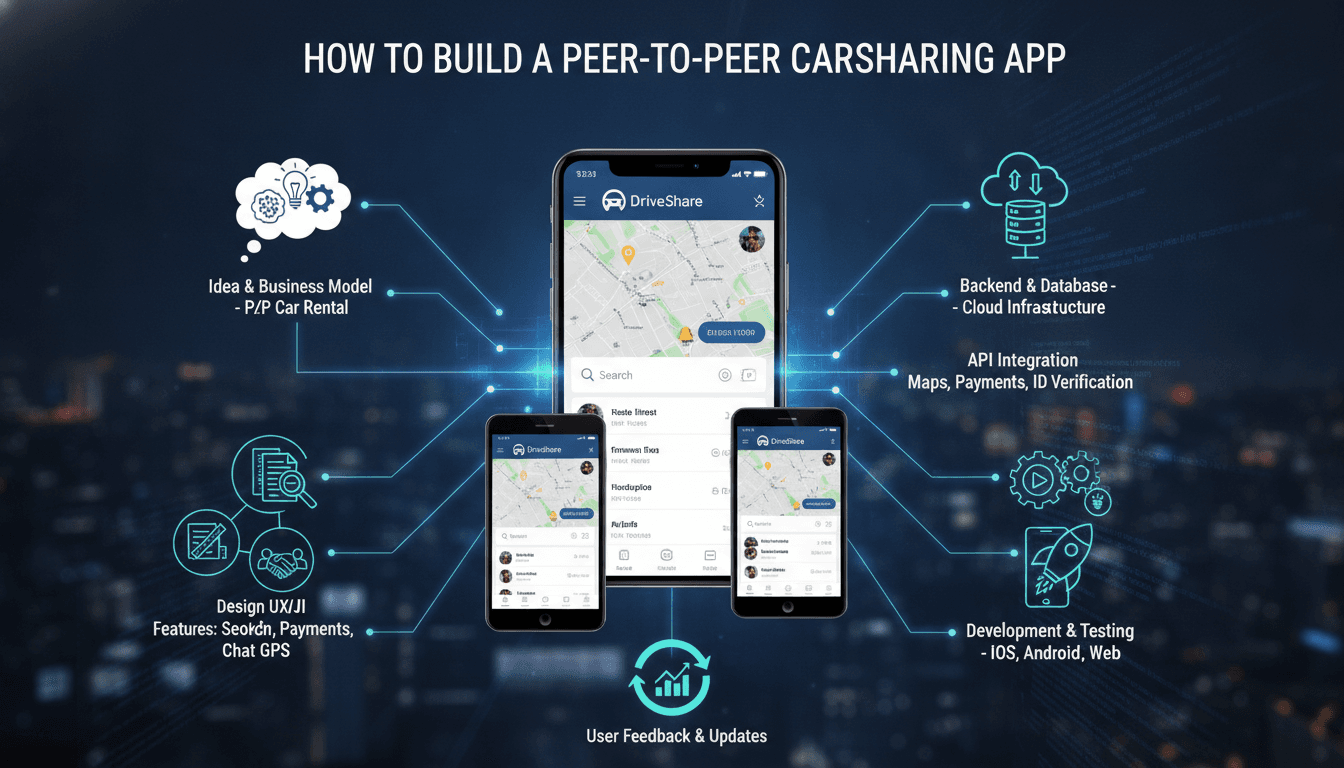
A practical breakdown of the architecture, cost drivers, and product decisions behind a peer-to-peer car rental platform — written for teams who are ready to build, not just evaluate.
What Does a Platform Like HyreCar Actually Do Under the Hood?
HyreCar sits at the intersection of two-sided marketplace logic and vehicle compliance. On one side, car owners list their vehicles. On the other, rideshare drivers who need a car — typically to drive for Uber or Lyft — rent those vehicles. The platform handles matching, insurance integration, identity verification, payments, and dispute resolution.
That combination makes it considerably more complex than a standard rental marketplace. You are not just matching supply and demand. You are managing regulated assets (vehicles) with real-world liability implications, integrating with third-party telematics data, and operating inside a legal grey zone that varies by state or country.
The Core Functional Modules
Before writing a line of code, map out the modules you will actually need:
- User onboarding and KYC: Both owners and drivers need identity verification. For drivers, you additionally need licence validation and MVR (Motor Vehicle Record) checks.
- Vehicle listing and verification: VIN decoding, ownership verification, photo upload with damage assessment, and eligibility checks against insurer rules.
- Search and availability engine: Geo-based search, real-time calendar availability, and pricing logic.
- Booking and reservation management: State machine for booking lifecycle (requested, approved, active, completed, disputed).
- Insurance integration: This is the hardest part. More on it below.
- Payments and payouts: Stripe Connect or a similar split-payment provider, with hold logic for deposits.
- Telematics and trip tracking: Optional but valuable for insurance pricing and dispute resolution.
- Ratings and trust system: Bidirectional reviews, host/driver trust scores.
- Admin and ops tooling: Internal dashboard for disputes, document review, and fraud flags.
What Is the Right Tech Stack for This?
There is no universal answer, but the decisions that matter most are around your backend architecture and your real-time infrastructure.
Backend
A monolith is fine for an MVP if your team is small. Once you split into Booking, Payments, Identity, and Notifications as separate concerns, you will want a service-oriented structure. Full microservices from day one is usually overkill and slows you down. A modular monolith with clean internal boundaries — something like a Django or Rails app with explicit service objects — lets you extract services later without rewriting everything.
To explore this further, see How to Make an App Like Turo.
For a production platform at meaningful scale:
| Layer | Recommended choice | Why |
|---|---|---|
| API | Node.js (Fastify) or Python (FastAPI) | High I/O concurrency, fast cold starts |
| Database | PostgreSQL 15+ | JSONB for flexible fields, strong ACID for booking state |
| Search / Geo | PostGIS + Elasticsearch | Polygon search, radius queries |
| Queue | RabbitMQ or AWS SQS | Async jobs for verification, notifications |
| Cache | Redis | Session, rate limiting, availability locks |
| Real-time | Socket.io or Ably | Booking status updates, driver location |
Mobile
React Native works well here if you want a single codebase across iOS and Android. The map interaction, camera for document upload, and real-time status updates are all achievable without native code. If you need deep telematics integration (background GPS, OBD-II Bluetooth), you will hit React Native's limits and Flutter or native Swift/Kotlin becomes the better choice.
How Do You Handle Insurance — the Hard Part?
Insurance is the feature most teams underestimate. HyreCar itself partnered with Markel Insurance to offer a commercial policy that activates the moment a trip starts and deactivates when it ends. That kind of dynamic, trip-level coverage requires a direct API relationship with an insurer or a managing general agent (MGA).
Your options:
Build a white-label insurance integration: Companies like Openly, Extend, or Cover Genius offer embeddable insurance APIs. You configure policy parameters; they handle underwriting and claims. This is the fastest route but you have less control over pricing and eligibility rules.
Partner directly with an MGA: More control, better economics at scale, but a 6–12 month sales and compliance process before you go live. Only worth it if you are confident in volume.
Self-insure with a captive: Irrelevant until you are processing thousands of trips per day. Ignore this for now.
Whatever path you choose, your booking state machine must be tightly coupled to the insurance policy lifecycle. A trip that ends without a formal close-out event creates an uncovered gap. This is a real liability, not a theoretical one.
/// Not sure where to start?
Get the architecture before you commit
Tell us what you're building and we'll map the technical approach, stack, and rough timeline. No cost, no obligation, no sales call required.
What Does It Cost to Build This?
Cost depends on scope, team location, and how much you defer to third-party APIs versus build in-house.
A realistic phased estimate for a well-scoped MVP (owner listing, driver onboarding, booking, payments, basic insurance integration, iOS + Android apps):
| Phase | Scope | Estimated time |
|---|---|---|
| Discovery and architecture | Requirements, ER diagram, API contracts | 3–4 weeks |
| Backend MVP | Core modules, Stripe Connect, KYC via Jumio or Onfido | 10–14 weeks |
| Mobile apps | React Native, maps, camera, real-time | 8–12 weeks |
| Insurance integration | API connection, policy lifecycle hooks | 4–6 weeks |
| Admin dashboard | Internal ops tooling | 3–4 weeks |
| QA and launch prep | Load testing, security review | 2–3 weeks |
Total: roughly 30–40 weeks for a production-ready V1, assuming a team of 4–6 engineers. Budget accordingly. If you are building in India with a senior team, you are looking at a materially lower burn rate than building in the US or Western Europe, with no meaningful quality difference if the team is well-managed.
How Do You Handle Fraud and Trust at Scale?
Fraud on a car rental marketplace is specific. The attack vectors are: synthetic identity documents, stolen payment credentials used for deposits, and vehicles listed that the owner does not actually have access to.
For a closer look at a related topic, read our guide on How to Make an App Like Avis Car Rental.
MVR checks via providers like Checkr or SambaSafety catch most bad actors on the driver side. For vehicle ownership, a VIN lookup against DMV records (via vendors like Polk or CARFAX) confirms the listing. For payments, Stripe Radar handles most card fraud out of the box; you tune it with custom rules as you learn your fraud patterns.
The trust system itself should track: booking completion rate, cancellation rate, dispute rate, and response time. Surface these signals to the other party before a booking is confirmed. Users make better decisions when they have relevant information, and your support queue shrinks.
For a closer look at a related topic, read our guide on How to Make an App Like Getaround.
Conclusion
Building a HyreCar-style platform is a 30–40 week engineering effort if you are serious about production quality. The insurance integration and KYC pipeline are where most teams lose time. Nail those two before you worry about features.
If you are at the architecture or vendor selection stage, the most useful next step is a detailed technical scoping session where you map your booking state machine against your insurance partner's API events. Everything else falls out from that.
Reach out to the Sodio team if you want a second opinion on your architecture or a realistic build plan.
FAQ
How long does it take to build an app like HyreCar? A production-ready V1 typically takes 30–40 weeks with a team of 4–6 engineers. That includes backend, mobile apps, KYC, payments, and insurance integration. Cutting scope — for example, skipping telematics or the admin dashboard — can bring this down to around 20–24 weeks.
What is the biggest technical challenge in a peer-to-peer car rental app? Insurance integration. Activating and deactivating a commercial policy at trip start and end, in real time, requires a direct API relationship with an insurer or MGA. The booking state machine and the policy lifecycle must stay in sync. Gaps in coverage create real legal exposure.
Do I need separate iOS and Android apps? Not at the start. React Native covers both platforms from a single codebase and handles the core interactions — maps, camera, real-time updates — without native modules. If you later need deep background GPS or Bluetooth OBD-II integration, you may need to go native on specific features.
What payment infrastructure should I use? Stripe Connect is the standard choice for marketplace split payments. It handles payouts to vehicle owners, deposit holds, and refunds. At high volume you might look at Adyen or Braintree for better rates, but Stripe's developer experience and fraud tooling (Radar) are hard to beat early on.
How do I verify that a car owner actually owns the vehicle they're listing? VIN decoding via a vendor like CARFAX or Polk cross-references the VIN against DMV registration data. Combined with a document upload of the title or registration, this catches most fraudulent listings. Some platforms also require a photo of the owner with the vehicle at time of listing.
Have a project in mind? Contact Sodio Technologies to discuss your requirements and explore the right technology solution for your business.
/// Work with us
Talk to the engineers who'd build it
You'll get a technical scope, timeline and cost estimate from the people doing the work, not an account manager. In-house team, no subcontracting, since 2016.