

How to Make an App Like Busuu
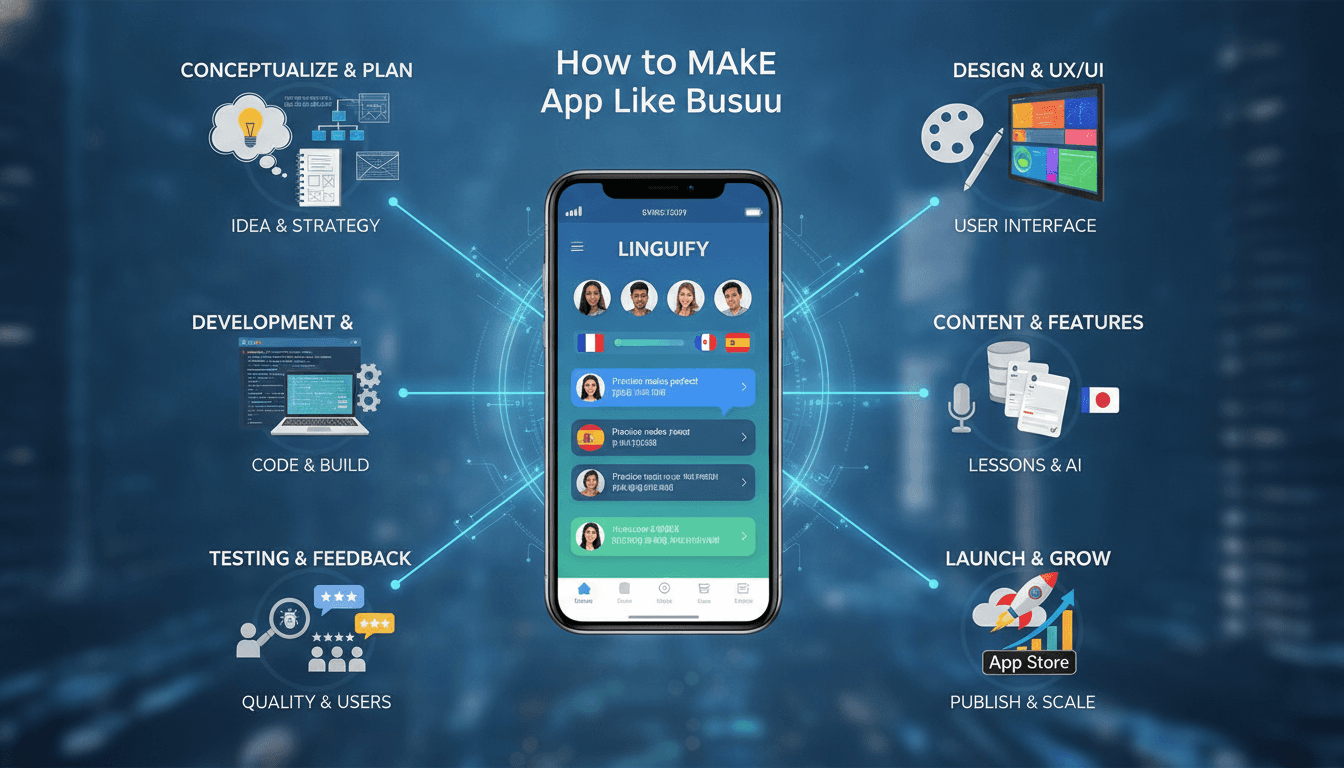
A technical breakdown of the architecture, feature set, and cost considerations that go into building a language-learning app at Busuu's scale — written for engineers and technical founders who want to understand what they're actually committing to.
What Does Busuu Actually Do Under the Hood?
Busuu sits in a competitive space alongside Duolingo and Babbel, but its differentiator is community-driven correction. Native speakers review your written and spoken exercises. That single feature shapes the entire backend architecture.
To explore this further, see How to Make an App Like Babbel.
At its core, the platform needs to handle:
- Asynchronous peer review with notification pipelines
- Spaced repetition scheduling (Busuu uses a variant of the SM-2 algorithm)
- Streaks, XP, and gamification state
- Offline-capable mobile clients with sync
- Audio recording, playback, and storage at scale
- A content management layer for lessons, which are structured JSON curricula, not flat HTML
The peer-review loop alone requires a task queue, a matching engine (pairing learners with native speakers by language pair and availability), and a notification system. Most teams underestimate this piece.
To explore this further, see How to Make an App Like Rosetta Stone.
Core Architecture: What You're Actually Building
Mobile Clients
React Native is a reasonable choice here if you want a single codebase. Flutter is faster to render and gives you more control over custom UI components, which matters when you're building audio waveforms, drag-and-drop vocabulary exercises, and animated streak counters. Both are viable. The trade-off is ecosystem depth: React Native has a larger pool of third-party libraries, Flutter has better frame-rate consistency on lower-end Android devices.
Offline support is non-negotiable for a language app. Users study on commutes. Implement a local SQLite store (via drift in Flutter or WatermelonDB in React Native) and a sync layer that resolves conflicts on reconnect. Design the sync schema before you design anything else — retrofitting it is painful.
For a closer look at a related topic, read our guide on How to Make an App Like Duolingo.
Backend Services
This is not a monolith use case. A modular service structure makes more sense:
| Service | Responsibility | Suggested Stack |
|---|---|---|
| Auth | Registration, OAuth, JWT refresh | Node.js + PostgreSQL |
| Curriculum | Lesson content, course graph | Python + PostgreSQL + Redis cache |
| Progress | XP, streaks, completion state | Go or Node + PostgreSQL |
| Review Queue | Peer-correction matching and delivery | Node + BullMQ + Redis |
| Notifications | Push, email, in-app | Node + FCM + SES |
| Media | Audio upload, transcoding, CDN delivery | Python + FFmpeg + S3 + CloudFront |
You don't need Kubernetes from day one. A well-configured ECS or Railway setup handles early traffic fine. Add orchestration when you have evidence of the scaling problem, not before.
Spaced Repetition Engine
SM-2 is the baseline. Duolingo published research on their Half-Life Regression model in 2016, which outperforms SM-2 for vocabulary retention prediction. If you have the ML engineering capacity, HLR is worth implementing. If not, SM-2 with interval caps of 1, 3, 7, 14, and 30 days covers 80% of the benefit.
Store review history per card per user. This table grows fast. Partition by user_id early and archive records older than 180 days to cold storage.
/// Not sure where to start?
Get the architecture before you commit
Tell us what you're building and we'll map the technical approach, stack, and rough timeline. No cost, no obligation, no sales call required.
How Does the Peer Review System Work?
The peer-review feature is the hardest part to build well. Here is how to think about it.
A learner submits a written or recorded exercise. The system needs to find a native speaker of the target language who is also learning the learner's native language. That matching is a simple two-column lookup most of the time, but you need a fallback: if no reciprocal match is available within a configurable timeout (say, 4 hours), fall back to any verified native speaker.
The matching queue runs on BullMQ (or Celery if you're in Python). Jobs are prioritised by wait time. When a match is found, both parties are notified via push. The reviewer submits corrections inline (for text) or at timestamps (for audio). Text diffing is straightforward. For audio, you need a waveform visualiser and a way to attach comments to time ranges — this is custom UI work, about 3 to 4 weeks for one frontend engineer.
Moderation matters. Allow users to flag corrections as unhelpful or abusive. Route flagged content to a human review queue. Don't try to automate moderation fully with an LLM on day one — false positives damage trust faster than slow manual review does.
What Does AI Add, and Where Does It Actually Help?
AI features in language apps fall into two camps: genuinely useful, and marketing window dressing.
Genuinely useful:
- Pronunciation scoring via a model like Mozilla DeepSpeech or a fine-tuned Wav2Vec 2.0. Real-time feedback on phoneme accuracy is something a human reviewer cannot do at scale.
- Grammar error detection using a fine-tuned BERT or a call to the OpenAI API with a structured prompt. The OpenAI API route is faster to ship but costs roughly $0.002 per 1K tokens — budget for this.
- Adaptive difficulty adjustment based on review history signals.
Less useful than it sounds:
- LLM conversation practice. It works, but users disengage faster than with human conversation partners. Keep it as a supplementary feature, not a replacement for the peer model.
If you are starting a new build, call the OpenAI API for grammar correction in v1. Replace it with a fine-tuned model when you have enough data (typically 50,000 to 100,000 correction pairs) and the cost justifies the engineering.
How Long Does This Take to Build and What Does It Cost?
Honest estimates, assuming a small but experienced team.
MVP (no peer review, basic spaced repetition, 2 languages):
- Timeline: 4 to 5 months
- Team: 1 backend, 1 Flutter/React Native engineer, 1 designer
- Cost range: $40,000 to $70,000 depending on location and rates
Full Busuu-equivalent (peer review, AI pronunciation, 12+ languages, offline sync):
- Timeline: 12 to 18 months
- Team: 3 to 4 engineers, 1 designer, 1 QA, 1 content tooling engineer
- Cost range: $200,000 to $400,000+
The content creation tooling — the CMS your curriculum team uses to author lessons — is often underbudgeted. Budget at least 6 weeks of engineering time for it. A bad authoring tool produces bad content faster.
Conclusion
Building a language app at Busuu's quality level is a 12-to-18-month project if you are doing it properly. The peer-review system and offline sync are the two places where complexity is consistently underestimated. Start with a focused MVP: one language pair, spaced repetition, and a simple exercise format. Validate retention metrics before building the peer-review infrastructure.
If you want to talk through your specific architecture or get a technical scoping done, reach out to the team at Sodio.
FAQ
How much does it cost to build an app like Busuu? A production-ready MVP with spaced repetition, two languages, and a mobile app typically costs between $40,000 and $70,000. A full-featured platform with peer review, AI pronunciation scoring, offline sync, and 12+ languages is a $200,000 to $400,000+ investment over 12 to 18 months.
What is the best tech stack for a language learning app? Flutter or React Native for mobile, Node.js or Go for backend services, PostgreSQL for relational data, Redis for queues and caching, and S3 with CloudFront for media. For AI features in early stages, the OpenAI API is the fastest path to production. Replace with fine-tuned models once you have sufficient data.
How does spaced repetition work in apps like Busuu? Busuu uses a variant of the SM-2 algorithm. Each vocabulary card has a review interval that grows after a correct recall and resets after an incorrect one. Intervals typically follow a sequence of 1, 3, 7, 14, and 30 days. Duolingo's Half-Life Regression model is more accurate but requires more ML infrastructure to implement.
Do I need AI to build a language learning app? No. AI adds genuine value in pronunciation scoring and grammar correction, but the core learning loop — spaced repetition, structured exercises, and community correction — does not require ML. Ship the core first. Add AI features once you have users and can measure whether they improve retention.
How do you handle offline mode in a mobile language app? Use a local SQLite database (drift for Flutter, WatermelonDB for React Native) to store lesson content and progress state. Queue any actions taken offline — completed exercises, peer corrections — and replay them against the server on reconnect. Design the conflict resolution rules before writing the sync layer, not after.
Have a project in mind? Contact Sodio Technologies to discuss your requirements and explore the right technology solution for your business.
/// Work with us
Talk to the engineers who'd build it
You'll get a technical scope, timeline and cost estimate from the people doing the work, not an account manager. In-house team, no subcontracting, since 2016.