

How to Make an App Like Babbel
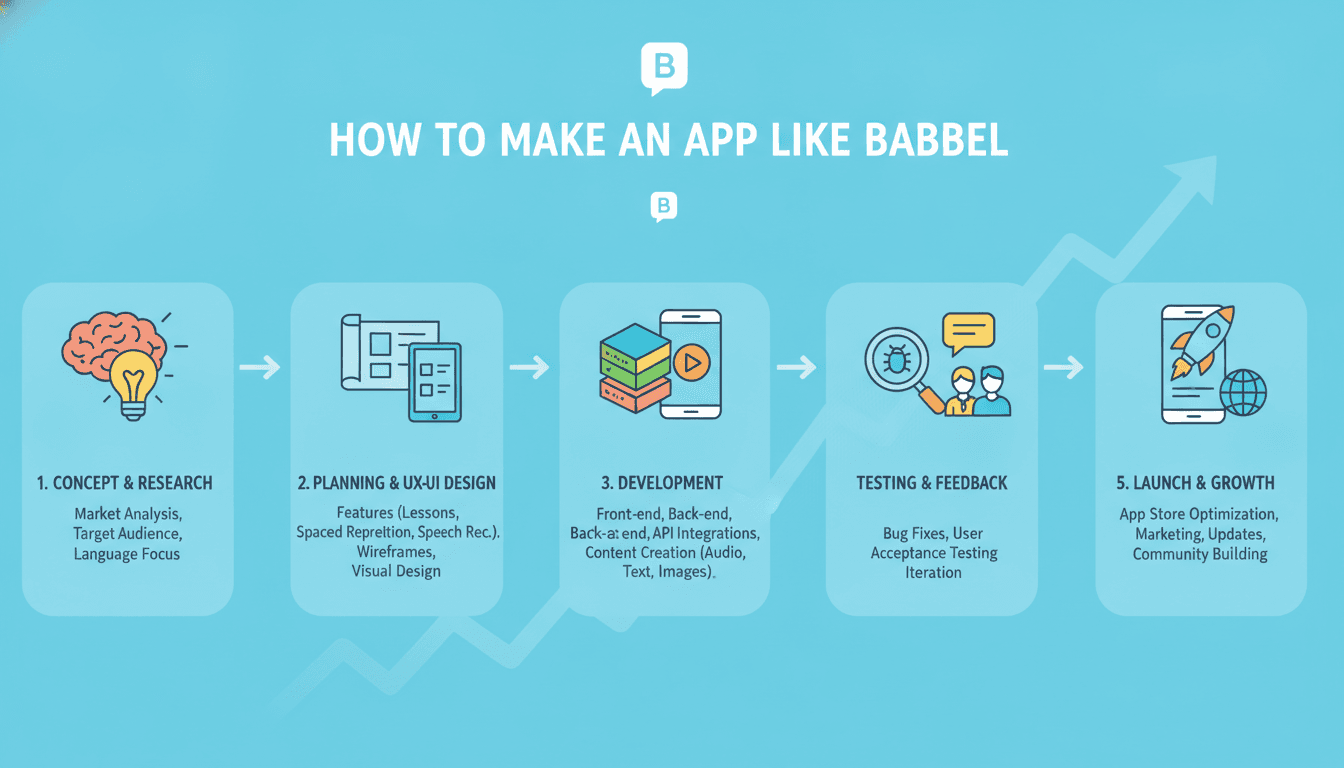
Building a language learning app that competes with Babbel means solving problems across adaptive learning algorithms, audio pipeline engineering, subscription monetisation, and mobile performance — all at the same time. This post breaks down how each layer works and where the real complexity lives.
What Does the Babbel Architecture Actually Look Like?
Babbel is not a content app with a quiz bolted on. It is a spaced repetition system wrapped in a curriculum engine, delivered over a cross-platform mobile shell, monetised through a subscription paywall, and continuously tuned by learning outcome data.
To explore this further, see How to Make an App Like Rosetta Stone.
The core components are:
- A content management system for structured lesson data (dialogues, vocabulary sets, grammar rules)
- A spaced repetition scheduler (SRS) that decides when to resurface vocabulary based on recall probability
- A speech recognition pipeline for pronunciation feedback
- A user progress store that persists state across devices and sessions
- A subscription and entitlement service managing access to paid content
Each of these is a non-trivial engineering problem on its own. The integration is where most teams underestimate the scope.
How Does Spaced Repetition Actually Work at Scale?
SRS is the pedagogical backbone. The algorithm used by most production systems today is a variant of SM-2, originally published by Piotr Wozniak in 1987. Babbel uses a modified version tuned to conversational learning rather than raw memorisation.
The core idea: each vocabulary item has an ease factor and an interval. After a review, the interval grows or shrinks based on whether the user answered correctly and how confidently. A correct answer might push the next review from 1 day to 4 days. A wrong answer resets it. Over time, well-known items are reviewed less frequently and difficult items appear more often.
Implementing SRS in a Production System
At the database level, you need a table per user per item tracking at minimum:
next_review_at(timestamp)interval(integer, days)ease_factor(float, default 2.5 in SM-2)repetition_count
At scale, the scheduling query has to be efficient. A naive WHERE next_review_at <= NOW() across millions of rows will kill a Postgres instance. The fix is a composite index on (user_id, next_review_at) and batching the scheduler so it runs per-user session rather than as a global sweep.
For a 1 million user base, you can expect 10 to 50 review events per user per day. That is 10 million to 50 million writes per day just for SRS state. Plan your write path accordingly. Redis with write-through to Postgres works well for session-level state before committing at session end.
What About Machine Learning on Top of SRS?
Some teams bolt an ML layer on top of SRS to personalise ease factor adjustments. This requires enough per-user data to train meaningful models, typically at least 30 to 50 review events per item. Before that threshold, default SRS performs better than a poorly-fitted model. Do not add ML complexity until you have data volume to justify it.
Building the Speech Recognition Pipeline
Pronunciation feedback is one of the hardest features to get right and one of the most differentiating.
You have two options: on-device inference or server-side API calls.
| Approach | Latency | Cost at Scale | Offline Support | Accuracy |
|---|---|---|---|---|
| On-device (e.g. Whisper tiny/base) | 200–600ms | Near zero marginal | Yes | Moderate |
| Server API (e.g. Google Speech-to-Text, Azure Cognitive) | 400–1200ms incl. round trip | $0.006–$0.016 per 15s clip | No | High |
| Hybrid (on-device for feedback, server for scoring) | Mixed | Low | Partial | High |
Babbel uses server-side pronunciation scoring for accuracy. For a new build, the hybrid approach makes sense: on-device Whisper (the base model runs in under 200ms on a modern iPhone) for real-time phoneme feedback during the exercise, and a server-side call for a final pronunciation score at submission.
The scoring problem is separate from transcription. Transcription tells you what the user said. Scoring tells you how well they pronounced it relative to a native speaker reference. This requires forced alignment, matching the user's audio to a reference transcript at the phoneme level. Montreal Forced Aligner (MFA) is the standard open-source tool. Commercial alternatives include Speechace and ELSA's API.
/// Not sure where to start?
Get the architecture before you commit
Tell us what you're building and we'll map the technical approach, stack, and rough timeline. No cost, no obligation, no sales call required.
What Tech Stack Should You Use for the Mobile App?
The right answer depends on team composition and target timeline.
Babbel maintains separate native iOS (Swift) and Android (Kotlin) codebases. That gives them full control over audio capture, playback, and on-device inference, but it doubles engineering effort for every feature.
React Native with the New Architecture (Fabric renderer, JSI) is a practical middle ground for most teams. Audio recording via react-native-audio-recorder-player and on-device ML via react-native-fast-tflite or ONNX Runtime Mobile covers the core requirements. The gap between React Native and native performance for audio-heavy apps has narrowed significantly since RN 0.71.
Flutter is the other option. Dart's FFI makes calling native audio and ML libraries straightforward. The plugin ecosystem for audio and speech is smaller than React Native's, but it is maturing. If your team has Flutter experience, there is no strong reason to switch.
Avoid building a web app wrapped in a WebView for a language learning use case. The audio latency introduced by the browser's audio stack makes pronunciation exercises feel broken.
We cover a closely related subject in How to Make an App Like Pimsleur.
Backend Services
For the API layer, a Node.js or Python (FastAPI) service behind an API gateway handles most needs. The SRS scheduler, content delivery, and user progress endpoints are not computationally heavy. What matters is the database design and caching strategy.
Content storage: lesson content is read-heavy and changes infrequently, so a CDN-cached object store (S3 + CloudFront) for audio assets and a PostgreSQL database for structured lesson data is the standard setup. Audio assets for a language like Spanish at beginner-to-intermediate level run to roughly 2–5 GB. Plan CDN costs accordingly.
Related reading: How to Make an App Like Busuu.
How Do You Handle Subscriptions and Entitlement?
Subscription logic is where a lot of teams create technical debt they regret later.
The basics: users purchase through App Store (StoreKit 2) or Google Play Billing Library 6+. Both platforms handle payment processing. Your backend receives a webhook on purchase, renewal, and cancellation. You store the entitlement state (active, expired, grace period) and gate content access against it.
The trap is building your entitlement check into the content delivery layer. When a subscription lapses, you need to immediately revoke access without a cold restart of the app. The clean pattern is a short-lived entitlement token (TTL of 15 to 30 minutes) refreshed from the server at session start. The app checks the token locally for speed and refreshes it in the background.
Grace periods matter. Both App Store and Google Play offer a grace period (typically 16 days on App Store) where a renewal fails but access is maintained. Your entitlement service needs to model this state explicitly, not treat it as expired.
For web subscriptions, Stripe is the standard. If you are offering subscriptions on all three surfaces, you need an entitlement service that reconciles state from three sources. RevenueCat handles this reconciliation and is worth the $0.01 per tracked customer fee at most scales.
Conclusion
The engineering surface area for a Babbel-equivalent app is real but tractable. The SRS engine, speech pipeline, and subscription entitlement service are the three components that will take the most time to get right.
If you are scoping this from scratch, start with the SRS database schema and content model before touching the frontend. Those decisions are the hardest to reverse. Get the data model solid, build a thin API layer over it, then add the mobile shell.
If you want to talk through architecture choices or scope a build, Sodio has built similar systems and can give you an honest read on timeline and cost.
FAQ
How long does it take to build an app like Babbel? A production-ready v1 with SRS, basic speech feedback, and subscription gating typically takes 6 to 10 months with a team of four to six engineers. A feature-complete parity product takes 18 to 24 months. The timeline is dominated by content pipeline work and speech model tuning, not the app shell.
How much does it cost to build a language learning app? Rough range is $150,000 to $400,000 USD for a v1, depending on team location and whether you use off-the-shelf speech APIs or build custom models. Ongoing costs are driven by speech API usage, CDN, and server compute, typically $0.02 to $0.08 per active user per month at early scale.
Can you use ChatGPT or other LLMs for the curriculum content? Yes, with caveats. GPT-4o and similar models can generate dialogue content and grammar explanations quickly. The risk is factual errors in grammar rules and unnatural phrasing in the target language. Every AI-generated piece of content needs review by a native speaker before it goes into the SRS pool.
What is the best database for storing SRS data?
PostgreSQL with a composite index on (user_id, next_review_at) handles this well up to tens of millions of users. At very high scale, some teams shard by user ID or move the scheduler state to a Redis sorted set keyed by next_review_at score. Start with Postgres and optimise when you have the data to prove you need it.
Do you need a custom speech recognition model or will an API do? For most teams, a commercial API (Google, Azure, or Speechace for pronunciation specifically) is the right starting point. Custom models require 50 to 100 hours of labelled audio per language per accent variant to meaningfully outperform APIs. That investment is only justified once you have product-market fit and a clear accuracy gap the APIs cannot close.
Have a project in mind? Contact Sodio Technologies to discuss your requirements and explore the right technology solution for your business.
/// Work with us
Talk to the engineers who'd build it
You'll get a technical scope, timeline and cost estimate from the people doing the work, not an account manager. In-house team, no subcontracting, since 2016.