

How to Make an App Like Eventbrite
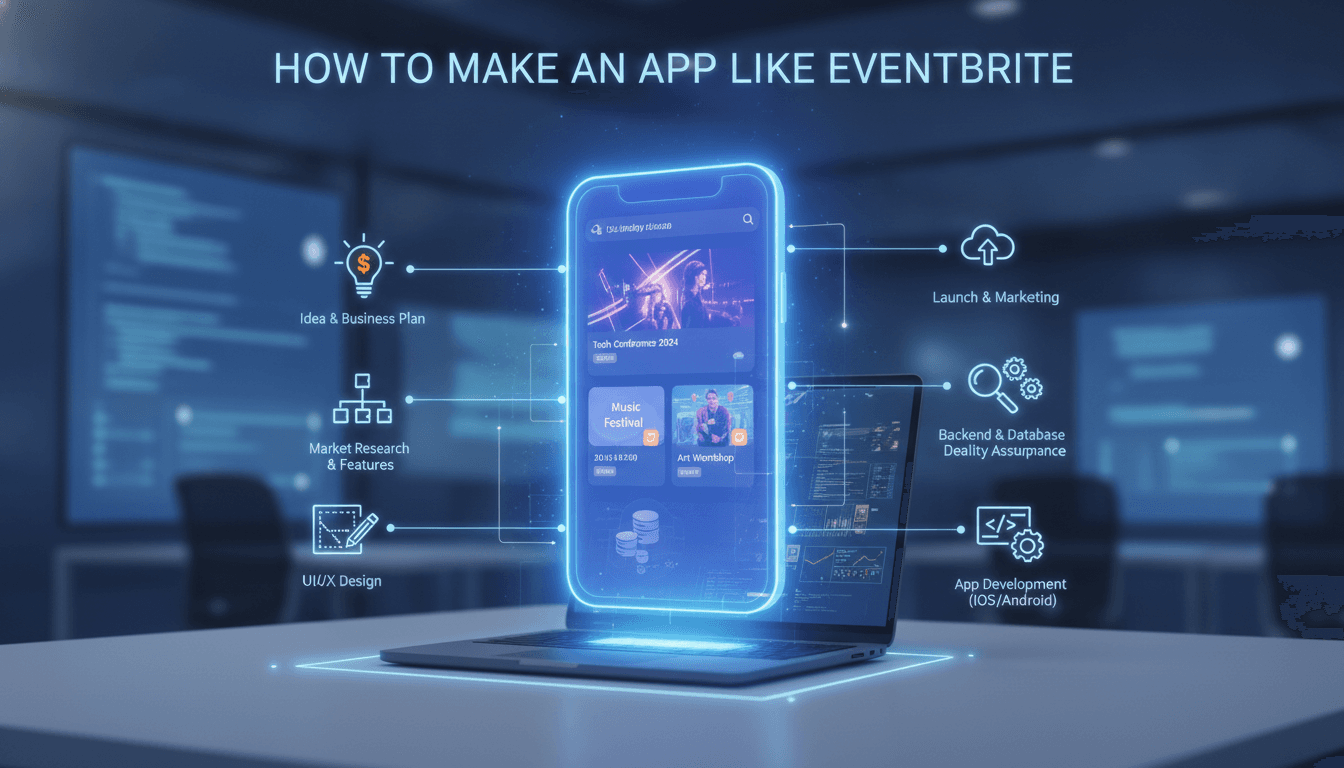
Building an event ticketing platform involves more moving parts than most product teams expect. This post breaks down the architecture, the tricky bits, and what it actually costs to get it right.
What Does an Eventbrite-Like Platform Actually Do?
Before writing a line of code, you need to be precise about scope. Eventbrite is not just a ticket store. It is an event discovery network, a payment processor, a check-in tool, an organiser dashboard, a marketing engine, and an attendee CRM, all running concurrently.
We cover a closely related subject in How to Make an App Like RSVPify.
The core functional surface breaks down like this:
- Event management: Organisers create, edit, and publish events with rich metadata (location, schedule, capacity, ticket tiers, refund policies)
- Ticketing engine: Ticket types (paid, free, donation, waitlisted), quantity caps, early-bird windows, promo codes
- Payment processing: Multi-currency transactions, partial refunds, payouts to organisers
- Check-in tooling: QR code generation and scanning, real-time capacity tracking, offline mode
- Discovery layer: Search, category filtering, geolocation, recommendations
- Organiser analytics: Sales funnels, conversion rates, traffic sources, attendee demographics
If you are building an internal corporate events tool or a niche vertical platform, you can drop entire sections of this. If you are building a direct Eventbrite competitor, you need all of it.
What Tech Stack Should You Choose?
There is no single correct answer, but there are choices that age poorly.
Backend
A monolith is fine for the first six months. Django or Rails will get you to launch faster than splitting everything into microservices on day one. The inflection point is usually around 50,000 monthly active users or when the ticketing service and the discovery service need to scale independently.
When you do split, the natural seams are:
- Ticketing service: Handles inventory, reservations, and order creation. Needs strong consistency. PostgreSQL with row-level locking or a dedicated inventory service backed by Redis for seat holds.
- Payment service: Stripe or Adyen integration with webhook reconciliation. Do not build your own payment processing.
- Notification service: Email (SendGrid or Postmark), SMS (Twilio), and push (FCM/APNs). Keep this async via a queue like RabbitMQ or SQS.
- Search service: Elasticsearch or Typesense. Typesense is operationally simpler and works well at sub-million event counts.
Frontend
Next.js on the web side is the practical choice in 2024. Server-side rendering matters for event discovery pages because SEO is a real acquisition channel. React Native or Flutter for mobile, depending on whether your team has stronger JS or Dart experience. Flutter's single codebase advantage is real, but React Native's ecosystem is larger.
Infrastructure
Start on AWS or GCP. Use managed services aggressively: RDS, ElastiCache, SQS, S3. The moment you are hand-managing Postgres replication is the moment you have made an expensive mistake.
The Hardest Engineering Problem: Concurrent Ticket Sales
Ticket inventory under high concurrency is genuinely difficult. A popular event can see thousands of checkout attempts in the first ten seconds of sale.
The naive implementation using a simple UPDATE tickets SET sold = sold + 1 WHERE sold < capacity breaks under load. You get overselling, race conditions, and angry attendees.
The correct pattern is a two-phase reservation model:
- Reserve: When a user clicks "checkout", hold the ticket for a fixed window (typically 8 to 15 minutes) in Redis with a TTL. Decrement available count in the Redis key, not the database.
- Confirm: On successful payment, write the confirmed order to PostgreSQL and release the Redis hold.
- Expire: A background worker continuously sweeps expired holds and increments the available count back.
This gives you optimistic concurrency without database row contention. For stadium-scale events (10,000+ concurrent buyers), you need to go further: a virtual queue backed by something like AWS SQS FIFO or a purpose-built waitroom service.
If this is relevant to your project, check out How to Make an App Like Ticketmaster.
Testing this properly means load-testing with Locust or k6 at 5x your expected peak. Most teams skip this and discover the bug in production.
/// Not sure where to start?
Get the architecture before you commit
Tell us what you're building and we'll map the technical approach, stack, and rough timeline. No cost, no obligation, no sales call required.
How Much Does It Cost to Build?
Costs vary significantly by geography, team structure, and scope. Here is a rough breakdown for a mid-scope platform (event creation, ticketing, payments, mobile check-in, organiser dashboard) with a dedicated team:
| Phase | Duration | Approximate Cost (USD) |
|---|---|---|
| Discovery & architecture | 3–4 weeks | $8,000 – $15,000 |
| Backend APIs + admin | 10–14 weeks | $40,000 – $70,000 |
| Web frontend (Next.js) | 8–10 weeks | $25,000 – $40,000 |
| Mobile app (React Native or Flutter) | 8–12 weeks | $30,000 – $50,000 |
| QA, DevOps, launch | 4–6 weeks | $15,000 – $25,000 |
Total range: roughly $118,000 to $200,000 for a production-ready v1. A no-frills MVP (web only, no mobile, no discovery layer) can come in at $40,000 to $60,000.
These numbers assume offshore or nearshore development. In-house engineering in the US or UK adds a multiplier of 2x to 3x.
If the numbers feel high, it is worth asking whether you need a custom build at all. For many use cases, white-labelling a platform like Ticket Tailor, Pretix (open source), or even a Stripe Payment Links setup gets you to market faster. Custom builds make sense when you have a specific monetisation model, a unique attendee experience, or tight integration with existing internal systems.
If this is relevant to your project, check out How to Make an App Like Peatix.
Compliance, Payments, and the Stuff That Kills Timelines
Payment regulations catch teams off guard more than any technical problem.
If you are processing payments in the EU, PSD2 Strong Customer Authentication (SCA) is mandatory. Stripe handles most of this transparently, but your checkout flow needs to support 3D Secure 2.0 redirect flows. Budget time for this.
If you hold funds from ticket sales before passing them to organisers (which Eventbrite does), you are operating as a payment facilitator. In many jurisdictions this requires a specific licence or partnership with a licensed entity. This is not optional and it is not fast. Adyen's Marketpay and Stripe Connect both offer compliant payout architectures that sidestep the licensing question for most startups.
GDPR and its equivalents mean attendee data (name, email, purchase history) needs proper data handling, consent flows, and deletion mechanisms. Plan for this in your data model from day one, not as a retrofit.
Conclusion
Building an event ticketing platform is achievable in four to six months with the right team, but the complexity is front-loaded in the inventory system, the payment architecture, and compliance. Get those three things right and the rest is standard product engineering.
The clearest next step: define your minimum scope precisely before any design or development begins. The difference between a niche B2B event tool and a consumer marketplace is not just features, it is a fundamentally different architecture and regulatory posture.
If you want to talk through the architecture for your specific use case, the Sodio engineering team is happy to do a no-obligation scoping call.
FAQ
How long does it take to build an app like Eventbrite? A full-featured platform typically takes 6 to 9 months with a team of 4 to 6 engineers. A focused MVP covering event creation, ticketing, and basic payments can be built in 12 to 16 weeks. Timeline depends heavily on scope, team size, and how early you lock down requirements.
What is the best tech stack for a ticketing platform? For most teams, Next.js on the frontend, Django or Node.js on the backend, PostgreSQL for transactional data, Redis for inventory holds, and Stripe for payments is a proven combination. Avoid premature microservices. Start with a modular monolith and split along natural service boundaries as traffic grows.
How do you prevent ticket overselling? Use a two-phase reservation model: hold tickets in Redis with a short TTL during checkout, then confirm in the database on successful payment. This handles concurrent buyers without database locking overhead. For very high-demand events, add a virtual queue to smooth the spike.
Should I build a custom platform or use an existing solution? Custom makes sense if you have a unique monetisation model, need deep integration with internal systems, or are building a vertical-specific product. For most organisations launching an events business, starting with Pretix (self-hosted, open source) or Ticket Tailor and migrating later is faster and cheaper.
What are the main compliance requirements for a ticketing platform? The two biggest are payment regulation and data privacy. If you process card payments in the EU, PSD2 SCA applies. If you act as a payment intermediary holding organiser funds, you need a compliant payout structure via Stripe Connect or Adyen Marketpay. GDPR governs attendee data handling across the EU and UK.
Have a project in mind? Contact Sodio Technologies to discuss your requirements and explore the right technology solution for your business.
/// Work with us
Talk to the engineers who'd build it
You'll get a technical scope, timeline and cost estimate from the people doing the work, not an account manager. In-house team, no subcontracting, since 2016.