

How to Make an App Like Eventful
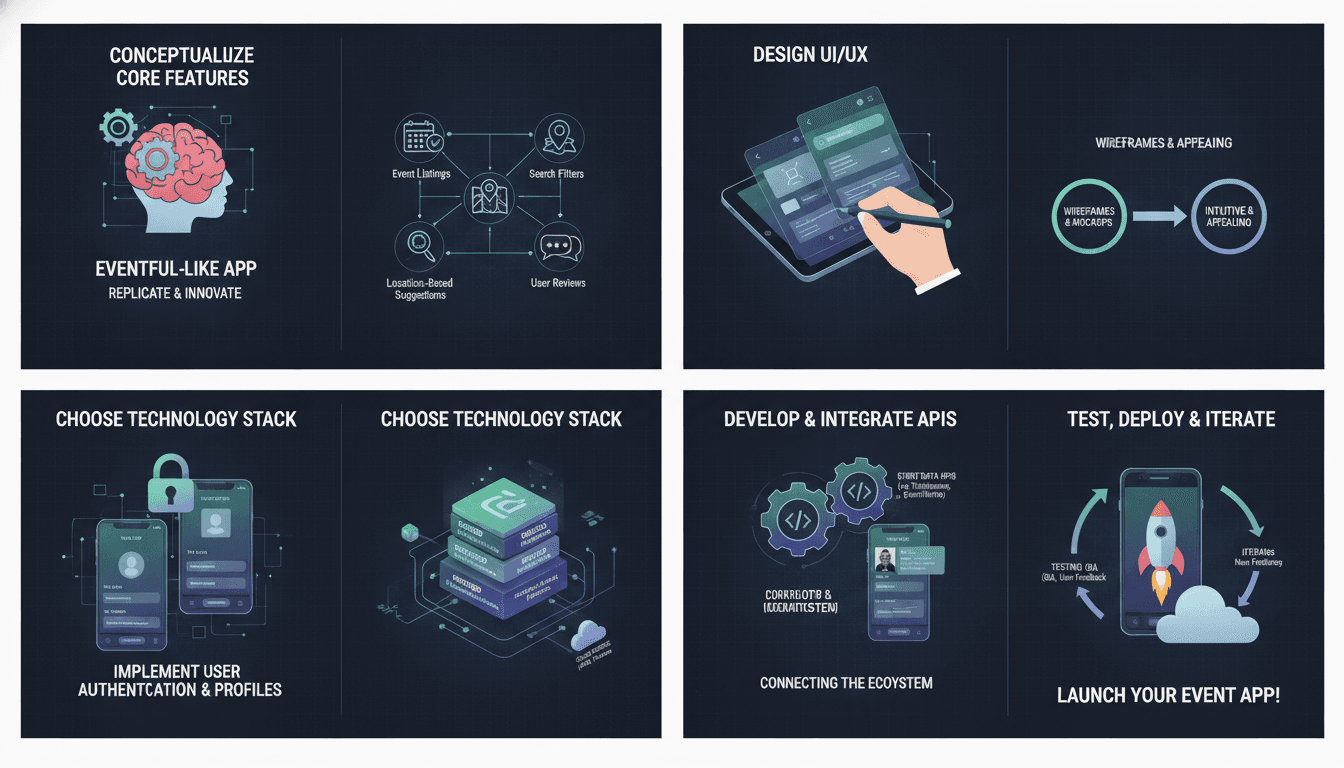
Building an event discovery and ticketing app is a well-understood problem with a deceptively complex implementation. This post covers the architecture, third-party integrations, and trade-offs you'll face when building something in the vein of Eventful, from venue data to real-time seat availability.
What Does "An App Like Eventful" Actually Mean?
Eventful was primarily an event discovery platform: it aggregated events from promoters, venues, and ticket sellers, let users follow artists and demand shows in their city, and surfaced personalised recommendations. It was acquired by Ticketmaster in 2019 and eventually shut down in 2023.
If this is relevant to your project, check out How to Make an App Like Ticketmaster.
If you're building something similar today, you're likely targeting one or more of these distinct product areas:
- Event discovery and aggregation (pulling in events from multiple sources)
- First-party ticketing (the venue or promoter sells through you)
- Secondary ticketing (resale market)
- Social and demand signalling ("I want this artist in my city")
Each of these has a different data model, different monetisation logic, and different technical complexity. Conflating them early is the most common architectural mistake.
What Does the Core Architecture Look Like?
Data Model
The central entities are Event, Venue, Artist, Ticket, and User. The tricky part is the relationship between Event and Ticket. A single event can have multiple ticket tiers (general admission, VIP, early bird), each with its own price, capacity, and availability window. Model this as a separate TicketTier table from the start. Bolting it on later is painful.
Event (1) → (many) TicketTier
TicketTier (1) → (many) Ticket
Ticket (many) → (1) Order
Order (many) → (1) User
Venues have a coordinate (lat/lng) and a capacity. Events have a start and optional end time stored in UTC with the venue's timezone stored separately. This sounds obvious but a surprising number of teams store local time and then struggle with daylight saving edge cases.
Real-Time Seat Availability
This is the hardest part of the system. When a user views a seat map, you need to show which seats are available, reserved (held in a cart), or sold. The window between "added to cart" and "payment confirmed" is where race conditions live.
The standard approach is a short-lived hold: when a user selects seats, you write a SeatHold record with a TTL of around 10 minutes and decrement available inventory in a Redis counter (not your primary DB). On payment confirmation, you write the Ticket record and release or expire the hold. Stripe's payment intents work well here because you can create the intent at hold time and capture it on confirmation.
If you're building a high-concurrency venue (think 50,000-seat stadium), Redis alone isn't enough. You'll want a distributed lock (Redlock or a Lua script on a Redis cluster) per seat to prevent double-booking during the payment window.
Event Aggregation
If you're building a discovery layer rather than a first-party ticketing platform, you need event data from external sources. The main options in 2024:
| Source | Coverage | Quality | Cost |
|---|---|---|---|
| Ticketmaster Discovery API | US/EU heavy, strong | High | Free tier, then paid |
| PredictHQ | Global, good for AI features | High | Paid from day one |
| SeatGeek Partner API | US focus, good secondary | Medium | Partner agreement |
| Eventbrite API | Strong for community events | Medium | Free |
| Scrapers | Flexible | Low, brittle | Engineering time |
Scrapers are tempting and almost always the wrong call. HTML changes break them, terms of service often prohibit them, and the data quality is poor. Use official APIs and supplement with scrapers only for sources that have no API and where you've cleared the legal risk.
Normalising data across sources is where the real work is. The same event will appear in multiple sources with different IDs, slightly different venue names, and inconsistent date formats. You'll need an entity resolution layer, a fuzzy matching pipeline (a combination of string similarity and coordinate proximity works well), and a canonical event store that deduplicates before serving.
/// Not sure where to start?
Get the architecture before you commit
Tell us what you're building and we'll map the technical approach, stack, and rough timeline. No cost, no obligation, no sales call required.
How Do You Handle Payments and Ticketing?
Payment Processing
Stripe is the default choice for new builds. Their PaymentIntents API handles the hold-then-capture flow cleanly, and their Connect product handles the split payments you'll need if venues are paid out separately from your platform fee.
For international events, be aware that Stripe's availability varies by country. If you're targeting India, Razorpay or Cashfree are stronger options for UPI and netbanking support. If you're building for Southeast Asia, PayMongo or Omise are worth evaluating.
Ticket Delivery
Physical QR-code tickets are the baseline. Generate a QR code that encodes a signed JWT containing the ticket ID and order ID. The scanning app at the venue verifies the signature and marks the ticket as used. Keep the signing key out of your client app.
Related reading: How to Make an App Like Songkick.
For high-value events, consider Apple Wallet and Google Wallet passes. Both have APIs (PassKit for Apple, Google Wallet API for Android) that let you push updates to passes after issuance, which is useful for time or venue changes.
Fraud and Chargebacks
Ticket fraud and chargeback abuse are genuine operational problems. Stripe Radar handles a lot of automated fraud detection. For high-value tickets, add velocity checks (more than two orders in an hour from the same card) and require 3D Secure for orders above a threshold. 3DS2 adds friction but significantly reduces chargeback rates.
What Does the Mobile App Need?
Most event apps are read-heavy on discovery and write-heavy only at purchase. This shapes your caching strategy. Event listings, venue pages, and artist profiles can be aggressively cached (CDN with a 5-minute TTL is fine). Seat availability cannot.
For the mobile layer, React Native is a reasonable choice if your team is JavaScript-heavy and you want a single codebase. Flutter gives you better rendering performance for seat map UIs (SVG-heavy, interactive). Native Swift/Kotlin gives you the best performance and access to PassKit at the cost of two codebases.
Seat maps deserve specific attention. Rendering an SVG seat map with 10,000+ seats and live availability overlays is a non-trivial front-end problem. Libraries like react-native-svg work for moderate complexity. For large arenas, you'll likely need a custom WebGL renderer or a third-party seat map SDK like Seats.io (which also handles the hold logic).
You may also find our article on How to Make an App Like Minecraft useful.
Search, Discovery, and Personalisation
Search is a day-one requirement. Elasticsearch or OpenSearch handles full-text search across event names, artist names, and venue names well. Geospatial queries (events within 20 km of the user) are supported natively by both.
Personalisation gets complex quickly. A simple collaborative filtering model (users who liked X also attended Y) is achievable with moderate data. PredictHQ's Beam product offers demand forecasting features if you want to surface events that are likely to sell out. Building a full recommendation engine in-house only makes sense at significant scale, typically above one million monthly active users.
For smaller catalogues, a well-tuned Elasticsearch query with boosting on proximity, recency, and user-followed artists will outperform a poorly trained ML model.
Conclusion
The architecture of an event app isn't especially exotic, but the edge cases compound quickly: seat holds, entity resolution across data sources, time zone handling, and fraud management each require deliberate design.
If you're at the stage of validating the product, start with Eventbrite or Ticketmaster as your data source, Stripe for payments, and a simple QR ticket flow. Build the hard parts (custom seat maps, entity resolution, personalisation) only when you have users pulling you toward them.
If you're past validation and building for scale, the seat availability layer and the aggregation pipeline are the two areas worth investing serious engineering time in. Everything else has a serviceable off-the-shelf solution.
Sodio has built event and booking systems across several verticals. If you want to talk through your specific architecture before committing to an approach, reach out directly.
FAQ
How long does it take to build an app like Eventful? A basic event discovery and ticketing app with mobile clients takes around 16 to 24 weeks for a team of four to six engineers. That assumes third-party APIs for event data and Stripe for payments. Custom seat map rendering, secondary ticketing, or a recommendation engine each add significant time on top.
What's the biggest technical mistake teams make when building ticketing apps? Not handling seat holds properly. Teams use their primary database for availability checks under concurrent load, which leads to double-booking. The correct pattern is a short-lived hold in Redis combined with a distributed lock during the payment window. Fix this early; it's difficult to retrofit.
Should I aggregate event data or generate it from scratch? Aggregate first. APIs like Ticketmaster Discovery and Eventbrite give you immediate catalogue depth. Only invest in generating your own event supply when you have venue or promoter relationships that APIs don't cover. The entity resolution work to normalise aggregated data is substantial but cheaper than building supply from zero.
Is React Native good enough for a seat map UI? For moderate complexity (under 2,000 seats, basic tier zones), yes. For large arenas with interactive individual seat selection, you'll hit performance limits with react-native-svg. At that point, either a WebGL renderer or a third-party seat map SDK like Seats.io is the right call. Flutter handles this better than React Native out of the box.
How do I prevent ticket fraud and scalping? A combination of Stripe Radar for payment fraud, 3DS2 for high-value orders, per-order purchase limits enforced at the database level, and transferable-but-not-resellable ticket logic covers most cases. Full secondary market controls (price caps, verified fan queues) require significant additional engineering and are only worth it at high demand events.
Have a project in mind? Contact Sodio Technologies to discuss your requirements and explore the right technology solution for your business.
/// Work with us
Talk to the engineers who'd build it
You'll get a technical scope, timeline and cost estimate from the people doing the work, not an account manager. In-house team, no subcontracting, since 2016.