

How to Make an App Like HelloTalk
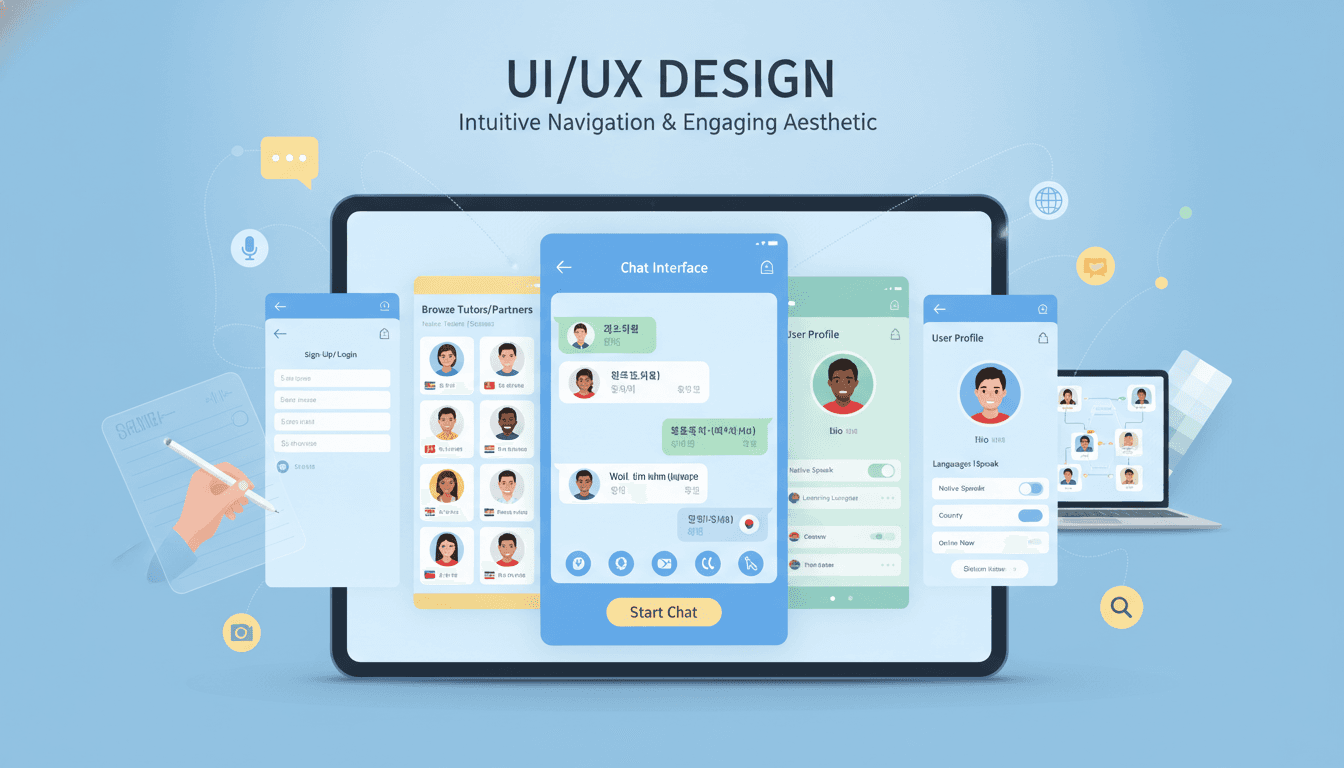
A practical breakdown of the architecture, feature set, and cost structure behind language-exchange apps — written for engineers and technical founders who want to build something that scales past a million users.
What Makes HelloTalk Different from a Generic Chat App?
HelloTalk is not a translation tool with a messaging layer bolted on. It is a social network built around language exchange, where the core loop is: find a native speaker of your target language who wants to learn yours, then practise together. That loop drives every architectural decision.
The features that make this work include real-time text, voice, and video chat; in-line translation and transliteration; voice recording with correction tools; a social feed (Moments); and a matching algorithm that pairs users by native language, target language, and proficiency level. As of 2023, HelloTalk reported over 30 million registered users across more than 150 countries.
You may also find our article on How to Make an App Like Tandem useful.
The engineering challenge is that most of those features require low latency, and several of them — inline translation, pronunciation feedback, grammar correction — require ML inference on or near the critical path of a conversation.
Core Architecture: What Does the Stack Actually Look Like?
Real-Time Messaging
WebSocket connections are the baseline. For a language-exchange app at scale, you will likely run a dedicated signalling layer separate from your REST API. XMPP is mature but operationally heavy. Most teams building this today use a custom WebSocket server (Node.js or Go) backed by Redis Pub/Sub for fan-out, with a persistent message store in Cassandra or DynamoDB for history.
You may also find our article on How to Make an App Like Rosetta Stone useful.
At HelloTalk's scale, the engineering team almost certainly runs this as a distributed cluster with regional edge nodes to keep round-trip latency under 100 ms for the bulk of users.
For voice and video calls, WebRTC is the standard. You need STUN and TURN servers; without TURN, roughly 15–20% of calls fail due to symmetric NAT. Services like Twilio, Agora, and 100ms abstract a lot of this, but they add per-minute costs that compound quickly at scale. If you are building for millions of monthly active users, owning your media server infrastructure on Janus or mediasoup eventually makes financial sense.
You may also find our article on How to Make an App Like Grindr useful.
Translation and Language Tools
This is where the product differentiates itself. You have four realistic options:
| Option | Latency | Cost at Scale | Customisability |
|---|---|---|---|
| Google Cloud Translation API | ~200 ms | High | Low |
| DeepL API | ~300 ms | Medium-High | Low |
| LibreTranslate (self-hosted) | ~400 ms | Low (infra only) | High |
| Fine-tuned MarianMT / NLLB-200 | ~150 ms (GPU) | Medium | Very High |
For a v1, the Google or DeepL APIs are fine. For a production product with tight margins and 150+ language pairs, running a self-hosted or fine-tuned model gives you more control over quality and cost. Meta's NLLB-200 covers 200 languages and is Apache 2.0 licensed, which is a genuine option for teams willing to run the inference infrastructure.
Pronunciation feedback is harder. You need an ASR (automatic speech recognition) model plus a forced-alignment layer to compare a learner's pronunciation against a reference. Whisper (OpenAI, open-source) handles the ASR part well. For the comparison layer, Montreal Forced Aligner or wav2vec 2.0 fine-tuned on phoneme alignment are the tools most teams use.
Matching Algorithm
The matching problem is relatively contained compared to a dating app. You are matching on a small number of structured attributes: native language, target language, proficiency level, and optionally timezone and age range. A simple scoring function in PostgreSQL with the right indices handles this at tens of thousands of concurrent users. Beyond that, you move to a pre-computed candidate pool refreshed periodically, with a lightweight ranking model applied at query time.
/// Not sure where to start?
Get the architecture before you commit
Tell us what you're building and we'll map the technical approach, stack, and rough timeline. No cost, no obligation, no sales call required.
What Does It Cost to Build an MVP?
Scope drives cost more than anything else. A trimmed MVP with text chat, basic matching, and third-party translation APIs is a different project from a full feature parity build.
A realistic MVP scope:
- User registration, profiles, and language preferences
- Text and voice messaging (WebRTC voice only, no video)
- Google Translate API integration for inline translation
- Basic matching by language pair
- iOS and Android apps (React Native or Flutter to share code)
- Backend API (Node.js or Go), PostgreSQL, Redis
At Sodio, a project like this typically runs 14–20 weeks end-to-end with a team of five (one PM, two backend engineers, one mobile engineer, one QA/DevOps). Cost depends on team composition and location, but for a custom build in this scope, budget in the range of USD 80,000–130,000 is realistic. Adding video calling, a social feed, and on-device ML pushes the timeline to 28–36 weeks and the cost proportionally higher.
Cloud costs at launch are modest. A three-node Kubernetes cluster on GKE or EKS, a managed PostgreSQL instance, Redis, and TURN server infrastructure will run roughly USD 1,500–2,500/month at under 10,000 active users.
How Do You Handle Safety and Moderation at Scale?
This is the part most product specs underinvest in.
A language-exchange app surfaces all the moderation challenges of a dating app: unsolicited explicit content, grooming risk if minors are present, spam, and scam accounts. HelloTalk uses a combination of automated content filtering and human review queues.
Automated tooling you should plan for from day one:
- Image and video scanning with Google Cloud Vision SafeSearch or AWS Rekognition before delivery
- Text classification for harassment and spam (a fine-tuned BERT-class model or the Perspective API)
- Account velocity checks (multiple accounts from the same device or IP)
- Rate limiting on the matching and contact request flows
Human review queues are unavoidable. Plan for one moderator per 5,000–8,000 daily active users in the early growth phase, with tooling to surface flagged content efficiently. This is an operational cost that compounds with growth, so the quality of your automated filtering directly affects your team size.
Age verification is a hard problem with no clean technical solution. Most apps rely on self-reported birthdate plus stricter automated review for accounts that receive reports. If you are building for markets with strict children's online safety regulations (UK CSEA, EU DSA, US COPPA), get legal advice early.
Conclusion
Building a language-exchange app is a meaningful engineering project, not a template fill-in. The chat layer is table stakes. The real work is in the translation pipeline, the pronunciation feedback system, and keeping the moderation infrastructure ahead of abuse vectors.
If you are at the stage of scoping this out, the most useful next step is to write down which of these capability areas you want to own vs. buy. That decision shapes your architecture, your team, and your long-term cost structure more than any other choice you will make.
Get in touch with the team at Sodio if you want to work through the architecture in detail before committing to a build plan.
FAQ
How long does it take to build an app like HelloTalk? An MVP with text and voice chat, language matching, and basic translation integration typically takes 14–20 weeks with a team of five. Full feature parity, including video, a social feed, and on-device ML for pronunciation feedback, is closer to 28–36 weeks. Timeline depends heavily on the number of simultaneous platforms and how much ML infrastructure you build in-house.
What technology stack should I use for the real-time chat layer? A WebSocket server in Go or Node.js, Redis Pub/Sub for message fan-out, and Cassandra or DynamoDB for message history is the most common pattern at scale. For voice and video, WebRTC with managed TURN infrastructure (Twilio or Agora for early stage, self-hosted Janus or mediasoup later) covers the majority of use cases.
Can I use open-source models for translation instead of Google Translate? Yes. Meta's NLLB-200 covers 200 language pairs and is Apache 2.0 licensed. Self-hosting it requires GPU inference infrastructure, which adds operational complexity but removes per-character API costs. For early-stage products, Google Translate or DeepL APIs are faster to ship. Migrating later is straightforward if you abstract the translation layer behind a service boundary.
How much does it cost to run a language-exchange app in production? Infrastructure costs for under 10,000 daily active users are roughly USD 1,500–2,500/month on a managed cloud stack (GKE or EKS, managed PostgreSQL, Redis, TURN servers). Cost scales primarily with media bandwidth (voice and video minutes) and ML inference volume. At 100,000+ DAU, media infrastructure becomes the dominant cost line.
What are the biggest technical risks in a build like this? Two stand out. First, TURN server reliability: without adequate TURN coverage, a significant percentage of voice and video calls fail silently for users behind strict NATs. Second, moderation infrastructure: automated content filtering needs to be in the architecture from the start, not retrofitted. Adding it later is significantly more expensive and the gap period carries real legal and reputational risk.
Have a project in mind? Contact Sodio Technologies to discuss your requirements and explore the right technology solution for your business.
/// Work with us
Talk to the engineers who'd build it
You'll get a technical scope, timeline and cost estimate from the people doing the work, not an account manager. In-house team, no subcontracting, since 2016.