

How to Make an App Like HomeAdvisor
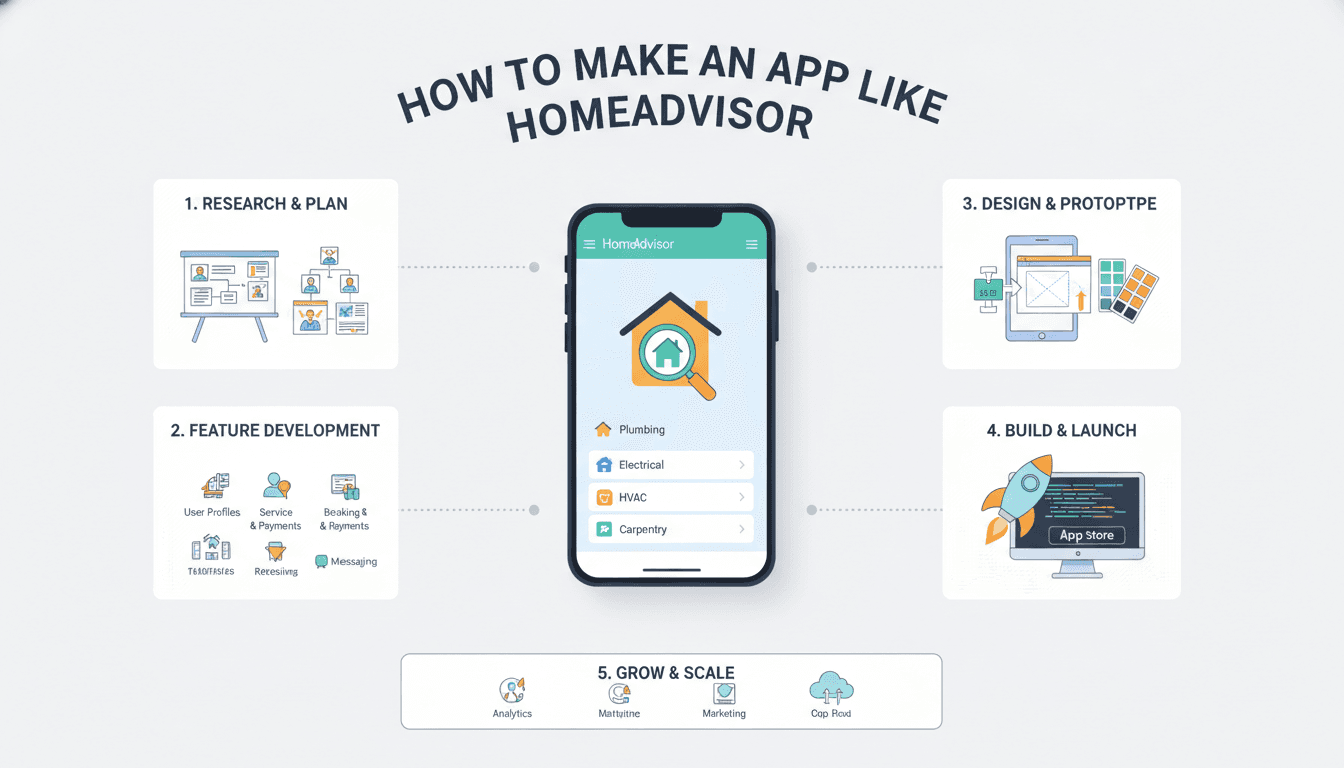
How to Make an App Like HomeAdvisor
Finding a trustworthy plumber, electrician, or landscaper used to mean flipping through a phone book and hoping for the best. HomeAdvisor changed that by turning home improvement into a searchable, reviewable, bookable experience. Today the platform connects millions of homeowners with pre-screened professionals, and it has proven that an on-demand marketplace for home services can scale into a billion-dollar business.
If you're considering building something similar, this guide walks through the business model, must-have features, technology choices, cost drivers, and go-to-market strategy for an app like HomeAdvisor.
We cover a closely related subject in How to Make an App Like Serviz.
Understanding the HomeAdvisor Model
HomeAdvisor is a two-sided marketplace. On one side are homeowners with a job to be done. On the other side are service professionals looking for qualified leads. The platform's value is in matching them quickly and reducing the risk on both sides through screening, reviews, and cost transparency.
Revenue typically comes from a blend of:
- Lead fees charged to professionals for each qualified customer match
- Annual or monthly membership subscriptions for pros who want ongoing access to leads
- Commission on completed and paid-through-platform bookings
- Featured placement and advertising for pros who want visibility in search results
- Value-added services such as background checks, insurance products, or financing options
The most important lesson from HomeAdvisor's growth is that liquidity matters more than features. A marketplace with great UX but no plumbers in the user's ZIP code is useless. Every product decision should be evaluated against whether it helps you accumulate supply and demand in the same geography at the same time.
Core Features to Build
An app like this is really three products in one: a homeowner app, a professional app, and an admin console. Here's what each needs.
We cover a closely related subject in How to Make an App Like Thumbtack.
Homeowner App
Onboarding and profile Social, email, or phone sign-up with address capture. The address is critical since everything downstream is geo-filtered.
Service discovery A browsable category tree (plumbing, HVAC, roofing, cleaning, moving) with search, autocomplete, and recently viewed services. Many users don't know the trade name for what they need, so natural-language search helps.
Guided job request flow Instead of a blank text box, ask structured questions: What type of job? What's the scope? When do you need it done? Structured data dramatically improves match quality and lets you estimate pricing.
Cost estimator HomeAdvisor's True Cost Guide is one of its strongest acquisition assets. Publishing average project costs by ZIP code drives enormous organic search traffic and builds trust before a user ever signs up.
Pro matching and profiles Show matched professionals with ratings, verified badges, years in business, license info, photo portfolios, and response times.
Booking and scheduling Calendar availability, instant booking for standardized services, and quote requests for custom work.
In-app messaging Keep conversations on-platform so you can moderate disputes and prevent disintermediation.
Payments Card and wallet support, escrow or milestone payments for larger jobs, digital invoices, and receipts.
Reviews and ratings Verified reviews tied to completed bookings, with photo uploads and structured criteria like punctuality, quality, and value.
Job history and rebooking One-tap rebooking of a pro a homeowner already trusts.
Professional App
Business onboarding and verification License uploads, insurance certificates, background check consent, and business details. This is your quality moat — don't cut corners here.
Lead feed and filters Pros should be able to filter by job type, distance, budget, and urgency. Push notifications for new matching leads are essential; speed to first response drives conversion.
Quoting tools Templated estimates, line items, materials plus labor breakdowns, and the ability to attach photos or scopes of work.
Calendar and job management Availability settings, scheduled jobs, route awareness for multi-stop days, and status updates.
Earnings dashboard Payouts, pending balances, lead spend, conversion rates, and a clear view of ROI. Pros churn when they can't see the value of their subscription.
Reputation management Review responses, profile enrichment, and performance badges.
Admin Panel
Marketplace operations Category and taxonomy management, pricing rules, service area definitions, and surge or promo controls.
Verification workflows Queues for reviewing licenses, insurance, and background check results.
Dispute resolution Case management, refund tooling, and communication logs.
Analytics Supply/demand heatmaps by ZIP, lead-to-booking conversion, pro utilization, cancellation reasons, LTV and CAC by cohort.
Fraud and trust controls Duplicate account detection, review manipulation flags, and off-platform payment detection.
The Matching Engine
Matching is where an app like HomeAdvisor lives or dies. A naive implementation sends every lead to every nearby pro, which floods professionals and annoys homeowners with too many calls.
We cover a closely related subject in How to Make an App Like TaskRabbit.
A better approach scores candidate pros on a weighted blend of signals:
- Geographic proximity and declared service radius
- Category and subcategory specialization
- Current availability and calendar load
- Historical acceptance rate and response speed
- Rating and completion quality
- Price alignment with the job's stated budget
- Subscription tier or lead credits available
Start with a transparent rules-based scoring system. It's easier to debug, easier to explain to pros who complain about lead volume, and it generates the labeled data you'll eventually need to train a machine learning ranker. Once you have tens of thousands of completed jobs, an ML model can meaningfully outperform heuristics on booking likelihood.
Recommended Technology Stack
Mobile clients React Native or Flutter lets you ship iOS and Android from one codebase, which matters when you're maintaining two separate apps (homeowner and pro). Native Swift and Kotlin make sense if you need deep hardware integration or maximum performance.
Web Next.js or a similar React framework, with server-side rendering for the cost guide and service landing pages. SEO is a primary acquisition channel here, so the web experience is not optional.
Backend Node.js with NestJS, Python with Django or FastAPI, or Go for high-throughput services. A modular monolith is usually the right starting point; break out matching, payments, and notifications into separate services as load justifies it.
Databases PostgreSQL with PostGIS for geospatial queries, Redis for caching and real-time presence, Elasticsearch or OpenSearch for service and pro search.
Real-time WebSockets or a managed service for chat and live job status.
Payments Stripe Connect or Adyen for MarketPay to handle split payments, escrow, and pro payouts with KYC built in.
Third-party integrations Google Maps Platform for geocoding and distance, Checkr or Sterling for background checks, Twilio for SMS and masked calling, SendGrid for email, Firebase Cloud Messaging and APNs for push.
Infrastructure AWS or GCP with containerized deployments, infrastructure as code, and CI/CD from day one.
Development Cost and Timeline
Costs vary enormously with region, scope, and team composition, but here's a realistic framing.
MVP (3 to 5 months) One service category or a small cluster, one city, homeowner app, pro app, basic admin, rules-based matching, payments, and reviews. Expect roughly $60,000 to $120,000 with an offshore or nearshore team, considerably more with a US-based agency.
Growth version (6 to 10 months) Multi-category, multi-city, advanced matching, subscription billing for pros, cost guide content system, dispute tooling, and analytics. Typically $150,000 to $300,000.
Scale platform (12+ months) ML-driven matching, insurance and financing partnerships, instant booking at scale, native apps, and a mature trust and safety operation. Budget well past $400,000.
Ongoing costs matter too. Plan for 15 to 25 percent of initial build cost annually for maintenance, plus background check fees, payment processing, map API usage, and cloud hosting that scales with volume.
Solving the Cold Start Problem
Every marketplace faces the chicken-and-egg problem. Some approaches that work:
Go hyper-local first. Launch in one metro area, or even a handful of ZIP codes. Density beats breadth.
Seed the supply side manually. Recruit professionals through direct outreach, trade associations, and supplier partnerships. Offer free leads for the first 90 days.
Pick a wedge category. Choose a service with high frequency or high urgency — house cleaning, handyman work, or emergency plumbing — rather than trying to cover 500 categories on day one.
Build content before the product. Cost guides, how-to articles, and project checklists rank in search and generate demand you can route to your first pros.
Guarantee outcomes. A satisfaction guarantee or workmanship warranty lowers the perceived risk of trying an unknown platform.
Trust, Safety, and Compliance
This is the category where platform failures become news stories. Take it seriously.
- Verify licenses and insurance, and re-verify on expiration
- Run background checks where legally permitted, and be transparent about scope
- Use masked phone numbers so personal contact details aren't exposed
- Encrypt data in transit and at rest, and follow PCI DSS through your payment provider
- Comply with GDPR, CCPA, and any regional data residency requirements
- Build a clear dispute and refund policy, and staff it with real humans
- Monitor for review fraud and off-platform payment solicitation
Also consider worker classification. Whether professionals are independent contractors or employees has real legal consequences that vary by jurisdiction, and it affects how much control your product can exert over scheduling and pricing.
Metrics That Actually Matter
Track these from launch:
- Lead-to-booking conversion rate — the health of your matching
- Time to first pro response — the strongest predictor of conversion
- Pro utilization — are your professionals getting enough work to stay?
- Repeat booking rate — the difference between a lead-gen business and a marketplace
- Take rate — revenue as a percentage of gross marketplace volume
- Supply/demand ratio by ZIP and category — where to invest in recruiting
- Pro churn and CAC payback — the economics of your subscription side
Ways to Differentiate
HomeAdvisor and Angi have a large head start, so a clone won't win. Consider angles like:
- Vertical focus — own one trade deeply, such as HVAC or roofing, with specialized tooling
- Transparent flat-rate pricing instead of lead-gen ambiguity
- Pro-first economics — many professionals resent lead fees; a subscription or commission model with better ROI is a real wedge
- AI-assisted scoping — let homeowners photograph a problem and get an instant scope and estimate
- Embedded financing for large renovation projects
- Property-lifecycle approach — maintenance reminders, home health scores, and service history tied to the property rather than the person
Final Thoughts
Building an app like HomeAdvisor is less about replicating a feature list and more about orchestrating a marketplace. The engineering is meaningful but solvable; the hard parts are supply acquisition, trust, and match quality. Start narrow, verify your professionals rigorously, instrument everything, and expand geography only once your unit economics work in the first market.
If you're ready to scope a build, begin with a discovery phase that defines your wedge category, target metro, and matching logic. That clarity will save you far more money than any technology decision.
Have a project in mind? Contact Sodio Technologies to discuss your requirements and explore the right technology solution for your business.
/// Work with us
Talk to the engineers who'd build it
You'll get a technical scope, timeline and cost estimate from the people doing the work, not an account manager. In-house team, no subcontracting, since 2016.