

How to Make an App Like Serviz
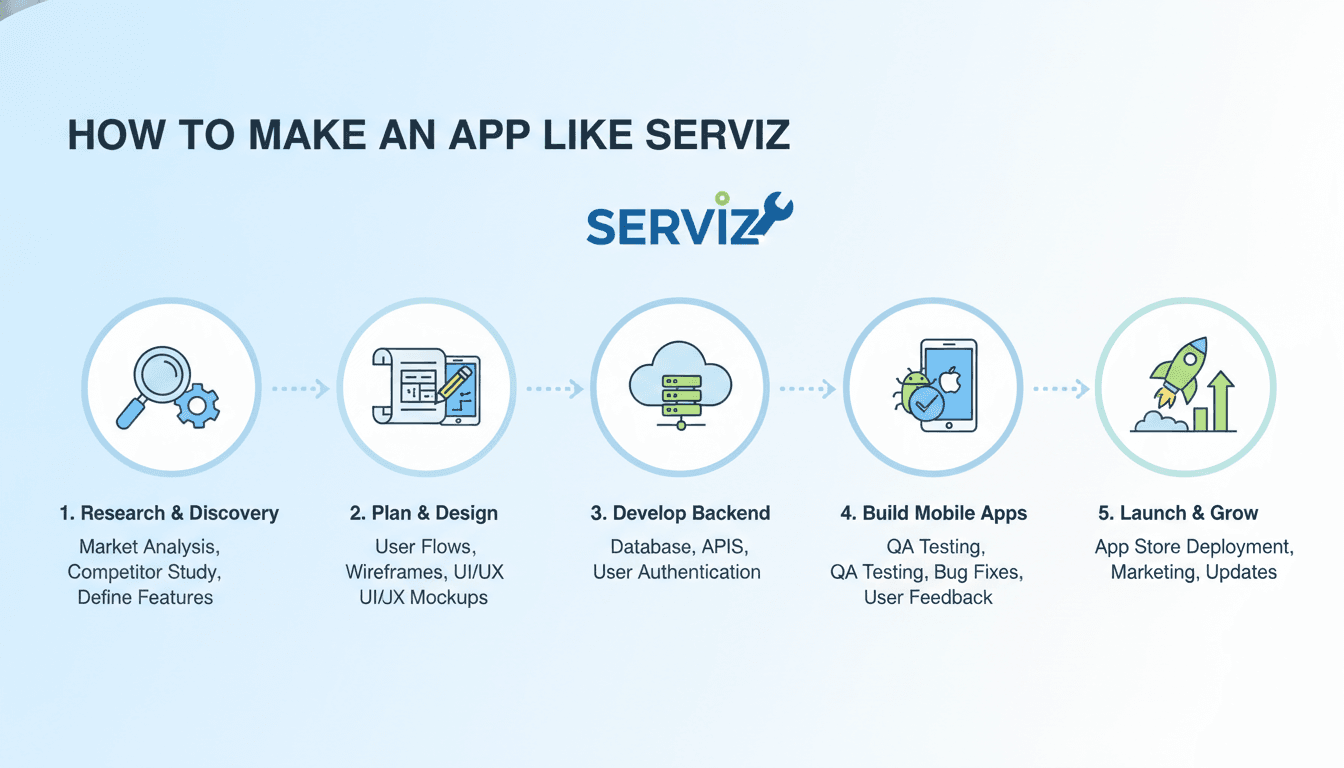
How to Make an App Like Serviz
The on-demand home services market has exploded over the past decade. Homeowners no longer flip through phone books or ask neighbours for a plumber's number — they open an app, tap a few buttons, and a vetted professional shows up at their door. Serviz built its reputation on exactly that promise: fast, transparent, upfront-priced home services delivered on demand.
If you're planning to build an app like Serviz, this guide walks you through the business model, the features you actually need, the tech stack that will support you, and what it realistically costs to get to market.
To explore this further, see How to Make an App Like Urban Company.
What Is Serviz and Why Does the Model Work?
Serviz is an on-demand home services marketplace that connects customers with pre-screened professionals for plumbing, electrical work, appliance repair, HVAC, handyman tasks, cleaning, and more. The core value proposition is simple:
- Upfront pricing — customers see the cost before booking, not after the work is done
- Vetted professionals — background checks and skill verification build trust
- Same-day and scheduled availability — convenience is the product
- Warranty on work — a guarantee period removes the fear of being ripped off
The model works because home services are a high-friction, low-trust category. Anyone who solves discovery, pricing transparency, and reliability captures enormous value. That's your opening.
Understand Your Market Before You Write Code
Before development begins, get clear on three things.
1. Pick Your Vertical and Geography
Don't launch with forty service categories across a whole country. Successful marketplaces start narrow and deep. Choose two or three high-frequency, high-margin services — appliance repair and plumbing, for instance — in a single metro area. Density matters more than breadth. A customer who opens your app and sees "no providers available" rarely comes back.
For a closer look at a related topic, read our guide on How to Make an App Like TaskRabbit.
2. Solve the Chicken-and-Egg Problem
Every marketplace faces it: customers won't come without providers, and providers won't join without customers. Practical tactics include:
- Recruiting an initial supply of 50–200 vetted pros manually before launch
- Guaranteeing minimum earnings for early providers
- Partnering with existing local service companies rather than only individual contractors
- Concentrating marketing spend in a few ZIP codes to create visible demand
3. Decide Your Revenue Model
Common approaches for apps like Serviz:
| Model | How It Works | Best For |
|---|---|---|
| Commission | Take 10–30% of each job | Most on-demand marketplaces |
| Subscription for pros | Monthly fee for leads and tools | Mature markets with loyal providers |
| Lead generation | Charge per qualified lead | Categories with high job values |
| Managed service | You employ the pros, keep the margin | Quality-controlled premium positioning |
| Membership for customers | Annual fee for discounted rates | Recurring services like cleaning |
Many apps blend two or more. Serviz-style upfront pricing pairs naturally with a commission model because you control the price the customer sees.
Core Features You Need to Build
An app like Serviz is really three products that talk to each other: a customer app, a provider app, and an admin platform.
We cover a closely related subject in How to Make an App Like HomeAdvisor.
Customer App Features
Onboarding and profile
- Phone or social sign-up with OTP verification
- Saved addresses with map pin adjustment
- Payment methods stored securely via a payment gateway
Service discovery and booking
- Category and subcategory browsing with clear iconography
- Search with autocomplete
- Guided question flows ("What kind of leak is it?") that let you generate an accurate upfront quote
- Transparent price estimate before confirmation
- Date and time slot selection, including same-day and emergency options
Live job tracking
- Provider profile with photo, rating, and reviews
- Real-time ETA and map tracking
- In-app chat and masked calling
Payments and post-service
- Card, wallet, and cash options
- Digital invoices and receipts
- Tipping
- Ratings and photo-based reviews
- Warranty claim or rework request
- Rebooking a favourite provider
Provider App Features
- Registration with document upload for licences, insurance, and background checks
- Availability calendar and service radius settings
- Job request notifications with accept/decline and countdown
- Navigation handoff to Google or Apple Maps
- Job checklist, parts and materials logging, and photo documentation
- Ability to adjust scope with customer approval (critical in home services — the job is often bigger than described)
- Earnings dashboard, payout history, and instant payout option
- Performance metrics: acceptance rate, completion rate, rating
Admin Panel Features
- Provider verification and onboarding workflow
- Dynamic pricing and service catalogue management
- Dispatch and manual reassignment tools
- Dispute and refund resolution
- Commission and payout configuration
- Promo code and referral campaign management
- Analytics: job volume, fill rate, cancellation reasons, CAC, LTV, cohort retention
- Content moderation for reviews
Features That Actually Differentiate You
Table stakes won't win. Consider building at least a couple of these:
AI-assisted diagnosis. Let customers upload a photo or short video of the problem. A vision model can classify the issue and tighten your price estimate, reducing on-site scope disputes — the single biggest source of friction in home services.
Smart dispatch. Rather than blasting a job to everyone, rank providers by proximity, skill match, historical rating for that specific service, and likelihood to accept. Better matching lifts fill rate and cuts cancellations.
Dynamic pricing with guardrails. Surge for emergency after-hours calls, discount to fill empty weekday slots. Home services demand is highly predictable by season and weather — a heatwave means HVAC calls.
Subscription maintenance plans. Quarterly HVAC service, biannual gutter cleaning. Recurring revenue stabilises supply utilisation and dramatically improves unit economics.
Parts and inventory integration. Connecting to supplier catalogues so pros can order parts in-app turns your platform into an operating system for their business, which makes you very hard to leave.
B2B and property manager accounts. Multi-property dashboards, consolidated billing, and SLA reporting unlock much higher volume per account than consumers.
Recommended Tech Stack
Your stack should prioritise real-time capability, geospatial queries, and reliability.
Mobile front end
- React Native or Flutter for shared code across iOS and Android
- Native Swift/Kotlin modules where you need precise background location behaviour
Web
- React or Next.js for the customer web booking flow and admin panel
- Server-side rendering for SEO on service and location landing pages — organic search is a major acquisition channel in home services
Backend
- Node.js with NestJS, or Python with Django/FastAPI, or Go for high-throughput services
- Microservices or a modular monolith split along booking, dispatch, payments, notifications, and identity
Data layer
- PostgreSQL with PostGIS for geospatial queries
- Redis for caching, geo-indexing of available providers, and job queues
- Elasticsearch for search
- A data warehouse such as BigQuery or Snowflake for analytics
Real-time and messaging
- WebSockets or MQTT for location streaming
- Firebase Cloud Messaging and APNs for push
- Kafka or RabbitMQ for event-driven workflows
Third-party services
- Maps, geocoding, and routing: Google Maps Platform or Mapbox
- Payments and split payouts: Stripe Connect, Adyen, or Razorpay
- Identity and background checks: Checkr, Onfido, or a regional equivalent
- Communications: Twilio for masked calls and SMS
- Analytics: Mixpanel or Amplitude plus Firebase
Infrastructure
- AWS, GCP, or Azure with containerised services on Kubernetes or ECS
- CI/CD via GitHub Actions
- Observability with Datadog, Sentry, and structured logging
Development Process Step by Step
1. Discovery and validation (2–4 weeks). Interview homeowners and contractors. Map the current journey and its pain points. Define your launch city, categories, and pricing logic.
2. Product definition and UX (3–5 weeks). Wireframe all three applications. Build clickable prototypes and test the booking flow with real users. Ambiguity here is the most expensive thing you can carry into development.
3. Architecture and planning (1–2 weeks). Data model, API contracts, dispatch algorithm design, third-party selection, security and compliance review.
4. MVP development (10–16 weeks). Build in vertical slices so you always have something demonstrable. Priority order is usually: auth, service catalogue and quoting, booking, dispatch, provider app, tracking, payments, reviews, admin.
5. QA and pilot (3–4 weeks). Functional, load, and security testing. Then run a closed pilot with a handful of providers and friendly customers in one neighbourhood. Expect to rework your dispatch and pricing logic based on what you learn.
6. Launch and iterate. Go live in one city. Watch fill rate, time-to-assignment, cancellation rate, rework rate, and repeat booking rate. Fix operations before you expand.
Cost of Building an App Like Serviz
Costs vary enormously with scope and team location. Rough ranges for a competent outsourced team:
| Scope | Timeline | Indicative Cost |
|---|---|---|
| Lean MVP — one city, two or three categories, core booking and payments | 3–4 months | $40,000 – $75,000 |
| Full-featured platform — three apps, smart dispatch, subscriptions, analytics | 6–9 months | $90,000 – $180,000 |
| Enterprise-grade — AI diagnosis, B2B accounts, multi-region, deep integrations | 10–14 months | $200,000+ |
Budget separately for ongoing costs that founders routinely underestimate: cloud and third-party API fees, background check costs per provider, payment processing, customer support staffing, and — the big one — provider acquisition and customer marketing. In on-demand services, operations spend typically dwarfs engineering spend after year one.
Legal and Operational Considerations
- Worker classification. Whether your pros are contractors or employees has major legal and cost implications and varies by jurisdiction. Get local counsel early.
- Licensing and insurance. Many trades require state or regional licences. Verify and store documentation, and track expiry dates.
- Liability coverage. Damage happens in people's homes. You need general liability coverage and a clear claims process.
- Data protection. Home addresses, payment details, and photos of interiors are sensitive. Encrypt at rest and in transit, minimise retention, and comply with GDPR, CCPA, or local equivalents.
- Safety. Background checks, in-app SOS, trip sharing, and identity verification for both sides of the marketplace.
Metrics That Tell You If It's Working
Track these from day one:
- Fill rate — percentage of requests matched to a provider
- Time to assignment — how long a customer waits for confirmation
- Completion rate — jobs finished versus accepted
- Rework and complaint rate — your quality signal
- Quote accuracy — how often the final price matches the estimate
- Provider utilisation — jobs per active provider per week
- Repeat rate and LTV/CAC — whether you have a business or just a marketing campaign
Common Mistakes to Avoid
- Launching in too many cities at once. Density beats coverage every single time.
- Treating supply as an afterthought. Provider experience is the product. If pros can't make good money efficiently, nothing else matters.
- Over-promising on price. Quotes that regularly get revised on-site destroy trust faster than any other failure.
- Building every feature before launch. Ship the booking loop, learn, then build.
- Ignoring SEO and web. A huge share of home services demand starts with a search query, not an app store visit.
- No plan for quality control. One bad plumber can generate reviews that cost you a hundred customers.
Final Thoughts
Building an app like Serviz is less about replicating a feature list and more about mastering the operational reality behind it: recruiting reliable pros, quoting accurately, matching intelligently, and guaranteeing the work. The technology is well-understood and entirely achievable — the differentiation comes from how tightly you couple your product to those operations.
Start narrow, obsess over the first thousand jobs, instrument everything, and expand only when your unit economics and your quality metrics both hold. That's how on-demand home services companies grow from a single neighbourhood into a category leader.
Have a project in mind? Contact Sodio Technologies to discuss your requirements and explore the right technology solution for your business.
/// Work with us
Talk to the engineers who'd build it
You'll get a technical scope, timeline and cost estimate from the people doing the work, not an account manager. In-house team, no subcontracting, since 2016.