

How to Make an App Like Housing.com
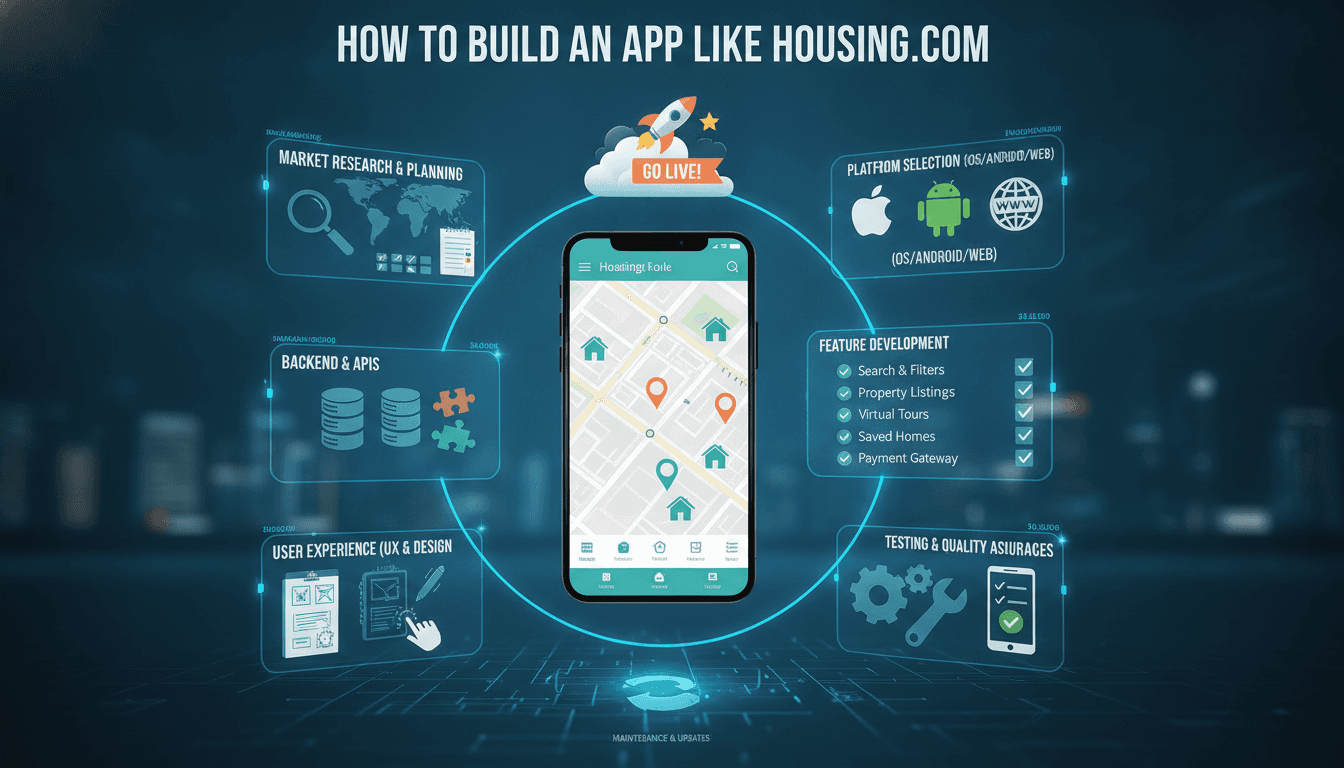
Building a real estate platform at the scale of Housing.com means handling property search, geo-tagged listings, map integrations, verified user flows, and enough concurrent traffic to not fall over during a Sunday afternoon browsing surge. This post breaks down the architecture, the cost centres, and the decisions that actually matter.
What Does a Platform Like Housing.com Actually Do Under the Hood?
Housing.com is not just a listings aggregator. It combines property search with geospatial data, broker and owner verification, lead management, home loan integrations, and increasingly, AI-powered price estimates. Each of those is a distinct system with its own data model and latency requirements.
At a high level, you are building:
- A listings ingestion pipeline (from brokers, owners, and scraping partners)
- A geospatial search engine that can filter by polygon, radius, or locality name
- A media pipeline for floor plans, images, and virtual tours
- A user identity and verification layer
- A lead routing engine connecting buyers/renters to sellers/brokers
- A demand forecasting and pricing intelligence layer
The reason most real estate portals struggle at scale is that these systems are often bolted together rather than designed as composable services from the start.
The Core Technical Stack
Geospatial Search
This is where most teams make their first expensive mistake. Standard relational databases with lat/lng columns will not scale past a few hundred thousand listings without serious pain. The right tool depends on your query pattern.
PostgreSQL with the PostGIS extension handles polygon-based search well up to roughly 5–10 million listings if you index correctly with GIST indexes on geometry columns. Beyond that, or if you need sub-100ms response times under load, Elasticsearch with its geo_shape and geo_distance query types is the practical choice. Housing.com-scale platforms typically run Elasticsearch as the primary search index with a relational database (PostgreSQL or MySQL) as the source of truth.
One thing to get right early: store geometries in WGS84 (EPSG:4326) but project to a metric CRS like EPSG:3857 for distance calculations. Doing this wrong produces subtle errors that are painful to debug after data is live.
Media Pipeline
Property images are high-volume and high-variance in quality. You need a pipeline that:
- Accepts raw uploads from mobile or web
- Runs automated quality checks (blur detection, aspect ratio validation)
- Generates multiple resolutions for responsive delivery
- Strips EXIF metadata for privacy
- Delivers via a CDN
AWS S3 plus CloudFront is a reasonable default. Use AWS Lambda or a dedicated worker service (Celery on Python, or BullMQ on Node) for async image processing. For floor plans, consider a separate flow that runs OCR or computer vision to extract room labels, which feeds your search index.
Listing Ingestion and De-duplication
Duplicate listings are a structural problem on any real estate platform. Brokers re-list the same property under different titles. Owners and brokers both list the same flat. Without de-duplication, your platform erodes trust fast.
A reasonable approach: generate a fingerprint from a combination of address tokens, geo-coordinates (snapped to an H3 grid at resolution 9, which gives ~0.1 km² hexagons), BHK configuration, and approximate area. Run a fuzzy match on incoming listings against this fingerprint. Flag matches above a threshold for manual review or automated merge.
H3 by Uber is purpose-built for this kind of hierarchical geospatial indexing and is significantly easier to work with than S2 for most real estate use cases.
/// Not sure where to start?
Get the architecture before you commit
Tell us what you're building and we'll map the technical approach, stack, and rough timeline. No cost, no obligation, no sales call required.
How Much Does It Cost to Build?
This is the question that shapes every architectural decision. Here is a realistic breakdown for an MVP that covers property search, listings, and lead management for a single city.
| Component | Estimated Build Time | Rough Cost Range (USD) |
|---|---|---|
| Backend API (Node.js or Django) | 10–14 weeks | $30,000–$50,000 |
| Geospatial search (ES + PostGIS) | 4–6 weeks | $12,000–$20,000 |
| iOS + Android apps | 12–16 weeks | $40,000–$70,000 |
| Web portal (React) | 8–10 weeks | $20,000–$35,000 |
| Media pipeline | 3–4 weeks | $8,000–$14,000 |
| Broker/owner verification | 3–4 weeks | $10,000–$18,000 |
| Total MVP | ~6–9 months | $120,000–$207,000 |
These are build costs, not operational costs. Elasticsearch on AWS runs $300–$800/month for a three-node cluster adequate for early scale. Add CloudFront, RDS, and application servers and you are looking at $1,500–$3,000/month infrastructure at launch.
Housing.com itself has raised over $150 million in funding historically. You are not replicating their current platform. You are building something that can grow into it.
What Are the Biggest Technical Risks?
Data Quality
A real estate platform is only as good as its data. Listings with wrong pin codes, stale prices, or misleading images create drop-off at critical points in the funnel. Build data validation at ingestion, not as an afterthought. Invest in a moderation workflow early. This is operational work as much as engineering work.
Search Relevance
Geospatial filtering is table stakes. Relevance ranking is where you differentiate. A listing 200 metres from the searched location but with three times the floor space may be more relevant than the closest result. Build a scoring model that weighs distance, recency, completeness of listing data, and user engagement signals (click-through rate, time on listing). Start simple with a weighted linear model; move to a learning-to-rank model (LambdaMART via XGBoost or LightGBM) once you have enough interaction data.
Broker Trust and Spam
Without verification, brokers will spam your platform. Require phone OTP at minimum, Aadhaar-based verification for Indian markets (via DigiLocker API), and a listing quota per account until trust is established. Rate-limit the listing creation API aggressively on new accounts.
Mobile App Architecture
React Native works well here if your team is predominantly JavaScript. Flutter is faster to a polished UI but the native map integrations (Google Maps SDK, Mapbox) require more bridging work. If maps are central to your UX, consider native iOS (Swift) and Android (Kotlin) for the map-heavy screens, with a shared React Native shell for the rest. This hybrid approach is uncommon but legitimate for performance-critical map interactions.
For offline support, consider caching recently viewed listings with WatermelonDB (React Native) or Room (Android). Users in areas with patchy connectivity will thank you.
Conclusion
The technical foundation of a Housing.com-style platform is not exotic. It is a disciplined combination of geospatial search, a clean media pipeline, strong data validation, and a lead routing layer. The mistakes that sink these projects are almost always in data quality and duplicate listings, not in the application layer.
If you are evaluating whether to build in-house or with a development partner, the geospatial search configuration and the listing de-duplication logic are the two areas where experienced hands save the most time. Everything else is well-trodden ground.
Reach out to the Sodio team if you want to talk through your architecture before you start writing code.
FAQ
How long does it take to build a real estate app like Housing.com? An MVP covering listings, search, and lead management for a single city takes roughly 6–9 months with a team of 6–8 engineers. A full-featured platform with AI pricing, verified broker profiles, and home loan integrations is realistically an 18–24 month build. Scope directly drives timeline.
Which database is best for property search? PostgreSQL with PostGIS handles most use cases up to around 5–10 million listings. For anything larger or requiring sub-100ms search under high concurrency, Elasticsearch with geo_shape queries is the practical choice. Most production platforms run both: Postgres as source of truth, Elasticsearch as the search index.
Do I need a separate app for brokers and buyers? Not necessarily. A role-based single app works well at early scale and keeps your maintenance overhead lower. Separate apps make sense once broker workflows (bulk listing uploads, CRM integrations, analytics dashboards) diverge significantly from the buyer experience, which typically happens post-Series A.
How do I handle duplicate property listings? Generate a fingerprint from a combination of geo-coordinates snapped to an H3 grid, BHK configuration, and approximate area. Run fuzzy matching on incoming listings against existing ones. Listings above a similarity threshold get flagged for merge or manual review. This will not catch everything, but it reduces duplicates by 70–80% in practice.
What is the realistic infrastructure cost for a real estate platform at launch? A launch-ready setup on AWS covering Elasticsearch, RDS PostgreSQL, CloudFront, and application servers runs roughly $1,500–$3,000/month. That covers moderate traffic and a single regional deployment. Costs scale non-linearly once you add real-time notifications, ML inference endpoints, and multi-region redundancy.
Have a project in mind? Contact Sodio Technologies to discuss your requirements and explore the right technology solution for your business.
/// Work with us
Talk to the engineers who'd build it
You'll get a technical scope, timeline and cost estimate from the people doing the work, not an account manager. In-house team, no subcontracting, since 2016.