

How to Make an App Like PropertyGuru
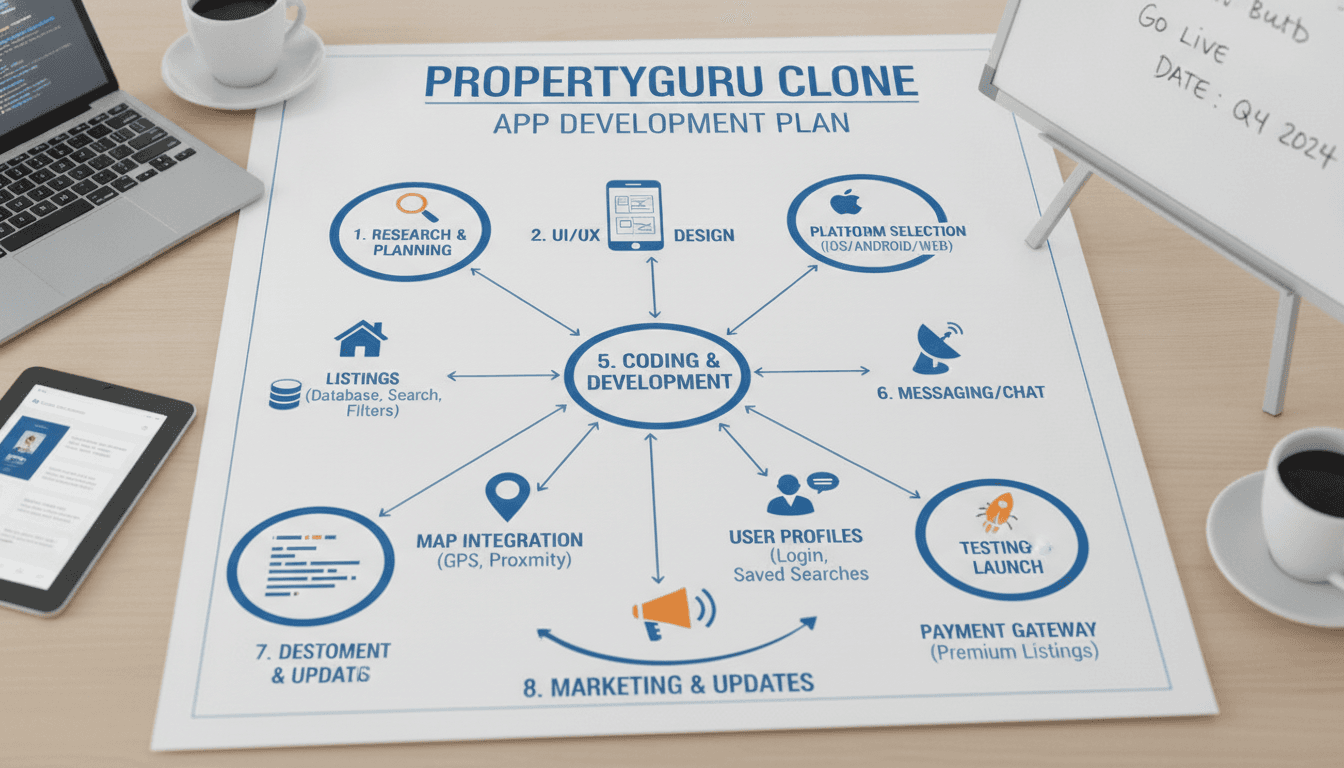
A practical breakdown of the architecture, feature set, and cost drivers behind a property listing platform — written for engineers who need to scope and build one.
What Does a Platform Like PropertyGuru Actually Do Under the Hood?
PropertyGuru is not a simple listings board. It is a multi-sided marketplace connecting buyers, sellers, renters, and agents, with a separate SaaS layer for agencies. At its core, you have four distinct product surfaces: a consumer search interface, an agent/developer portal, a lead management system, and an analytics dashboard. Each of these has meaningfully different data access patterns and scaling requirements.
The search interface is read-heavy and latency-sensitive. Users expect sub-200ms results with geospatial filtering, image loading, and mortgage estimates rendered in a single page interaction. The agent portal is write-heavy: listings being created, edited, boosted, and expired on a continuous basis. Lead management is event-driven. The analytics layer is batch-heavy.
If you treat all four surfaces as a single monolithic application, you will hit scaling bottlenecks quickly. The correct call is to split these along service boundaries from day one, even if the team is small.
Core Architecture: What You Actually Need to Build
Data Model
The property listing is the central entity, but it is not a flat record. A listing has:
- A canonical address, resolved against a geodata provider such as Google Maps Platform or HERE
- One or more media assets (images, floor plans, virtual tours)
- A pricing history, not just a current price
- An availability state machine (active, under offer, sold/let, archived)
- Agent or developer attribution with ownership rules
Use PostgreSQL with PostGIS for the core listing store. PostGIS gives you native geospatial queries — radius search, polygon filtering for neighbourhood boundaries — without pulling in a separate geo database. For full-text search across listing descriptions and location names, Elasticsearch or OpenSearch sitting alongside Postgres is the standard pattern. Do not try to do full-text search in Postgres at scale; it works at low volume but degrades under concurrent load.
Media Pipeline
Images are the most infrastructure-intensive part of a property platform. A single listing may have 30 to 50 high-resolution images. You need:
- Upload directly to object storage (S3 or GCS) via pre-signed URLs, bypassing your API server
- An async image processing pipeline (resize, WebP conversion, watermarking) triggered by storage events
- A CDN in front of processed images — CloudFront or Fastly
Video walkthroughs and 3D tours (Matterport-style) require a separate pipeline with Cloudflare Stream or Mux for transcoding and adaptive bitrate delivery.
Search and Discovery
Geospatial search is the hard part. Users filter by:
- Draw-on-map polygons (arbitrary shapes)
- Named localities (suburb, postcode, MRT/metro catchment)
- Commute time, which requires a routing API call
Elasticsearch with geo_shape queries handles polygon search well. For commute-time filtering, you will need to call a routing API (Google Distance Matrix or OpenRouteService for cost control) and cache aggressively — commute times do not change minute to minute.
Ranking is where most teams underinvest. Basic ranking by recency or price works for an MVP. At production scale, you want a learning-to-rank model trained on click and lead conversion signals. PropertyGuru uses a tiered sponsored listing model on top of organic rank, which means your ranking system needs to blend paid placement rules with relevance signals cleanly.
How Much Does It Cost to Build?
Scope determines cost more than any single technology decision.
| Scope | Estimated Build Time | Rough Budget (USD) |
|---|---|---|
| MVP (listings, search, agent portal, basic leads) | 4–5 months | $60,000–$90,000 |
| Mid-market (above + mortgage tools, map search, CRM integration) | 7–9 months | $120,000–$180,000 |
| Full-scale platform (above + analytics, ML ranking, multi-country) | 12–18 months | $250,000–$450,000+ |
These ranges assume a team of 4–6 engineers. Infrastructure costs at launch are modest — you can run the MVP stack on under $1,500/month in AWS spend. That number grows non-linearly once you are storing and serving tens of millions of images and running ML inference at query time.
The biggest hidden cost is geodata licensing. Google Maps Platform pricing for a platform with significant API call volume can run to $10,000–$30,000/month. Budget for this early, or evaluate HERE or Mapbox as alternatives depending on your geography.
/// Not sure where to start?
Get the architecture before you commit
Tell us what you're building and we'll map the technical approach, stack, and rough timeline. No cost, no obligation, no sales call required.
What Integrations Are Non-Negotiable?
Identity and Agents
Agents are your supply side. You need a credentialing layer that can verify agent licence numbers against a regulatory body (CEA in Singapore, RERA in India, etc.). This is often a manual workflow with an API wrapper rather than a clean third-party integration, so build an internal review queue from the start.
Payments and Lead Credits
PropertyGuru monetises through listing credits and boosting. This requires a wallet or credit system, not just a payment gateway. Agents buy credits via Stripe or Razorpay and spend them on listing actions. Your payment service needs to handle idempotency carefully — a failed network call during a boost action should not charge twice or fail silently.
Mortgage Calculators
These are typically not live rates. They pull from a rate table that is updated periodically via a bank feed or manually. Build this as a separate config-driven service rather than hardcoding rate logic into your frontend.
CRM for Agencies
Larger agencies want listing data synced with their CRM (Salesforce, HubSpot, or a custom agency tool). A webhook-based outbound integration is the right pattern here. Do not build a full bidirectional sync on day one; outbound webhooks get you 80% of the value at 10% of the complexity.
How Do You Handle Multi-Country Expansion?
This is where platforms typically accumulate the most technical debt. Currency, language, legal entity, and property taxonomy all vary by market.
The taxonomy problem is underappreciated. Property types, tenure categories, and measurement units (square feet vs square metres) differ enough between markets that a single shared schema becomes unwieldy. The cleaner approach is a tenant-aware configuration layer where each market can define its own listing attributes, rather than trying to normalise everything into one global schema.
For currency, store all monetary values in the minor unit of the local currency (paise, cents, satang) as integers. Never store floats for money. Use an ISO 4217 currency code column alongside every price field.
Localisation of content (listing descriptions, UI strings) via i18next or a similar framework is table stakes. Machine translation of user-generated listing content using DeepL or Google Cloud Translation is acceptable for search indexing but should be flagged clearly in the UI if shown to users.
Conclusion
Building a PropertyGuru-equivalent is a two to three year product journey, not a six-month sprint. The technical problems — geospatial search, media pipelines, ranking, multi-market data models — are all solvable with well-understood tools. The harder work is sequencing: knowing which parts of the platform gate growth and building those first.
Start with a tight MVP: listings, map search with PostGIS and Elasticsearch, a single-market agent portal, and Stripe-based credit purchases. Get real agents using it. The ranking model, the CRM integrations, and the multi-country config layer are second and third phase work.
If you are scoping this build now, the most useful next step is a two-week technical discovery engagement to map your target market's specific regulatory and taxonomy requirements before writing a line of code.
FAQ
How long does it take to build a property portal like PropertyGuru? A functional MVP with listings, map search, and an agent portal takes roughly four to five months with a team of four to six engineers. A production-ready platform with ML ranking, multi-country support, and agency CRM integrations is a twelve to eighteen month build. Most teams underestimate the media pipeline and geodata integration timelines significantly.
What tech stack should I use for a property listing platform? PostgreSQL with PostGIS for the listing and geospatial data store, Elasticsearch or OpenSearch for full-text and faceted search, React or Next.js on the frontend, and Node.js or Python (FastAPI) for backend services. Object storage (S3 or GCS) with a CDN for media. This stack is well-supported, has broad hiring availability, and scales to tens of millions of listings.
How do I handle geospatial search for property listings?
Use Elasticsearch with geo_shape queries for polygon and radius filtering. Store canonical coordinates against each listing using a geocoding provider. For commute-time search, call Google Distance Matrix or OpenRouteService and cache results by origin-destination pair. PostGIS in your primary database handles administrative boundary queries and reporting well.
What are the biggest cost drivers in a property platform build? Engineering time is the largest cost. After that, geodata licensing (Google Maps Platform at scale can exceed $20,000/month), CDN and object storage for media, and ML infrastructure if you are running a learning-to-rank model at query time. Many teams overpay on cloud compute early by not separating read and write workloads or caching search results aggressively enough.
Should I build a native mobile app or a web app first? Build the web app first. Progressive Web Apps on Next.js cover the majority of property search use cases, and most property searches start on a browser. Build native iOS and Android apps once you have validated product-market fit and agent supply. React Native is a reasonable choice for the mobile layer given shared logic with a React web codebase, though map-heavy interactions often require native modules.
Have a project in mind? Contact Sodio Technologies to discuss your requirements and explore the right technology solution for your business.
/// Work with us
Talk to the engineers who'd build it
You'll get a technical scope, timeline and cost estimate from the people doing the work, not an account manager. In-house team, no subcontracting, since 2016.