

How to Make an App Like Maven
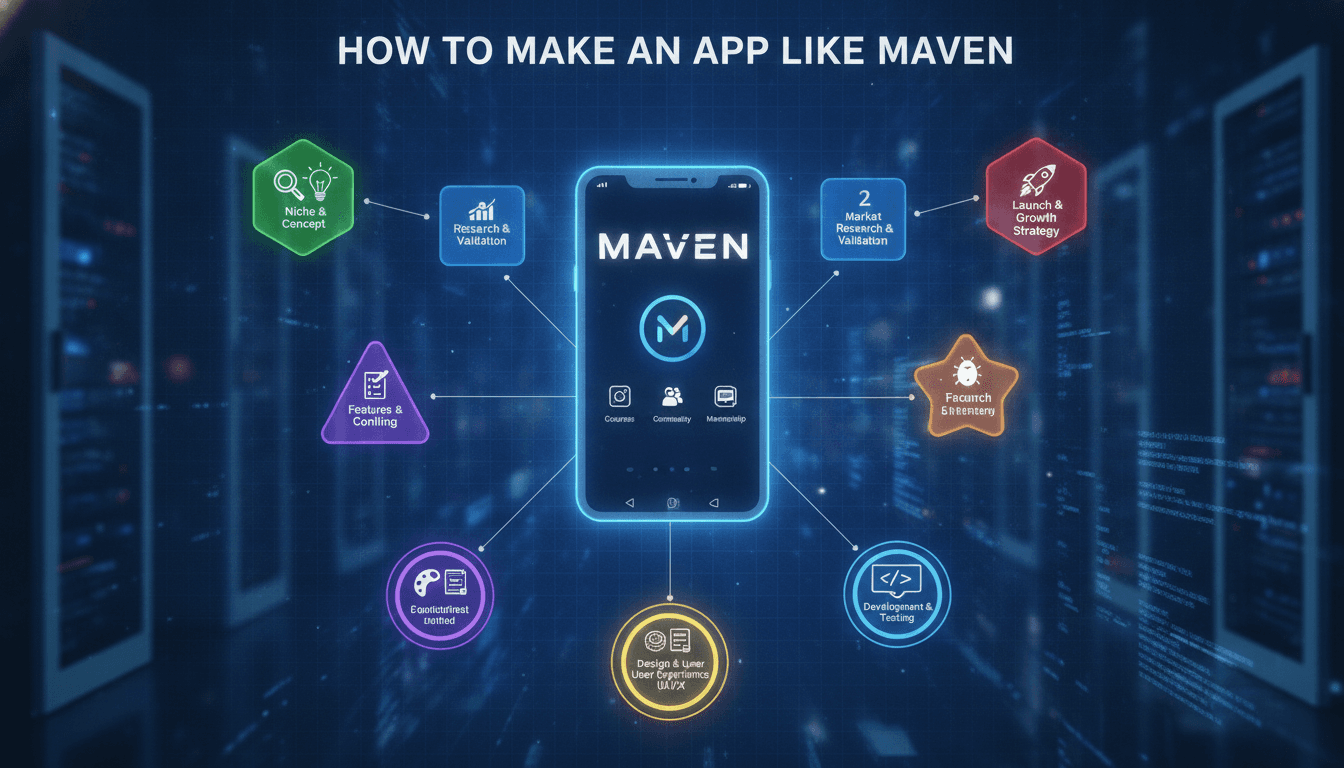
A practical breakdown of the architecture, features, and engineering decisions behind building a professional networking and mentorship platform like Maven — from matching logic to monetisation infrastructure.
What Makes Maven Different from a Generic Networking App?
Maven sits in a specific niche: paid, cohort-based learning and expert-led communities. That distinction matters enormously for your data model and your business logic.
For a closer look at a related topic, read our guide on How to Make an App Like Groupon.
A standard social network stores connections and feeds. Maven stores structured expert profiles, course cohorts, session scheduling, payment splits between host and platform, and community access gating. Each of those is a non-trivial domain.
The core entities you are building around:
- Experts/Hosts — users who create courses, host sessions, or run communities
- Learners — users who pay to access content or sessions
- Cohorts — time-boxed groups of learners moving through structured content together
- Sessions — live video calls, AMAs, or workshops attached to a course or community
- Communities — persistent spaces with feeds, channels, and membership tiers
If you try to shoehorn these into a generic user-content-follow graph, you will spend six months undoing that decision.
What Does the Core Technical Stack Look Like?
Backend
Node.js with TypeScript or Go are both reasonable choices. Go performs better under concurrent scheduling load (many simultaneous session bookings), but Node's ecosystem around payment SDKs and video APIs is broader. Most teams building this at seed or Series A stage pick Node.js with Express or Fastify and move to a service boundary later.
Your database layer will likely need two things running in parallel: PostgreSQL for transactional data (users, payments, enrolments) and a search layer like Elasticsearch or Typesense for expert/course discovery. Do not try to run discovery queries against your primary Postgres instance at scale.
We cover a closely related subject in How to Make an App Like Meetup.
For the session scheduling engine, you need to handle timezone normalisation carefully. Store everything in UTC. Render in the user's local timezone on the client. This sounds obvious and gets wrong constantly.
Frontend and Mobile
React on web, React Native or Flutter for mobile. If your primary use case is desktop-first (most professional learning platforms are), invest in the web experience first and treat mobile as a companion app.
To explore this further, see How to Make an App Like TripAdvisor.
The one exception: if push notifications for session reminders are critical to your retention loop, you need native or React Native from day one. Flutter works here too, but your video SDK integration will need validation against whichever provider you pick.
Video Infrastructure
Do not build your own WebRTC stack. Use Daily.co, Agora, or Twilio Video. Daily has a flat per-minute pricing model that is predictable at low volume. Agora's pricing is competitive at higher concurrency but the SDK documentation has historically been inconsistent. Twilio Video is the most reliable but the most expensive.
For recorded sessions, you need a CDN-backed storage layer. AWS CloudFront with S3 origin works fine. Transcode with AWS MediaConvert or Mux if you want adaptive bitrate playback without managing FFmpeg yourself.
/// Not sure where to start?
Get the architecture before you commit
Tell us what you're building and we'll map the technical approach, stack, and rough timeline. No cost, no obligation, no sales call required.
How Does the Matching and Discovery Engine Work?
This is the part that separates a credible platform from a directory with a search bar.
Maven-style discovery is not purely keyword search. It combines:
- Structured tags (topics, industries, experience level)
- Availability windows (so you surface experts who can actually take a session this week)
- Social proof signals (number of past sessions, ratings, repeat bookings)
- Recency and activity (an expert who last logged in eight months ago should rank lower)
A simple implementation uses Typesense or Elasticsearch with weighted fields. You boost on rating_score, sessions_completed, and last_active_at. You filter on availability before scoring.
The harder problem is cold start. A new expert has no sessions, no ratings, no signal. Options:
- Manual curation during onboarding
- A lower price tier for "new experts" to drive initial bookings
- Synthetic social proof from beta users (ethically disclosed)
Most platforms underinvest here and end up with a graveyard of expert profiles that never convert.
Payments, Splits, and Platform Economics
This is where most teams spend the least time in planning and the most time in debugging.
Maven operates on a revenue split model: the platform takes a percentage of each transaction. Stripe Connect is the standard implementation. The host is a Connected Account, the platform collects the full charge and transfers the host's share minus platform fee.
| Scenario | Stripe Product | Notes |
|---|---|---|
| One-off session booking | Stripe Checkout + Connect | Simplest path |
| Subscription community | Stripe Billing + Connect | Requires webhook-driven entitlement logic |
| Cohort with instalment payments | Stripe Payment Intents + schedules | More complex, test refund flows early |
| International hosts | Stripe Connect cross-border | Payout timing varies by country |
Build your refund and dispute logic before you launch. Not after your first chargeback.
For tax, if you are selling in the EU, you are responsible for VAT on digital services from day one. Stripe Tax handles this automatically if you configure it correctly. Do not defer this.
What Infrastructure Do You Need to Handle Scale?
At under 10,000 monthly active users, a single-region deployment on AWS or GCP is fine. Use managed services: RDS for Postgres, ElastiCache for Redis (session caching, rate limiting, presence), and ECS or Cloud Run for your application layer.
The session scheduling service should be decoupled early. When a user books a session, you write to a queue (SQS or Pub/Sub) and a worker handles calendar invites, Zoom or Daily room creation, and notification dispatch. Do not do this synchronously in the booking request handler. If the video API is slow, your booking page times out.
For notifications: Firebase Cloud Messaging for push, SendGrid or Postmark for transactional email. Postmark has better deliverability for transactional volume. SendGrid is cheaper at high volume but needs more configuration to avoid spam folders.
Monitoring from day one: Datadog or Grafana Cloud with structured logging. The failure modes on a session platform (expert no-shows, video room creation failures, payment webhook drops) are specific enough that generic uptime monitoring will not catch them in time.
Conclusion
Building a Maven-equivalent is a 9 to 14 month project for a team of four to six engineers, depending on how much of the video and payment infrastructure you abstract versus build. The core complexity is not any single feature. It is the integration surface between scheduling, payments, video, notifications, and access control, all of which need to be consistent with each other at all times.
If you are at the stage of deciding whether to build this internally or engage an external team, the honest question to ask is: do you have engineers who have shipped payment split logic and real-time scheduling before? If not, the time to learn on the job adds six months minimum.
The next step is a scoping session that maps your specific use case (community, course, one-to-one sessions, or a combination) to a build sequence. Start there before you commit to a stack.
FAQ
How long does it take to build an app like Maven? A production-ready platform with expert profiles, session booking, payments, and basic community features takes 9 to 14 months with a team of four to six engineers. A stripped-down MVP covering just one-to-one sessions and payments can be done in 4 to 5 months if scope is tightly controlled from the start.
How much does it cost to build a Maven-style platform? Costs vary widely by region and team structure. A typical build with a mid-size product engineering team runs between $150,000 and $400,000 for the initial version. Ongoing infrastructure costs at early scale (under 5,000 MAU) are generally under $2,000 per month using managed cloud services.
Which video API should I use for a Maven-like platform? Daily.co is the easiest to integrate and has predictable per-minute pricing. Agora is worth evaluating at higher concurrency volumes. Twilio Video is the most stable but most expensive. Avoid building on raw WebRTC unless you have a dedicated media engineering team, which most product companies do not.
Do I need a separate mobile app from day one? Not necessarily. Most professional learning platforms see 70 to 80% of their usage on desktop. A well-optimised web app with progressive web app (PWA) capabilities covers most early use cases. Invest in native mobile when push notification-driven retention becomes a measurable priority for your growth model.
How do I handle the cold start problem for expert matching? Cold start is primarily a supply-side problem. Pre-screen and manually curate your first 50 to 100 expert profiles. Offer reduced platform fees or promotional visibility to early experts who complete their profiles fully. Build your ranking algorithm to weight recency and responsiveness so active new experts surface over inactive established ones.
Have a project in mind? Contact Sodio Technologies to discuss your requirements and explore the right technology solution for your business.
/// Work with us
Talk to the engineers who'd build it
You'll get a technical scope, timeline and cost estimate from the people doing the work, not an account manager. In-house team, no subcontracting, since 2016.