

How to Make an App Like Meetup
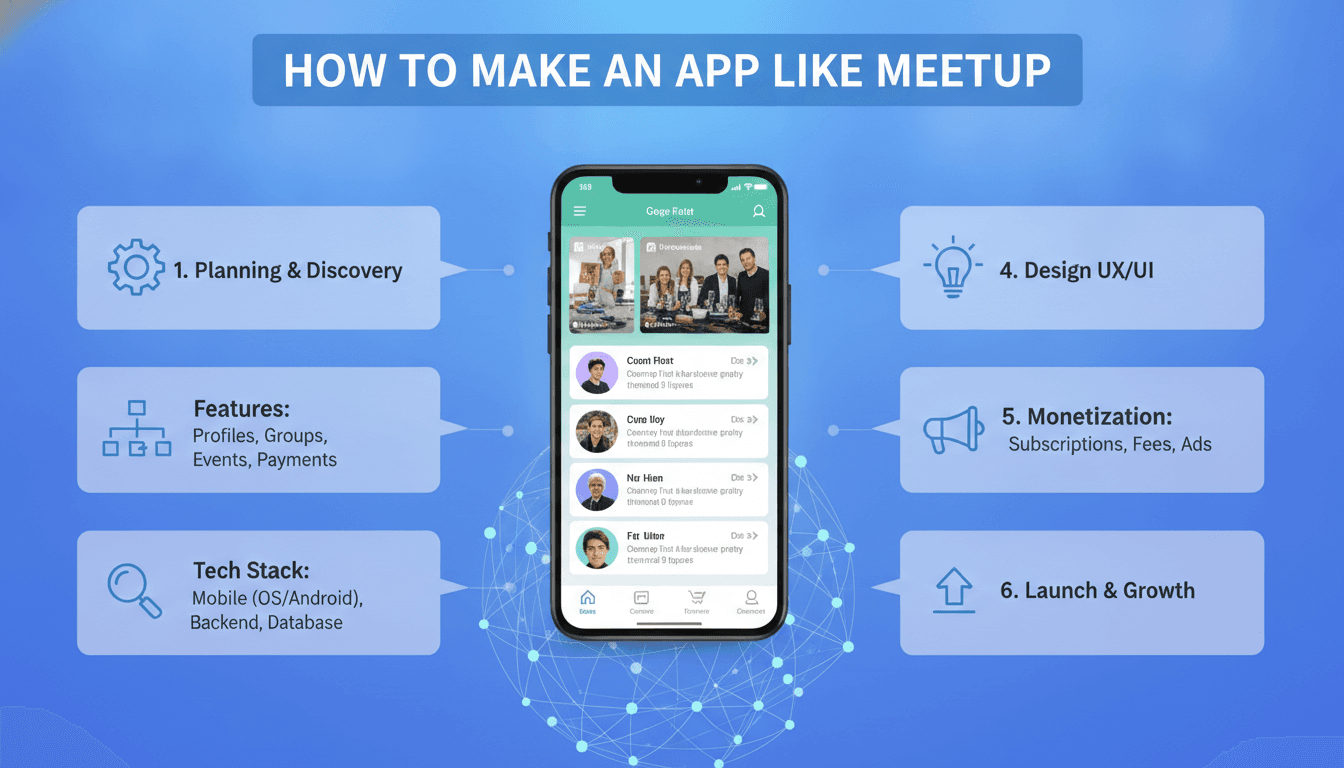
Building a community events platform is more involved than it looks. The core loop — create event, invite people, collect RSVPs — is straightforward. Everything around it is not.
This post walks through the architecture, feature set, and engineering decisions you'll face if you're building something in the same space as Meetup. It assumes you've shipped a mobile or web product before and want the specifics, not a feature checklist.
You may also find our article on How to Make an App Like RSVPify useful.
What Does a Meetup-Like App Actually Need to Do?
Meetup's product is deceptively simple on the surface. Organisers create groups, schedule events, and members RSVP. Under the hood, you're building:
- A content graph (users, groups, events, memberships, attendance)
- A discovery layer (location-based search, category filtering, personalised recommendations)
- A real-time notification system
- A payments layer for paid events
- A messaging layer for group communication
Each of these is a non-trivial subsystem. The question is which ones you build yourself and which you delegate to third-party services.
To explore this further, see How to Make an App Like Maven.
Data Model First
Get the entity relationships right before writing any API code. The core entities:
| Entity | Key relationships |
|---|---|
| User | belongs to many Groups, attends many Events |
| Group | has many Events, has many Members (Users) |
| Event | belongs to one Group, has many Attendees |
| Membership | join table: User ↔ Group, with role (organiser, member, moderator) |
| Attendance | join table: User ↔ Event, with status (going, waitlisted, not going) |
Keep memberships and attendance as first-class models with status fields. Trying to bolt on waitlists or roles later is painful.
How Should You Handle Location and Event Discovery?
Discovery is where Meetup does its best work and where most clones fall short. Users need to find events near them without knowing what to search for.
For geospatial queries, PostgreSQL with the PostGIS extension handles the majority of use cases at scale. A ST_DWithin query on an indexed geography column returns nearby events in under 10ms for tables with millions of rows, provided you've set up a GIST index correctly. You don't need a dedicated geo database until you're past 50–100 million rows.
For search and filtering by category, Elasticsearch (or OpenSearch if you want a managed AWS-native option) gives you full-text search, faceted filtering, and the ability to combine geo distance with relevance scoring. Syncing Postgres to Elasticsearch via a CDC pipeline (Debezium is reliable for this) keeps your source of truth in Postgres without dual-write complexity.
Personalised recommendations are a longer investment. A basic collaborative filtering model trained on attendance history can lift click-through meaningfully, but it needs data. If you're pre-launch, start with rule-based recommendations (events in groups the user follows, popular events nearby) and instrument everything so you have a training dataset when you're ready.
/// Not sure where to start?
Get the architecture before you commit
Tell us what you're building and we'll map the technical approach, stack, and rough timeline. No cost, no obligation, no sales call required.
What's the Right Tech Stack for This?
There's no single answer, but here's what we'd reach for at Sodio for a greenfield build targeting both iOS and Android with a web presence.
Backend: Node.js (with TypeScript) or Go for the API layer. Go is faster and cheaper to run at scale; Node.js has a larger hiring pool and faster iteration in the early stages. Either works. Use PostgreSQL as your primary datastore, Redis for session management and rate limiting, and a message queue (RabbitMQ or AWS SQS) for async tasks like email dispatch and push notifications.
Frontend web: Next.js 14 with the App Router. Server-side rendering matters for event pages because they need to be indexable by search engines — organic discovery is a meaningful growth channel for this category of app.
Mobile: React Native is the pragmatic choice if you want a shared codebase. Flutter is faster to render and has better animation primitives, but the ecosystem for things like maps (Google Maps SDK integration, MapLibre) is more mature on React Native. If budget allows, native Swift and Kotlin give you better access to platform capabilities like Widgets and Live Activities.
Payments: Stripe Connect. This is the right call for a marketplace-style payment flow where organisers collect money from attendees. It handles KYC, payouts, and currency conversion. Building your own payment routing is not worth the compliance overhead unless you're processing hundreds of millions annually.
Push notifications: Firebase Cloud Messaging (FCM) covers both Android and iOS. Pair it with a service like OneSignal or Expo Notifications if you want a management layer without building one.
Real-Time Features
Group chat and event announcements need real-time delivery. WebSockets work, but managing connections at scale (especially across multiple API server instances) requires a pub/sub layer. Redis Pub/Sub is sufficient up to a moderate scale. Beyond that, a dedicated service like Ably or Pusher is cheaper to operate than building your own Socket.IO cluster.
You may also find our article on How to Make an App Like Peatix useful.
How Long Does It Take and What Does It Cost?
This is usually the question that matters most.
A minimum viable version — group creation, event creation, RSVP, basic discovery, user profiles, push notifications — takes a team of four (two backend, one frontend/mobile, one designer/PM) roughly 16–20 weeks to ship in a testable state. That assumes experienced engineers, not a team learning the stack.
Rough engineering cost estimates (at market rates for a good team):
| Scope | Approximate duration | Approximate cost (USD) |
|---|---|---|
| MVP (as above) | 16–20 weeks | $80,000–$120,000 |
| MVP + payments + group chat | 24–30 weeks | $130,000–$180,000 |
| Full-featured v1 with recommendations | 36–48 weeks | $200,000–$300,000 |
These are order-of-magnitude estimates. The variance is real. Payments and compliance work routinely take twice as long as planned. Discovery and recommendation features are open-ended by nature.
The Parts Most Teams Underestimate
Moderation tools. Meetup has had significant problems with spam groups and fake events. You need basic moderation from day one: report mechanisms, organiser verification, automated duplicate detection. This is unsexy engineering that protects the platform's integrity.
Email deliverability. Event reminders, RSVP confirmations, and digest emails are your primary retention mechanism. Using SendGrid or Postmark with proper SPF, DKIM, and DMARC configuration is table stakes. Budget time for this — it's often deprioritised and then becomes a crisis.
Timezone handling. Events span timezones. Store all timestamps in UTC. Display in the user's local timezone. Use a library like date-fns-tz or Luxon rather than rolling your own timezone logic. This sounds trivial and bites everyone who treats it as trivial.
Recurring events. "Repeat this event every Tuesday" sounds simple. The data model for recurring events with exceptions (cancelled instances, rescheduled instances) is a known hard problem. Look at the iCalendar spec (RFC 5545) before you design this. Many teams implement it badly the first time.
Conclusion
The technical fundamentals for a Meetup-like platform are well-understood. Postgres with PostGIS, a solid React Native or Flutter mobile app, Stripe Connect for payments, and a sensible async job system get you most of the way there.
The hard parts are the ones that don't show up in architecture diagrams: moderation, email deliverability, recurring event logic, and the gap between a working prototype and a product that feels reliable to real users.
If you're scoping this out and want an honest estimate for your specific requirements, talk to us. We've built event and community platforms and can give you a real number, not a range so wide it's useless.
FAQ
How much does it cost to build an app like Meetup? An MVP covering group creation, event scheduling, RSVP, and push notifications typically costs $80,000–$120,000 with an experienced team of four over 16–20 weeks. Adding payments, group chat, and recommendations pushes the budget to $130,000–$300,000 depending on scope and team location.
Should I build native iOS and Android apps or use a cross-platform framework? React Native or Flutter will cover 90% of use cases and halve your mobile development cost. Go native only if you need deep platform integration — things like iOS Live Activities, HealthKit, or ARKit. For an events app, cross-platform is almost always the right call at the start.
What database should I use for location-based event search? PostgreSQL with PostGIS handles geo queries well into millions of rows with a proper GIST index. For combined geo and full-text search, add Elasticsearch or OpenSearch synced via a CDC pipeline. You don't need a dedicated geo database at early scale.
How do I handle payments for paid events? Stripe Connect is the standard choice. It manages the marketplace payment flow between attendees and organisers, handles KYC for organisers, and supports payouts in over 40 currencies. Building custom payment routing is not worth the compliance overhead for most teams.
How long does it take to build an MVP? With a team of four experienced engineers and a clear scope, expect 16–20 weeks to a testable MVP. Scope creep, compliance work, and integrations like payments commonly extend this. Fixing the MVP scope tightly and shipping it before adding features is almost always the right approach.
Have a project in mind? Contact Sodio Technologies to discuss your requirements and explore the right technology solution for your business.
/// Work with us
Talk to the engineers who'd build it
You'll get a technical scope, timeline and cost estimate from the people doing the work, not an account manager. In-house team, no subcontracting, since 2016.