

How to Make an App Like News360
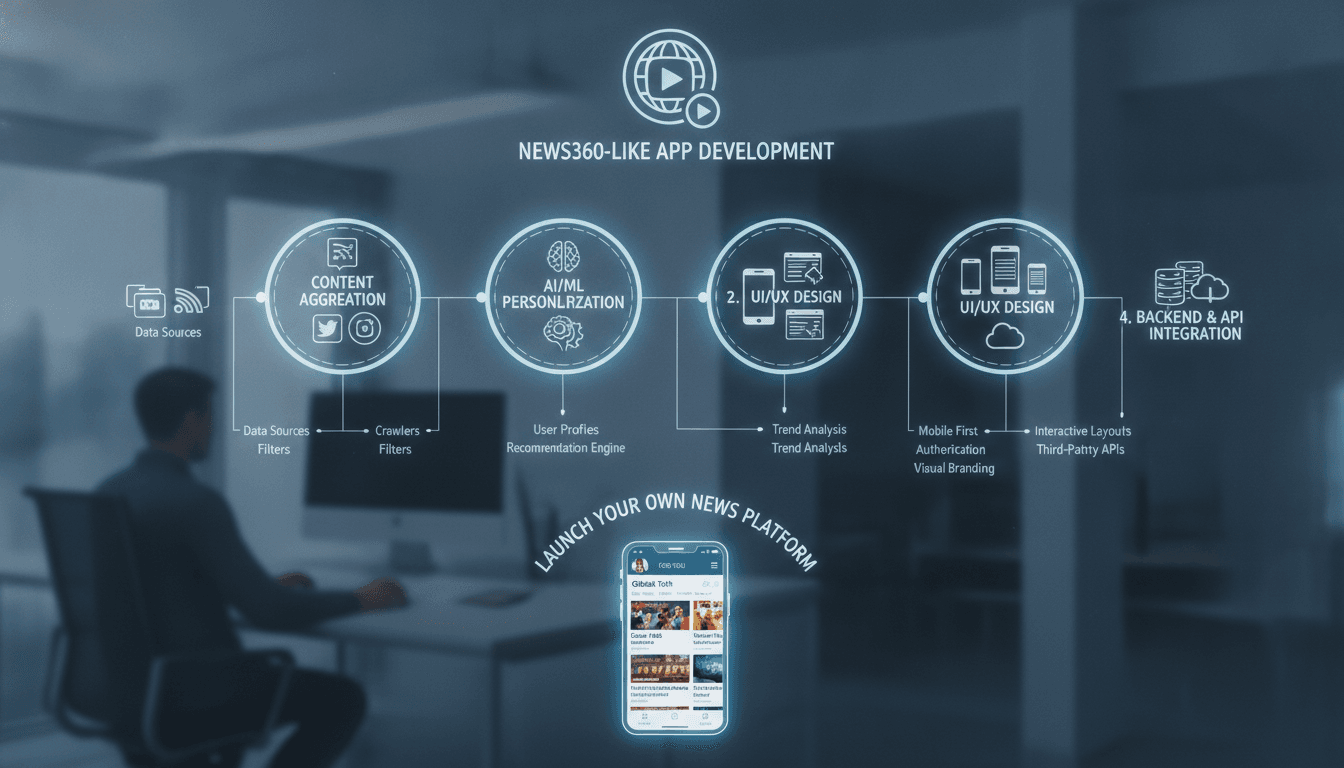
A practical breakdown of the architecture, data pipelines, and personalisation logic you need to build a news aggregation app that actually holds user attention, with honest notes on where complexity tends to bite.
What Does News360 Actually Do Under the Hood?
News360 is a news aggregator with a personalisation layer. It pulls articles from RSS feeds, APIs, and crawled sources, then ranks and filters them per user based on implicit signals like reading time, tap behaviour, and scroll depth, plus explicit signals like topic follows and source ratings.
The core loop is:
- Ingest content from hundreds of sources
- Classify and tag each article (topic, entity, sentiment)
- Build and update a per-user interest profile
- Rank candidate articles against that profile at request time
- Serve a feed, collect signals, repeat
Nothing in that loop is technically exotic. The difficulty is operational: doing it at scale, keeping latency under 300ms for feed loads, and making the personalisation actually feel useful rather than just reflective of what the user clicked five days ago.
Choosing Your Content Ingestion Architecture
This is where most teams underestimate effort. You have four content source types to handle:
| Source type | Volume | Reliability | Latency |
|---|---|---|---|
| RSS/Atom feeds | High | Medium | Minutes |
| News APIs (NewsAPI, GDELT, Bing News) | Medium | High | Seconds |
| Publisher direct integrations | Low | High | Seconds |
| Web crawling | Very high | Low | Variable |
RSS remains the workhorse. A feed poller written in Go or Python with a distributed queue (Kafka or RabbitMQ depending on your throughput requirements) handles most of the volume. For 500 active sources polled every 5 minutes, you are generating roughly 150,000 fetch attempts per day. Most return nothing new. Deduplication by URL hash and content fingerprint (MinHash works well for near-duplicate detection) reduces downstream processing load significantly.
GDELT is worth knowing about. It indexes and analyses global news in near-real time, covering broadcast, print, and web in 65 languages. Its event database and GKG (Global Knowledge Graph) can shortcut a lot of your NLP tagging work, especially for entity recognition and tone analysis.
For crawling, use Scrapy with a rotating proxy pool and a render service like Splash or Playwright for JavaScript-heavy pages. Be aware that roughly 30–40% of publisher sites actively block scrapers; budget time for maintenance.
Deduplication and Content Normalisation
Every article needs to land in a canonical form before NLP processing: clean body text (Trafilatura outperforms newspaper3k on most publisher layouts), publication timestamp, canonical URL, language tag, and source metadata.
Deduplication happens at two levels. URL-level deduplication catches reposts. Content-level deduplication (MinHash LSH with a Jaccard threshold around 0.8) catches wire service articles that 40 different outlets have published under different URLs. Skipping this step means your users see the same AP story twenty times.
How Does the Personalisation Engine Work?
The personalisation system has three separable components: classification, profile modelling, and ranking.
Article Classification
You need topic tags, named entity tags, and ideally a reading-level or complexity score. A fine-tuned BERT model (distilBERT is fast enough for production; the base model adds latency you probably cannot afford) handles multi-label topic classification reasonably well. Train on a labelled corpus like RCV1 or AG News as a starting point, then fine-tune on your own category taxonomy.
For named entity recognition, spaCy's en_core_web_trf model is production-quality. If you are covering multiple languages from day one, consider a multilingual model like XLM-RoBERTa, though you pay a meaningful accuracy penalty on English compared to monolingual models.
Sentiment is optional for the feed ranking itself but useful for user controls ("less negative news") and for analytics.
User Interest Profiles
The standard approach is a weighted topic vector that decays over time. Each implicit signal (read, share, save, skip) updates the vector with a configurable weight. Read-time weight matters: a user who spends 4 minutes on a geopolitics article is signalling more than one who taps and bounces in 8 seconds.
Decay prevents the profile from being dominated by a news cycle the user engaged with six weeks ago. An exponential decay with a half-life of 7–14 days works well for most news consumption patterns.
Collaborative filtering is worth adding once you have sufficient data (typically 50,000+ active users). It lets you surface articles a user would probably engage with based on what similar users read, which helps with discovery outside the user's known interests.
/// Not sure where to start?
Get the architecture before you commit
Tell us what you're building and we'll map the technical approach, stack, and rough timeline. No cost, no obligation, no sales call required.
Real-Time Ranking
At feed request time, you retrieve candidate articles (typically the last 24–48 hours of ingested content, filtered to the user's language and source preferences), score each against the user's profile, apply diversity constraints (no more than 3 articles from the same source, no more than 5 articles on the same topic cluster), and return the top N.
Scoring can be as simple as a dot product between the article's topic vector and the user's interest vector, boosted by recency and source quality score. Once you have training data, a learning-to-rank model (LightGBM works well here) outperforms hand-tuned heuristics significantly.
Latency target: the ranking step should complete in under 50ms. Precompute article embeddings at ingest time. Cache user profiles in Redis. Do not run NLP models in the critical path.
What Does the Mobile App Architecture Look Like?
React Native covers both iOS and Android from a single codebase and is the pragmatic choice for a team that wants to move fast without doubling the frontend headcount. Flutter is a reasonable alternative if your team already has Dart experience.
The feed screen itself is a virtualised list (FlatList in React Native with windowSize tuned for your article card size). Prefetch the next page before the user reaches the bottom. Article view should open in an in-app WebView with reader mode CSS applied, not a system browser, so you retain the session for signal collection.
Push notifications for breaking news require APNs and FCM integrations. Topic-based push segmentation (send only to users who follow a given topic) cuts notification fatigue meaningfully compared to blanket sends.
Offline mode is worth the investment. Cache the last loaded feed to AsyncStorage or SQLite. Users in low-connectivity environments, which is a significant portion of any global news app's audience, will notice.
Where Does This Get Expensive to Build?
The ingestion and NLP pipeline needs to run continuously. That is 24/7 compute, not batch. A Kubernetes cluster on GKE or EKS with autoscaling handles variable load, but you need a team comfortable operating it.
Content licensing is the non-engineering cost most teams miss. Full-text display without a licensing agreement with publishers sits in a legally grey area in many jurisdictions. Display snippets and link out, or negotiate direct deals. The EU's Copyright Directive (Article 15, in force since 2021) makes this particularly important for European markets.
Personalisation cold start is a real problem. A new user with zero signal history gets a generic feed. Onboarding flows that collect explicit topic preferences (5–10 topics, not 50) help, but the first 48 hours of user experience are genuinely worse than the steady state.
Conclusion
The architecture is tractable. A team of 4–6 engineers can build the core feed pipeline, classification layer, and mobile app in roughly 6–9 months, assuming solid experience with the relevant stack. The ongoing cost is the operational overhead of keeping the ingestion pipeline healthy as sources change their feed formats, block crawlers, or go offline.
The single most important decision early on is your deduplication strategy. Get that wrong and every downstream system deals with the consequences. Start there, get it solid, then build the personalisation layer on top of clean data.
If you are scoping this out for your own product, the first practical step is to prototype the ingestion pipeline against 50 real sources and measure your actual deduplication rate before committing to an architecture.
FAQ
How long does it take to build a news aggregation app like News360? A focused team of 4–6 engineers typically needs 6–9 months to ship a working product with personalised feeds, mobile apps for iOS and Android, and a stable ingestion pipeline. The timeline stretches if you add real-time crawling, multilingual support, or complex licensing integrations from the start.
How many sources can a news aggregation app realistically handle? RSS polling scales to thousands of sources without exotic infrastructure. NewsAPI's paid plans cover around 80,000 sources. The practical constraint is deduplication and quality control: more sources means more noise, more wire service duplicates, and more maintenance when feeds break or change format.
What NLP models work best for news article classification? DistilBERT fine-tuned on your category taxonomy is the production-ready choice for English. It runs inference in roughly 20–40ms on a T4 GPU, which is fast enough for batch processing at ingest time. For multilingual support, XLM-RoBERTa covers 100 languages but trades some accuracy for breadth.
Do you need a content licence to build a news app? Displaying full article text without a licence is legally risky, particularly in the EU under the 2021 Copyright Directive. Displaying headlines, snippets under 100 words, and linking out to the original source is generally safer, though not universally risk-free. Get legal advice specific to your target markets.
What is the biggest technical mistake teams make when building news apps? Skipping content deduplication early. Wire service articles (AP, Reuters, AFP) get republished by dozens of outlets within minutes. Without MinHash or a similar near-duplicate detection system, your feed fills with the same story from twenty sources, which destroys user trust in the personalisation layer faster than almost any other single failure.
Have a project in mind? Contact Sodio Technologies to discuss your requirements and explore the right technology solution for your business.
/// Work with us
Talk to the engineers who'd build it
You'll get a technical scope, timeline and cost estimate from the people doing the work, not an account manager. In-house team, no subcontracting, since 2016.