

How to Make an App Like SmartNews
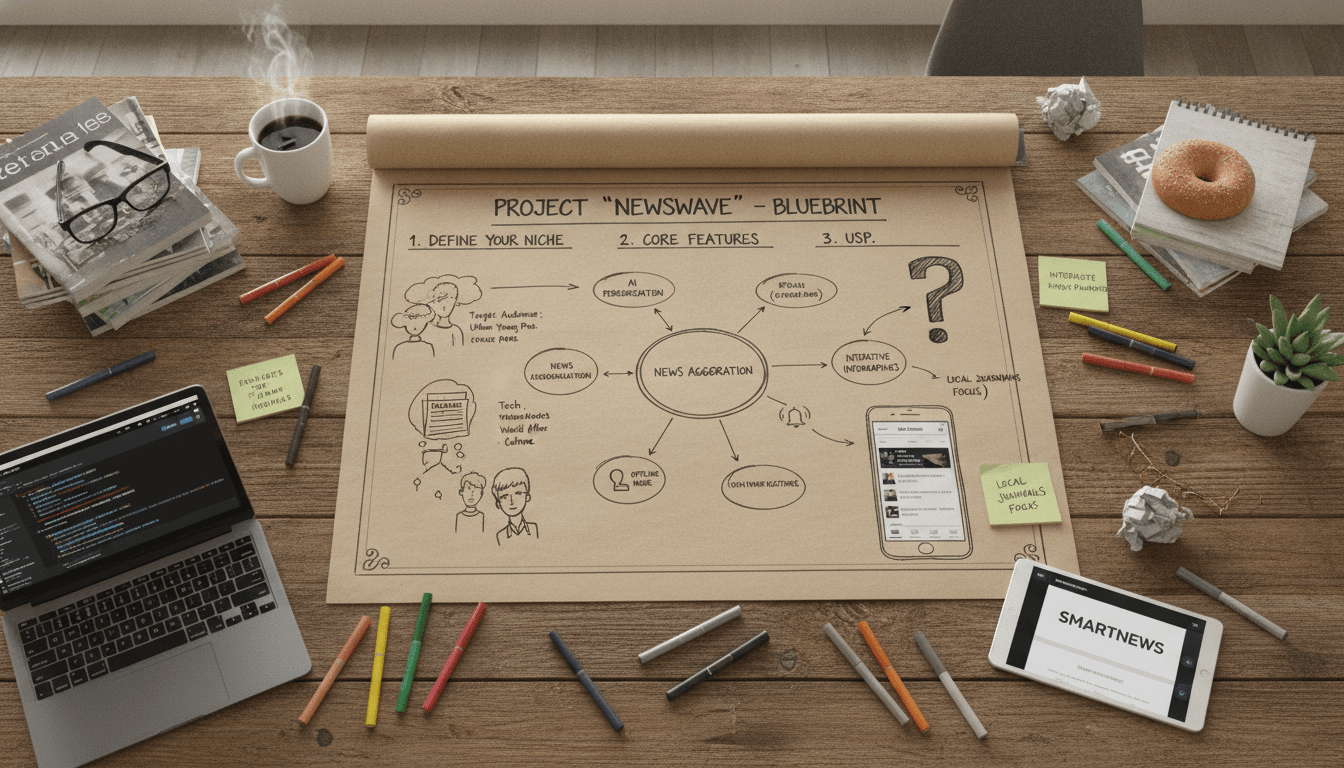
Building a news aggregation app with personalised feeds, real-time ingestion, and ML-driven ranking is a non-trivial engineering problem. This post breaks down the architecture decisions, data pipelines, and trade-offs involved — based on the kind of systems we've built at Sodio.
What Does SmartNews Actually Do Under the Hood?
SmartNews pulls articles from thousands of RSS feeds and publisher APIs, runs them through a content extraction pipeline, classifies them by topic, and then ranks each user's feed using a combination of collaborative filtering and content-based signals. The app claims over 50 million downloads globally and processes millions of articles daily.
The deceptively hard part is not fetching content — it is doing it fast enough that breaking news appears in under two minutes, while also deduplifying near-identical stories from 20 different outlets, and doing all of that at a cost that doesn't eat your margins.
Content Ingestion
The ingestion layer needs to handle two modes: scheduled polling (RSS/Atom feeds every 5–15 minutes) and push-based delivery (WebSub/PubSubHubbub for publishers that support it). Most publishers don't support WebSub, so you end up polling the majority of your sources.
At scale, polling 10,000 sources every 10 minutes means roughly 1,000 HTTP requests per minute. That sounds manageable until you account for retry logic, rate limits, SSL certificate errors, and sources that occasionally return 200 OK with an empty body. Use a queue-based worker pool — Celery with Redis, or Kafka consumers if you're already on that stack — rather than a naive cron job.
For content extraction (stripping nav, ads, footers), Mozilla's Readability algorithm is the practical starting point. The Python port readability-lxml works well enough for 80–85% of pages. The remaining 15–20% need site-specific extractors. Budget for that maintenance overhead from day one.
Story Deduplication and Clustering
Deduplication is where a lot of teams underestimate the work. You can't just compare URLs. The same AP wire story gets republished, reworded, and reheadlined by dozens of outlets within hours.
The standard approach is MinHash LSH (Locality-Sensitive Hashing) on shingled article text. Libraries like datasketch in Python make this straightforward to prototype. At production scale, you'll want to move the similarity index into something like Faiss or a purpose-built vector store such as Qdrant, so you can do approximate nearest-neighbour lookups in milliseconds rather than seconds.
Cluster breaking news stories into events, not just topics. A story about a specific train derailment is an event; "rail safety" is a topic. Your downstream ranking model needs the event graph to avoid flooding a user's feed with 30 articles about the same incident.
How Does the Personalisation Engine Work?
This is the core product differentiator, and it's worth being direct about the options.
| Approach | Cold-start problem | Latency | Infrastructure complexity |
|---|---|---|---|
| Collaborative filtering (user-item matrix) | Severe | Low (pre-computed) | Medium |
| Content-based filtering (TF-IDF / embeddings) | None | Medium | Low-Medium |
| Two-tower neural model | Moderate | Low (pre-computed) | High |
| LLM-based re-ranking | None | High (100–400ms) | High |
For most teams building a SmartNews-style app, the practical starting point is a hybrid: content-based signals for new users (using reading time, scroll depth, and explicit category follows as proxies for preference), and collaborative filtering once you have enough interaction data — typically around 30–50 engagement events per user.
SmartNews has published research on its use of a multi-armed bandit approach (specifically Thompson Sampling) to balance exploration vs. exploitation in feed ranking. It's a sensible choice because it doesn't require a full model retraining cycle to adjust to new content — the bandit updates its posterior incrementally.
/// Not sure where to start?
Get the architecture before you commit
Tell us what you're building and we'll map the technical approach, stack, and rough timeline. No cost, no obligation, no sales call required.
Embedding Models for Article Representation
For content embeddings, sentence-transformers/all-MiniLM-L6-v2 is a reasonable baseline — it's fast (14,000 sentences per second on a CPU), produces 384-dimensional vectors, and is small enough to run without a GPU in your ingestion pipeline. For multilingual support, paraphrase-multilingual-MiniLM-L12-v2 covers 50+ languages, which matters if you're targeting markets outside English-speaking countries.
Don't use raw TF-IDF at the article level as your only representation. It collapses too much semantic signal. Use it for exact keyword matching in search, not for similarity.
What Does the Mobile Architecture Look Like?
SmartNews's app is native on both iOS and Android. If you're building from scratch and targeting both platforms, Flutter is a reasonable choice to reduce team size, with the caveat that complex, per-platform feed animations are harder to get right than in native code.
The feed itself should be backed by a pre-computed ranked list, refreshed on the server every 5–10 minutes and served from a CDN edge cache. Don't rank in real-time on request — the latency budget for a feed load should be under 300ms end-to-end, and running a ranking model per request kills that. Reddit learned this the hard way and moved to pre-computation years ago.
For offline reading, cache the top N articles (SmartNews caches aggressively — reportedly compressing article HTML to a few KB per article using their own algorithm). SQLite with WAL mode is the standard mobile choice for local article storage.
Push notifications for breaking news require a topic subscription model. Firebase Cloud Messaging handles delivery; the logic for deciding who gets which alert belongs on your backend, not in FCM's topic system, because FCM topics don't give you fine-grained personalisation.
Infrastructure and Cost Reality
Running this at production scale is not cheap. The main cost drivers are:
- Ingestion workers: constant compute, proportional to source count
- Embedding generation: GPU time if you're re-embedding on article update
- Vector index: memory-resident indexes cost money; Qdrant's on-disk mode trades latency for cost
- CDN egress: news apps are read-heavy; CloudFront or Cloudflare sit in front of your feed API
A realistic architecture for a 100,000 MAU app can run on 3–4 t3.medium EC2 instances for ingestion, an RDS Postgres instance for the article store, and a single Qdrant node. Ballpark: $800–1,200/month in AWS costs before CDN. That number scales roughly linearly until you hit 500k MAU, at which point the database and vector index both need horizontal thinking.
Postgres works fine as your primary article store up to around 50–100 million rows with proper indexing. Beyond that, partition by publication date and consider archiving older content to S3 with Athena for analytics queries.
Conclusion
The architecture for a SmartNews-style app is well-understood. Ingestion at scale, deduplication with LSH, a hybrid personalisation model, and a pre-computed feed served from the edge. None of the individual pieces are exotic. The difficulty is integrating them reliably and keeping the pipeline latency low enough that breaking news actually feels live.
If you're scoping this build, start with a fixed set of 500–1,000 sources, a content-based ranker, and a simple event clustering model. Validate retention and session depth before investing in the two-tower model or a custom bandit implementation.
Get in touch with the Sodio team if you want to talk through the architecture for your specific content verticals and user scale.
FAQ
How long does it take to build a news aggregation app like SmartNews? A production-ready MVP with ingestion, basic personalisation, and iOS/Android apps typically takes 4–6 months with a team of 4–6 engineers. The variable is the personalisation layer — a content-based ranker is 6–8 weeks; a full collaborative filtering or two-tower model adds another 6–10 weeks on top.
What's the biggest technical risk in building a news app at scale? Content extraction reliability. RSS feeds break, publishers change their HTML structure, and paywalls intermittently expose content they shouldn't. Plan for a dedicated maintenance allocation — roughly 10–15% of ongoing engineering time — just to keep the extraction pipeline working across your source list.
Do you need machine learning from day one? No. A chronological feed filtered by explicit user-selected categories is a valid v1. It gives you the interaction data you need to train a meaningful personalisation model. Shipping ML before you have engagement data is a common and expensive mistake.
How do you handle copyright when aggregating news content? Displaying full article text without a publisher licence is legally risky in most jurisdictions. The standard approach is to display a headline, image, and excerpt (typically 150–300 characters), then deep-link to the publisher's site. SmartNews has direct licensing agreements with major publishers for full-text caching — that takes significant commercial negotiation.
Can a Flutter app match the performance of SmartNews's native apps? For most feed interactions, yes. Infinite scroll, image loading, and article transitions are well within Flutter's capability. Where you'll feel the gap is in complex platform-specific integrations — widgets, lock screen notifications, and deep OS-level background fetch behaviour. Those require platform channels and add engineering complexity that partly offsets the cross-platform development saving.
Have a project in mind? Contact Sodio Technologies to discuss your requirements and explore the right technology solution for your business.
/// Work with us
Talk to the engineers who'd build it
You'll get a technical scope, timeline and cost estimate from the people doing the work, not an account manager. In-house team, no subcontracting, since 2016.