

How to Make an App Like Pimsleur
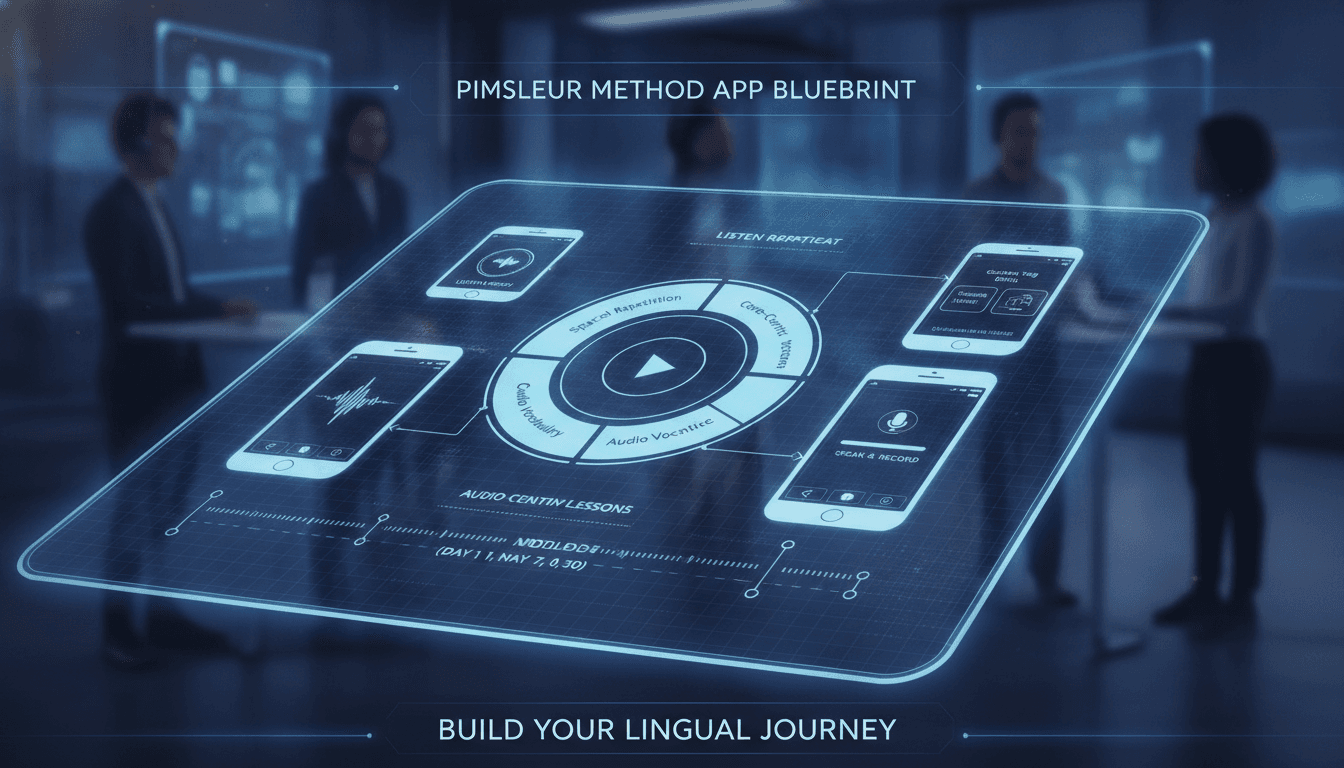
A technical breakdown of the architecture, feature set, and build decisions behind a language-learning app modelled on Pimsleur — covering audio pipeline, spaced repetition, subscription billing, and what it actually costs to get this right.
What Makes Pimsleur Hard to Copy?
Most people look at Pimsleur and see an audio app. What's actually there is a tightly integrated system: a pedagogical engine, a content delivery pipeline for large audio files, a spaced repetition scheduler tuned specifically for auditory recall, and a subscription billing layer that handles multiple markets. Each of those is solvable. The difficulty is that they interact. Your SRS schedule depends on session completion data. Your content pipeline affects how quickly you can A/B test lesson structures. Getting the billing wrong breaks the whole funnel.
We cover a closely related subject in How to Make an App Like Babbel.
This post walks through each layer and the decisions that matter at each one.
What Does the Core Architecture Look Like?
Content and Audio Pipeline
Pimsleur-style lessons run 25 to 30 minutes per session. At high quality (128 kbps AAC), that's roughly 24 MB per lesson. A single language course at 30 lessons is around 720 MB. If you ship 10 languages at launch, you're managing 7+ GB of audio assets before you add supplementary content.
You have three realistic options:
- Progressive streaming with pre-fetch: Stream the first segment, pre-fetch the next 2 to 3 while the user listens. Works well on mobile, requires a CDN with low-latency edge nodes. Cloudfront or Cloudflare R2 both work.
- Full offline download per course: User downloads a course before starting. Simpler playback logic, larger local storage footprint, harder to update lesson content post-download.
- Hybrid: Stream by default, allow selective offline download per lesson or module. Most production apps land here.
The audio encoding matters too. AAC at 96 kbps is indistinguishable from 128 kbps for speech content in most double-blind tests. Encoding at 96 kbps cuts storage and delivery costs by roughly 25%. Run your own test with your target demographic.
Metadata management is often underestimated. Each audio segment needs timestamps for the interactive pause-and-respond mechanic that Pimsleur is built on. That's a separate data layer, typically JSON or a lightweight SQLite schema per lesson, that maps segment IDs to timestamps, prompt types, and expected response windows.
Spaced Repetition Engine
Pimsleur uses a proprietary interval system loosely related to Graduated-Interval Recall (GIR). The core idea is that a new vocabulary item appears multiple times within a lesson at expanding intervals, then reappears across lessons on a schedule designed to hit the forgetting curve before the item is lost.
You don't need to reverse-engineer Pimsleur's exact algorithm. SuperMemo SM-2 is open, well-documented, and has 30+ years of research behind it. The Anki implementation is a practical starting point. The key difference for an audio-first app is that your "card" is a spoken prompt, not a text flashcard. The scheduler logic is the same; the input/output format is different.
To explore this further, see How to Make an App Like Lingvist.
Build the SRS engine as a separate service. It takes user session events as input and outputs the next scheduled review time and item priority queue. This keeps it testable in isolation and lets you swap algorithms without touching the content delivery layer.
Mobile Architecture
React Native works for this product. The main constraint is audio playback in the background, which requires native modules regardless of your cross-platform choice. React Native's community library react-native-track-player handles background audio well and supports lock screen controls on both iOS and Android.
If you're building for iOS first, AVFoundation gives you fine-grained control over audio session categories, which matters when your app needs to duck music, resume after a phone call, and handle AirPods disconnection gracefully. These edge cases will generate a disproportionate share of your 1-star reviews if you get them wrong.
To explore this further, see How to Make an App Like Quizlet.
Flutter is a viable alternative if your team has Dart experience. The audio ecosystem is slightly less mature than React Native's, but just_audio and audio_service cover the main requirements.
/// Not sure where to start?
Get the architecture before you commit
Tell us what you're building and we'll map the technical approach, stack, and rough timeline. No cost, no obligation, no sales call required.
How Does Subscription Billing Work at Scale?
Don't build billing in-house. The compliance surface for subscription apps covers App Store and Play Store in-app purchase rules, SCA (Strong Customer Authentication) under PSD2 for European users, and localised pricing if you go multi-market. RevenueCat abstracts most of this and integrates with Stripe for web-based subscriptions. The SDK is straightforward; the configuration is where you spend time.
A few specifics worth knowing:
- Apple takes 15% for subscribers past 12 months under the Small Business Programme, dropping from 30%. Structure your pricing model with this in mind.
- Google Play allows alternative billing in some markets following EU DMA enforcement. This is a moving target; check the current policy before building around it.
- Implement receipt validation server-side. Client-side validation is trivially bypassed.
Entitlement management (knowing whether a given user has access to a given course or feature) should live in your backend, not in the app. RevenueCat's entitlement model or a custom table in Postgres both work. The point is that the source of truth is not the device.
What Backend Stack Should You Use?
For the application API, Node.js with Fastify or Python with FastAPI are both reasonable at this scale. The SRS service benefits from Python if you want access to the scientific Python ecosystem for algorithm tuning (NumPy, SciPy). The content delivery API is mostly I/O-bound and works fine in Node.
Database choices:
| Data Type | Recommended Store |
|---|---|
| User accounts, subscriptions | PostgreSQL |
| SRS schedule and item state | PostgreSQL or Redis (if sub-10 ms read latency is required) |
| Audio file metadata | PostgreSQL |
| Audio files | S3-compatible object storage |
| Session analytics | ClickHouse or BigQuery |
Use Redis for the SRS item priority queue only if your user base is large enough that Postgres query latency becomes a bottleneck. For most apps under 100,000 DAU, Postgres handles it fine.
What Does It Cost to Build?
Ballpark figures for a cross-platform MVP with one language, 30 lessons, SRS, and subscription billing:
- Design and UX: 200 to 300 hours
- Mobile development (React Native): 600 to 900 hours
- Backend and API: 400 to 600 hours
- Content pipeline and audio tooling: 150 to 250 hours
- QA and testing: 200 to 300 hours
Total: roughly 1,550 to 2,350 hours. At market rates for a competent team, that puts you in the $80,000 to $200,000 range depending on geography and seniority mix. This does not include content production, which is the larger ongoing cost for a Pimsleur-style product.
Cloud infrastructure at launch is modest. Audio delivery via Cloudfront with 50,000 monthly active users will cost under $500/month. That scales roughly linearly.
Conclusion
The engineering complexity in a Pimsleur-style app is manageable. The real challenge is content production and the tight coupling between your pedagogical decisions and your data model. Get the SRS schema and the audio segment metadata structure right before you write application code, because changing them later is expensive.
If you're planning a build and want a technical review of your proposed architecture before committing to it, that's a useful early step. Sodio has built content-heavy mobile products and can run a structured architecture review against your specific requirements.
FAQ
How long does it take to build a Pimsleur-style app? A cross-platform MVP covering one language with SRS, audio streaming, and subscription billing typically takes 5 to 8 months with a team of 4 to 6 people. That timeline assumes content is produced in parallel, not sequentially. Content production for 30 audio lessons usually adds another 2 to 3 months if you're recording original material.
Can you build this with React Native or does it need to be native?
React Native is sufficient. The main native requirement is background audio playback, which react-native-track-player covers on both iOS and Android. You will still write some native module code for edge cases around audio session management, but it's a small surface area, not a reason to go fully native.
How do you handle offline access for downloaded audio lessons?
Downloaded lessons should be stored in the app's documents directory with file integrity checksums. The local SRS state and session progress are written to SQLite via a library like react-native-mmkv or expo-sqlite. On reconnection, session events sync to the backend. Conflict resolution is simple because session data is append-only.
What's the hardest part of building the SRS engine? Not the algorithm, which is well-documented. The hard part is handling interruptions: a user who stops mid-lesson, a session that crashes, a lesson replayed out of order. Your event model needs to distinguish between a completed exposure and a partial one, and your scheduler needs to handle both gracefully without inflating the user's review queue.
Do you need AI or ML to build this? Not for the core product. Pimsleur's method is rules-based, and a well-implemented SM-2 scheduler outperforms naive ML approaches at this task. Where ML adds genuine value is in pronunciation feedback (comparing a user's recorded audio against a reference using a model like Wav2Vec 2.0) and in adaptive pacing based on individual forgetting curve parameters. Both are phase-two features, not MVP requirements.
Have a project in mind? Contact Sodio Technologies to discuss your requirements and explore the right technology solution for your business.
/// Work with us
Talk to the engineers who'd build it
You'll get a technical scope, timeline and cost estimate from the people doing the work, not an account manager. In-house team, no subcontracting, since 2016.