

How to Make an App Like Pokemon Go
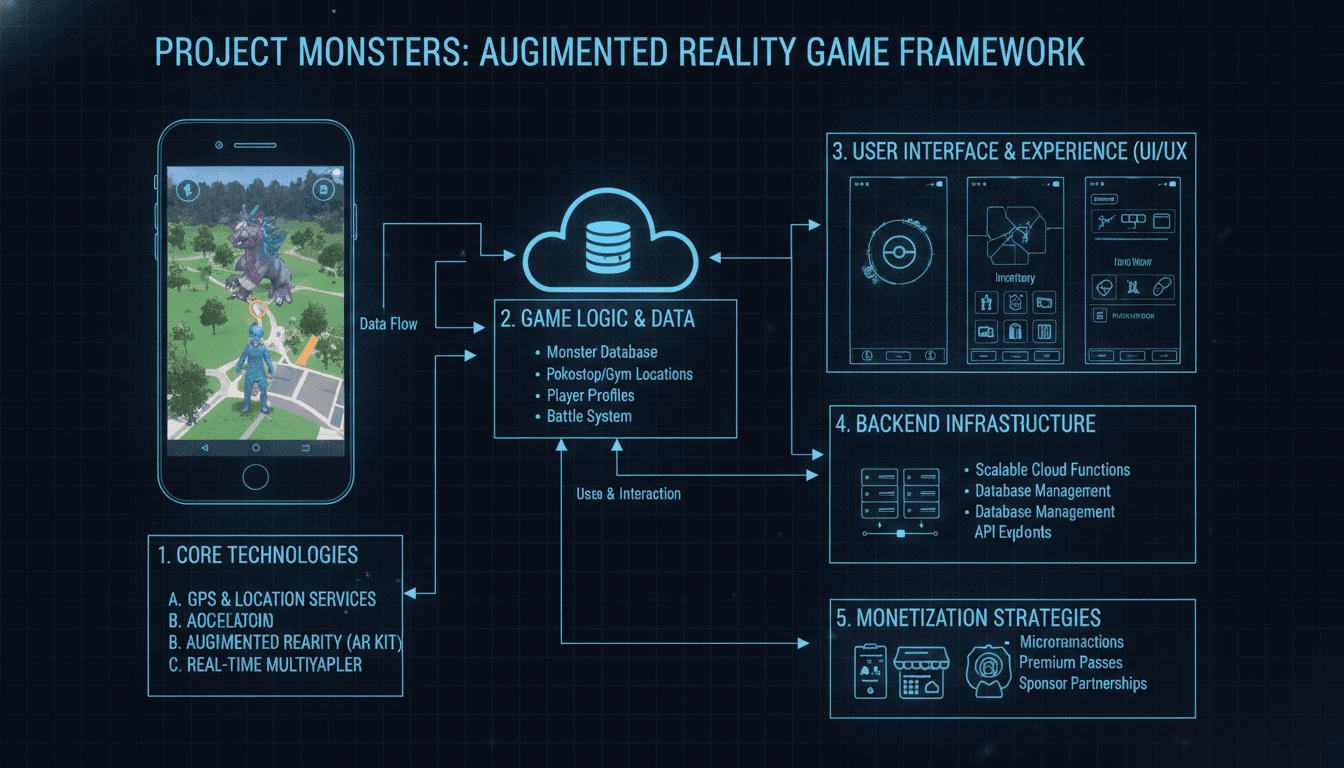
Building an AR location-based game is one of the more technically demanding projects you can take on. This post breaks down the real architecture decisions, costs, and trade-offs involved — from GPS precision to backend scaling under viral load.
What Actually Makes Pokémon GO Work Under the Hood
Pokémon GO is not just a mobile game with a map overlay. It is a distributed real-time system that processes location data from tens of millions of devices simultaneously, renders AR on consumer hardware, and keeps game state consistent across a global player base.
If this is relevant to your project, check out How to Make an App Like TripAdvisor.
When Niantic launched in 2016, the backend collapsed almost immediately. They were running on Google Cloud and still couldn't handle the load. That is your first architectural lesson: location-based games with social mechanics scale non-linearly. One player walking into a new zone can trigger state changes for dozens of other players nearby.
The core technical pillars are:
- Real-time geospatial indexing
- AR rendering tied to device sensors
- A stateful game engine that runs server-side
- A client that stays in sync with minimal latency
- Anti-cheat at the network layer
Each of these is a distinct engineering problem. Solving one poorly breaks the others.
How Does GPS Precision Actually Work in AR Games?
Raw GPS on a consumer smartphone is accurate to roughly 3–5 metres under open sky. In urban canyons, that degrades to 15–30 metres or worse. For a game where a Pokémon is pinned to a specific real-world coordinate, that variance matters.
We cover a closely related subject in How to Make an App Like MagicPlan.
The standard approach combines four signals:
- GPS (primary outdoor positioning)
- Wi-Fi positioning (triangulation using nearby access points via APIs like Google Maps Platform or Apple Core Location)
- Cell tower triangulation (coarse fallback, typically 100–300 m accuracy)
- Device accelerometer and gyroscope (dead reckoning between GPS fixes)
Niantic uses what they call a "real-world graph" — a spatial index of points of interest built partly from their earlier game Ingress, where players crowdsourced portal locations. You probably don't have that asset. You will need to either license POI data (Google Places API, Foursquare Places, OpenStreetMap via Overpass API) or build a content management layer that lets you place game objects manually on a map.
For geospatial indexing at scale, the two dominant approaches are H3 (Uber's hexagonal hierarchical spatial index, open source) and S2 geometry (used by Google, also open source). H3 is easier to work with for most teams. At resolution 9, each hexagon covers roughly 0.1 km², which is fine granularity for spawn zone logic.
AR Rendering: ARCore vs ARKit vs WebXR
On Android, you're using ARCore. On iOS, ARKit. Both use SLAM (Simultaneous Localisation and Mapping) to track the device's position relative to detected surfaces. For cross-platform builds, Unity with AR Foundation abstracts both, which is the standard choice for game studios.
WebXR is an option if you want a browser-based experience, but the feature gap versus native is still significant in 2024. Camera access, sensor fusion, and rendering performance are all better in a native build. Stick with native unless you have a specific reason not to.
Pokémon GO's AR mode is relatively simple: it places a 3D model on a detected plane and lets the player walk around it. The more complex version is Niantic's AR+ mode on iOS, which uses ARKit's world tracking to make the creature appear to stay fixed in world space as the player moves. This requires persistent anchor points, which ARCore and ARKit both support but behave differently across devices.
You may also find our article on How to Make an App Like Pokémon Go useful.
/// Not sure where to start?
Get the architecture before you commit
Tell us what you're building and we'll map the technical approach, stack, and rough timeline. No cost, no obligation, no sales call required.
What Does the Backend Architecture Look Like?
The backend for a game like this has four distinct concerns that map cleanly to separate services.
Game state service: Manages spawn logic, player inventory, event timing, and world state. This is your most complex piece. Pokémon GO uses a server-authoritative model, meaning the client never decides what spawns or whether a catch succeeds. The server does. This is non-negotiable for anti-cheat.
Geospatial service: Handles queries like "what game objects exist within 500 m of this coordinate?" At scale, this needs a purpose-built spatial database. PostgreSQL with PostGIS works well up to moderate load. Beyond that, teams move to dedicated solutions like Redis with the RedisGEO module or a custom H3-indexed store. Niantic built their own.
Real-time sync: Players need near-instant updates when another player triggers a nearby event. This is typically handled with WebSockets or gRPC streaming. At very high concurrency, you need a pub/sub layer underneath — Kafka or Google Pub/Sub are the common choices.
Identity and anti-cheat: GPS spoofing is the primary exploit vector. Detecting it requires server-side analysis of movement patterns (speed checks, impossible teleportation), device attestation via Google Play Integrity API and Apple DeviceCheck, and statistical anomaly detection on location sequences. None of this is simple to build, and false positive rates matter — banning real players is expensive.
Infrastructure Costs at Scale
| Scale | MAU | Estimated Monthly Infra Cost |
|---|---|---|
| Early / MVP | 10,000 | $2,000–$5,000 |
| Growth | 500,000 | $30,000–$80,000 |
| Scale | 5,000,000+ | $300,000+ |
These are rough figures for a GKE or EKS deployment with managed databases. The spike risk on launch is the real danger. Auto-scaling handles gradual growth; it does not handle a 50x load jump in 48 hours. Provision headroom and load test against 5x your expected peak before launch.
How Long Does It Take to Build and What Does It Cost?
Honest answer: a true Pokémon GO equivalent built from scratch takes 18–36 months and costs $1.5M–$4M+ depending on team location and scope. Most teams building in this space are not building a Pokémon GO equivalent. They are building a smaller, more focused game with one or two of these mechanics.
A realistic MVP that includes:
- Location-based object placement
- Basic AR using ARKit/ARCore
- A server-authoritative game loop
- 10,000 concurrent users capacity
...takes roughly 8–12 months with a team of 6–8 engineers (mobile, backend, DevOps, and a game designer). Budget $400,000–$800,000 for that scope, depending on geography.
The thing most teams underestimate is ongoing infrastructure management. The game does not sleep. Spawns, events, and leaderboards run 24/7. You need on-call engineering from day one.
Conclusion
If you are building a location-based AR game, start with the geospatial and game state services before you touch the client. Get the server-authoritative architecture right early — retrofitting it later is painful and usually incomplete.
Pick your spatial indexing library (H3 is the pragmatic choice), set up PostGIS for early development, and design your anti-cheat model before you have players to cheat. The mobile client is the visible part, but the backend is where these games succeed or fail.
If you want to talk through your specific architecture or scope, reach out to the team at Sodio.
FAQ
How long does it take to build an app like Pokémon GO? A full-scale location-based AR game takes 18–36 months with a large team. A focused MVP with core mechanics — location-based objects, basic AR, and a server-authoritative game loop — is achievable in 8–12 months with a team of 6–8 engineers, budgeting roughly $400,000–$800,000.
What technology stack do AR location-based games use? Most use Unity with AR Foundation for cross-platform AR rendering, ARKit on iOS and ARCore on Android for sensor fusion, PostgreSQL with PostGIS or an H3-indexed store for geospatial queries, and WebSocket or gRPC streaming for real-time sync. The backend is typically deployed on GKE or EKS.
How do you prevent GPS spoofing in a location-based game? The core approach is server-side movement analysis — speed checks, teleportation detection, and statistical anomaly scoring on location sequences. Device attestation via Google Play Integrity API and Apple DeviceCheck adds a hardware-level signal. No single method is sufficient; you need all of them layered together.
What is H3 and why is it used in games like this? H3 is Uber's open-source hexagonal hierarchical spatial indexing system. It divides the Earth's surface into hexagonal cells at multiple resolutions. At resolution 9, each cell covers about 0.1 km². It makes spatial queries — like "find all game objects near this point" — fast and consistent, which matters enormously at scale.
Do you need to build your own map data for an AR game? No. You can license point-of-interest data from Google Places API, Foursquare Places, or pull freely from OpenStreetMap via the Overpass API. The trade-off is cost, coverage quality, and terms of service. If your game logic depends heavily on specific real-world location types, validate data quality in your target markets early — coverage varies significantly by region.
Have a project in mind? Contact Sodio Technologies to discuss your requirements and explore the right technology solution for your business.
/// Work with us
Talk to the engineers who'd build it
You'll get a technical scope, timeline and cost estimate from the people doing the work, not an account manager. In-house team, no subcontracting, since 2016.