

How to Make an App Like Pokémon Go
How to Make an App Like Pokémon Go
When Pokémon Go launched, it did something almost no app had managed before: it pulled millions of people off their couches and into parks, sidewalks, and city squares, phones held high, chasing creatures that only existed on screen. Within weeks it had racked up hundreds of millions of downloads and billions in revenue, and it permanently changed what developers thought location-based augmented reality could do.
If you're wondering how to build something similar, this guide walks through the technology, features, team, timeline, and budget involved in creating a location-based AR game — and, more importantly, how to make one that people actually keep playing.
You may also find our article on How to Make an App Like Pokemon Go useful.
What Actually Makes Pokémon Go Work
Before jumping into tech stacks, it helps to understand why the app succeeded. It wasn't the AR camera overlay — that feature was novel but most serious players eventually turned it off to save battery. The real engine behind Pokémon Go is a combination of four things:
A real-world map layer. The entire game world is mapped onto actual geography. PokéStops and Gyms sit at real landmarks, which turned the game into a reason to explore your own neighborhood.
Location-driven scarcity. Certain creatures only appear in certain places, at certain times, in certain weather. Scarcity plus geography creates urgency.
Social gravity. Raids, community days, and team affiliations mean players show up in the same physical place at the same time. That's extremely hard to replicate and extremely sticky once it exists.
An emotionally loaded IP. Pokémon arrived with thirty years of nostalgia baked in. This is the piece most clones underestimate — and the piece you'll need to compensate for with exceptional design or a genuinely fresh concept.
Your app doesn't need to copy all four. But it needs a convincing answer for why someone would walk outside to use it.
Core Features to Plan For
Geolocation and Real-World Mapping
This is the foundation. You'll need continuous GPS tracking, a map rendering layer, and a system for placing game objects at real coordinates. Most teams start with the Google Maps SDK or Mapbox, though Niantic famously built on OpenStreetMap data to define spawn zones, paths, and points of interest.
Key technical considerations:
- GPS accuracy degrades indoors and in dense urban areas — build in tolerance radii rather than exact-point matching
- Battery drain is your biggest UX threat; throttle location polling intelligently based on player speed and state
- You'll need a spatial database capable of fast proximity queries (PostGIS, MongoDB geospatial indexes, or Redis with geo commands)
Augmented Reality Layer
The AR component turns the camera feed into a playable surface. Your two main options:
ARKit (iOS) and ARCore (Android) give you native plane detection, motion tracking, light estimation, and occlusion. They're free, well-documented, and performant.
Unity with AR Foundation wraps both into a single cross-platform layer and is the more common choice for anything with real game mechanics, since you get a full game engine alongside the AR capability. Unreal Engine is a viable alternative if you need higher visual fidelity.
For more advanced experiences, Niantic's own Lightship ARDK offers semantic segmentation, shared AR sessions, and persistent world-anchored content — essentially the toolkit they built for themselves, opened up to other developers.
Character and Object Spawning Logic
This is where the game design lives. You need a server-side system that decides what appears, where, and when. Typical inputs include biome or terrain type, time of day, weather API data, population density, player level, event schedules, and randomized rarity weighting.
Crucially, spawning must be server-authoritative. If the client decides what spawns, players will reverse-engineer it within a week.
User Accounts and Progression
Registration, profiles, XP, levels, inventory, collections, achievements, and daily streaks. Progression systems are what convert a novelty into a habit — plan them before you build them, not after.
Social and Multiplayer Systems
Friends lists, trading, gifting, team affiliation, leaderboards, and co-op events. Real-time or near-real-time multiplayer (raids, battles) significantly increases backend complexity — you'll be looking at WebSockets, a dedicated game server layer, and careful state reconciliation.
Notifications
Push notifications are how you get players back outside. Location-triggered alerts ("a rare creature is nearby") are powerful but easy to overuse. Geofencing plus smart frequency capping is the balance to strike.
Monetization
The standard model is free-to-play with in-app purchases: consumables, cosmetics, storage upgrades, and a premium currency. Pokémon Go also pioneered sponsored locations — real businesses paying to be PokéStops and drive foot traffic. If your app achieves meaningful density in any city, that revenue stream becomes genuinely interesting.
Related reading: How to Make an App Like WallaMe.
Anti-Cheat
Do not treat this as a phase-two concern. GPS spoofing is trivial on rooted and jailbroken devices, and a spoofed player base destroys the integrity of a location game fast. You'll want mock-location detection, root/jailbreak detection, server-side speed and teleportation checks, device integrity attestation (Play Integrity API, App Attest), and behavioral anomaly detection.
Related reading: How to Make an App Like Rec Room.
Recommended Tech Stack
Game engine and AR: Unity with AR Foundation, or native ARKit/ARCore for lighter experiences. Niantic Lightship ARDK for advanced shared-world features.
Mobile: Unity's C# layer for game logic; Swift and Kotlin for native modules, permissions, and OS integrations. Flutter or React Native can work for companion apps or lighter AR experiences but aren't ideal for full 3D games.
Backend: Node.js, Go, or Java for the API layer. Go is a strong fit for high-concurrency location services.
Database: PostgreSQL with PostGIS for spatial data, Redis for caching and real-time proximity lookups, and a document store for player state if your schema is fluid.
Real-time: WebSockets, or a managed service like Photon or Nakama for multiplayer game state.
Maps: Google Maps Platform, Mapbox, or OpenStreetMap depending on budget and customization needs.
Cloud: AWS, GCP, or Azure with autoscaling — location games have extremely spiky traffic. Kubernetes for orchestration if you expect scale.
Analytics: Firebase, Amplitude, or Mixpanel, plus a custom event pipeline for game economy telemetry.
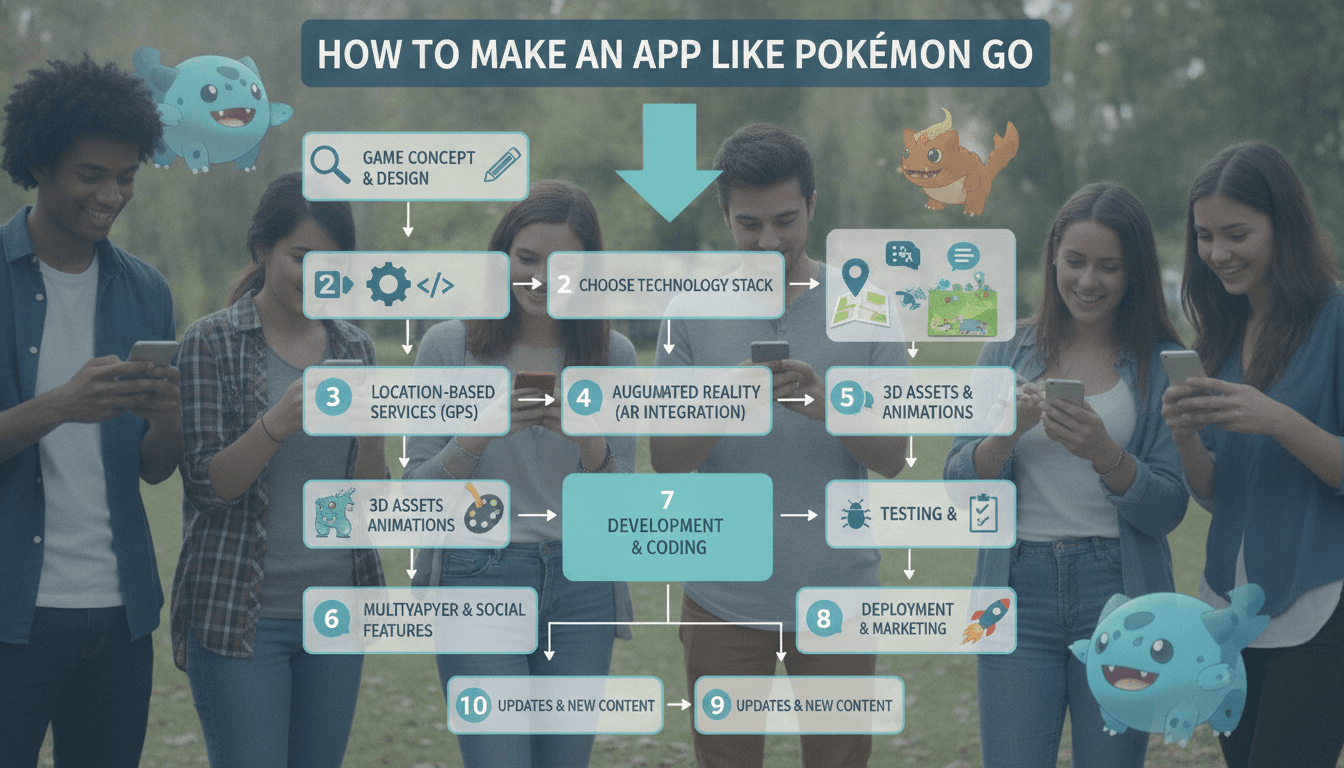
Development Process
Phase 1: Discovery and Concept (2–4 weeks)
Define the core loop. What does a player do in the first sixty seconds, and why would they do it again tomorrow? Validate the concept, research competitors, and lock down your IP or original creative direction. Map out monetization early — retrofitting an economy into a finished game rarely works.
Phase 2: Design (4–6 weeks)
UX wireframes, UI design, 3D character and asset design, and world-building. AR interfaces have their own rules: text must be readable in sunlight, controls need to work one-handed, and anything requiring precision while walking is a bad idea.
Phase 3: Prototype (4–8 weeks)
Build a vertical slice — one map, a handful of spawns, one catch mechanic, one AR interaction. Test it outdoors, in real conditions, on mid-range devices. Prototypes that only work on a flagship phone in an office are misleading.
Phase 4: Full Development (4–8 months)
Backend services, game systems, AR polish, social features, monetization, and the admin tooling your live-ops team will need. Build the content management system that lets non-engineers create events — you will need it constantly after launch.
Phase 5: Testing (ongoing, 6–8 weeks concentrated)
Field testing across cities, device types, network conditions, and weather. Load testing for launch-day traffic. Security and anti-cheat penetration testing. Beta programs in limited regions.
Phase 6: Launch and Live Operations (ongoing)
Soft launch in a smaller market to tune the economy and server costs. Then scale regionally. Post-launch, a location game is a service, not a product — expect a permanent team running events, balancing, and content drops.
Team Composition
A realistic team for a project of this scope includes a product manager, a UX/UI designer, two or three 3D artists and animators, a game designer, two to four Unity/AR developers, two to three backend engineers, a DevOps engineer, and two QA engineers including one dedicated to field testing. A data analyst becomes essential once you're live.
Cost and Timeline
Costs vary enormously with scope and region, but as rough guidance:
MVP (single city or region, basic AR, limited multiplayer): $80,000–$150,000 over 4–6 months.
Mid-tier product (full AR, social features, monetization, multi-region): $150,000–$350,000 over 6–10 months.
Full-scale AAA-style experience: $400,000 and well beyond, 12+ months, with substantial ongoing costs.
Budget separately for infrastructure, which scales with players and can be significant for location services; map API licensing, which is usage-based and easy to underestimate; 3D asset production, often outsourced; and live operations, which is a permanent line item.
The Hard Parts Nobody Mentions
Legal and safety. Players walking into traffic, trespassing on private property, or gathering at sensitive locations created real problems for Niantic. You'll need in-app safety warnings, speed lockouts, exclusion zones around hospitals, schools, memorials, and private land, and a process for property owners to request removal.
Privacy and compliance. Continuous location tracking puts you squarely under GDPR, CCPA, and equivalents. If minors are in your audience, COPPA applies too. Minimize what you collect, be explicit in your consent flows, and encrypt location data at rest and in transit.
The cold start problem. A social location game with no players in your city is just a map. Plan for geographic concentration at launch rather than a thin global rollout.
Content treadmill. Players consume content faster than you can make it. Procedural generation, seasonal events, and community-driven content help, but there is no escaping the need for a content pipeline.
Making It Yours
The biggest mistake in this category is building a Pokémon Go reskin. The market is littered with them. The apps that have found traction since — fitness games that turn running into gameplay, educational apps that turn museums and historic districts into interactive tours, city-scale scavenger hunts for tourism boards, retail apps that gamify store visits — succeeded because they applied the location-AR formula to a purpose, not to a copy.
Ask what unique real-world behavior your app rewards. If the answer is compelling, the technology described above is entirely achievable. If it isn't, no amount of AR polish will save it.
Getting Started
Building a location-based AR game is genuinely difficult — it sits at the intersection of game development, geospatial engineering, real-time backend systems, and mobile performance optimization. But the tooling is far better than it was in 2016, the hardware is dramatically more capable, and the appetite for experiences that get people off their screens and into the world hasn't gone anywhere.
Start with a tight prototype, test it outdoors with real people, and let what you learn shape the rest. The technical complexity is solvable. Whether your core loop is fun is the question worth answering first.
Have a project in mind? Contact Sodio Technologies to discuss your requirements and explore the right technology solution for your business.
/// Work with us
Talk to the engineers who'd build it
You'll get a technical scope, timeline and cost estimate from the people doing the work, not an account manager. In-house team, no subcontracting, since 2016.