

How to Make an App Like RideAmigos
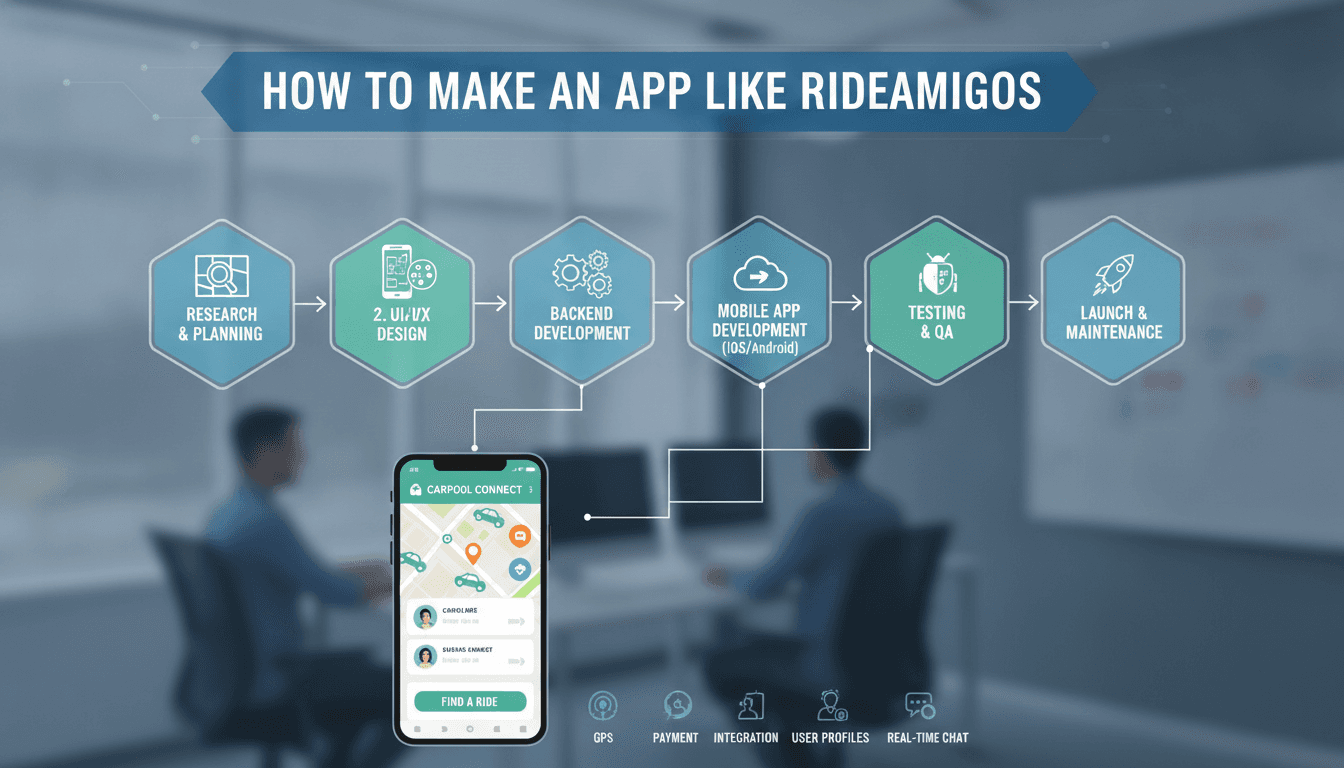
How to Make an App Like RideAmigos
Commuting is one of the most expensive, time-consuming, and carbon-heavy parts of modern work life. RideAmigos tackled that problem head-on by building a Transportation Demand Management (TDM) platform that helps employers, universities, and cities nudge commuters toward carpooling, transit, biking, and remote work.
If you're planning to build an app like RideAmigos, you're not just building a ride-matching tool — you're building a behavior-change engine backed by data, incentives, and integrations. Here's how to approach it.
Related reading: How to Make an App Like Moovit.
What Exactly Is RideAmigos?
RideAmigos is a B2B2C commute management platform. Organizations (employers, campuses, transit agencies, regional planning bodies) license the platform, and their employees or members use it to:
- Discover commute options: carpool, vanpool, transit, bike, walk, telework
- Get matched with carpool partners who share similar routes and schedules
- Log trips automatically or manually
- Earn rewards, points, and prizes for sustainable commuting
- Participate in challenges and campaigns
Meanwhile, administrators get dashboards showing mode split, vehicle miles traveled (VMT) reduced, CO2 avoided, parking demand, and compliance reporting for local regulations.
That dual-audience model — commuters on one side, program administrators on the other — is the single most important architectural decision you'll make.
Step 1: Nail the Business Model Before the Build
Consumer ride-matching apps struggle because of the cold-start problem: nobody carpools until enough people are on the platform. RideAmigos sidesteps this by selling to organizations, which delivers a pre-built, geographically clustered user base on day one.
Common monetization approaches:
| Model | How It Works | Best For |
|---|---|---|
| SaaS subscription | Annual license per organization, tiered by employee count | Enterprise and campus clients |
| Per-seat pricing | Monthly fee per active commuter | Mid-size employers |
| Government contracts | Regional TDM programs funded by transit agencies | Public sector |
| Incentive markup | Margin on rewards, gift cards, and transit passes | Add-on revenue |
| Data & analytics tier | Premium reporting, API access, custom dashboards | Planning organizations |
Decide early, because pricing shapes your tenancy model, permissions system, and reporting depth.
Step 2: Define the Core Feature Set
Commuter-Facing Features
Onboarding and profile setup Home and work locations, typical schedule, preferred modes, vehicle details, accessibility needs. Keep it under 90 seconds or you'll lose people.
Trip planning and multimodal routing Compare driving alone against carpool, transit, bike, and walk options side by side — with cost, time, calories, and CO2 for each. This requires routing engine integration (more on that below).
Carpool and vanpool matching The matching algorithm considers origin proximity, destination proximity, schedule overlap, detour tolerance, gender preferences, smoking preferences, and trust signals. Surface matches with a map preview and an in-app messaging channel so users never exchange phone numbers until they choose to.
Automatic trip logging GPS-based mode detection using accelerometer and location data classifies trips as drive, transit, bike, or walk. Manual logging should always be available as a fallback, and calendar-based recurring trips reduce friction enormously.
Rewards and gamification Points per sustainable trip, streaks, leaderboards, team competitions, raffle entries, and redeemable rewards. This is where behavior change actually happens — treat it as a first-class system, not a bolt-on.
Challenges and campaigns Time-boxed events like "Bike to Work Week" with custom rules, branding, and prize pools that admins configure themselves.
Emergency Ride Home A guaranteed ride home benefit for carpoolers who face an unexpected schedule change. This removes the single biggest psychological barrier to giving up a personal car.
Admin-Facing Features
Program dashboard Mode split over time, participation rate, VMT reduced, GHG avoided, parking spaces saved, cost per participant.
Campaign builder Create challenges, set rules, define reward tiers, upload branding, and target specific employee groups.
Survey engine Annual commute surveys are legally required in many jurisdictions. Build templated surveys with automated distribution and reminder logic.
Compliance reporting Export-ready reports matching regional TDM ordinance formats, plus ESG and sustainability reporting for corporate clients.
User and group management Bulk import, SSO provisioning, department hierarchies, multi-site organizations.
Step 3: Choose Your Tech Stack
Mobile React Native or Flutter gives you iOS and Android from one codebase, which matters when your differentiation is in the backend logic rather than platform-specific UI flourishes. If continuous background location tracking accuracy is mission-critical, budget for native modules on both platforms.
Backend Node.js with NestJS, or Python with Django/FastAPI. Both have strong geospatial ecosystem support. Structure the system as modular services: identity, trip logging, matching, rewards, analytics, and notifications.
Database PostgreSQL with PostGIS is the obvious choice for geospatial queries. Add Redis for caching match results and leaderboards, and a time-series store or data warehouse (ClickHouse, BigQuery, Snowflake) for analytics workloads so reporting queries never touch production.
Third-party services
- Mapping and routing: Mapbox, Google Maps Platform, or open-source OSRM/Valhalla
- Transit data: GTFS and GTFS-Realtime feeds from local agencies, or Transitland
- Push notifications: Firebase Cloud Messaging
- Identity: Auth0 or Okta for enterprise SSO (SAML, OIDC)
- Rewards fulfillment: Tango Card, Tremendous, or similar gift card APIs
Infrastructure Containerized services on AWS or GCP, with autoscaling for the morning and evening commute traffic spikes that will dominate your load profile.
Step 4: Build the Matching Algorithm
This is your intellectual property. A workable approach:
- Spatial filtering — Use PostGIS to find all users whose origin and destination fall within a configurable radius of the requesting user's route corridor.
- Route overlap scoring — Calculate the detour cost for each candidate pairing. If picking someone up adds more than X minutes, deprioritize it.
- Temporal matching — Compare departure and arrival windows, factoring in flexibility tolerance the user declared.
- Preference filtering — Apply hard constraints (accessibility, vehicle capacity) and soft preferences (gender, smoking, music, conversation level).
- Trust and reliability weighting — Boost users with verified employer email, completed profiles, positive ratings, and consistent trip history.
- Ranking — Produce a composite score and return the top matches with clear explanations of why each was suggested.
Recompute matches on a schedule rather than on demand, cache aggressively, and let users "save" a match into a recurring carpool arrangement.
Step 5: Solve Trip Verification
Rewards create an incentive to cheat. Your verification layer needs:
- GPS trace analysis with speed and stop-pattern signatures per mode
- Cross-verification when two carpool participants log the same trip
- Bluetooth or QR-based check-in for confirmed shared rides
- Anomaly detection for impossible speeds, teleporting locations, and duplicate submissions
- Admin review queues for flagged trips with configurable reward caps
Get this wrong and your client's program loses credibility fast.
Step 6: Design for Privacy and Trust
You're tracking where people live, where they work, and when they travel. That's about as sensitive as consumer data gets.
- Collect location only during active trips, and make that visible in the UI
- Store home addresses as fuzzed coordinates for matching purposes
- Never expose exact addresses to other users — show approximate pickup points
- Comply with GDPR, CCPA, and any state-level biometric or location laws
- Offer meaningful opt-outs that don't break the core experience
- Support enterprise data-processing agreements and SOC 2 requirements
Also build safety features: in-app messaging with no phone number exposure, user reporting and blocking, ratings, verification badges, and a trip-sharing feature for trusted contacts.
Step 7: Plan the Development Timeline
| Phase | Scope | Duration |
|---|---|---|
| Discovery & UX | Research, user flows, wireframes, prototypes | 4–6 weeks |
| MVP build | Auth, profiles, trip logging, basic matching, admin dashboard | 12–16 weeks |
| Rewards & campaigns | Points engine, challenges, fulfillment integrations | 6–8 weeks |
| Analytics & reporting | Dashboards, exports, compliance templates | 6–8 weeks |
| Pilot & iteration | Deploy with 1–2 client organizations, refine | 8–12 weeks |
A credible MVP with a single pilot client typically lands in the 5–7 month range. Full feature parity with an established platform like RideAmigos is a multi-year roadmap.
Step 8: Go to Market
Since this is B2B, your growth engine is sales and partnerships, not app store optimization:
- Target employers in regions with TDM mandates — they have a compliance problem you solve
- Partner with regional transit agencies and metropolitan planning organizations
- Pitch universities, which face acute parking pressure and have sustainability goals
- Lean into ESG reporting, since corporate sustainability teams now control real budget
- Publish case studies with hard numbers: VMT reduced, parking costs avoided, participation rates
Common Mistakes to Avoid
Building consumer-first. Without an anchor organization, your matching pool will be too sparse to ever produce a good match.
Underinvesting in the admin experience. Administrators are your actual buyers. If their dashboard is painful, they won't renew regardless of how much commuters like the app.
Treating rewards as an afterthought. Fulfillment logistics, tax implications for prizes, and budget controls are genuinely complex and need real design attention.
Ignoring transit data quality. GTFS feeds vary wildly in quality between agencies. Build validation and graceful degradation.
Over-tracking location. Aggressive background tracking drains batteries, triggers OS restrictions, and erodes trust. Be surgical.
Final Thoughts
An app like RideAmigos succeeds on the strength of three things: a matching engine that actually produces usable carpool pairings, an incentive system that changes habits, and reporting that proves ROI to the people writing the checks. The mobile app is the visible surface, but the value lives in the data layer beneath it.
Start narrow — one vertical, one region, one strong pilot client — prove the outcomes with real numbers, and expand from there.
Have a project in mind? Contact Sodio Technologies to discuss your requirements and explore the right technology solution for your business.
/// Work with us
Talk to the engineers who'd build it
You'll get a technical scope, timeline and cost estimate from the people doing the work, not an account manager. In-house team, no subcontracting, since 2016.