

How to Make an App Like Tasty
How to Make an App Like Tasty
Tasty, BuzzFeed's wildly popular recipe platform, turned short-form cooking videos into a global phenomenon. With hundreds of millions of monthly video views and an app that consistently ranks among the top food and drink titles, Tasty proved that people don't just want recipes — they want recipes that are fast, visual, and shareable.
If you're planning to build a recipe and cooking app of your own, this guide walks through everything from core features and tech stack to monetization and development costs.
To explore this further, see How to Make an App Like Allrecipes.
Why Build a Recipe App Like Tasty?
The food-tech space is far from saturated. A few reasons founders keep entering it:
- Massive, evergreen audience. Everyone eats. Recipe content never goes out of season.
- High engagement. Cooking apps see repeat daily and weekly usage, especially around meal times.
- Multiple monetization paths. Subscriptions, grocery affiliate links, sponsored recipes, in-app commerce, and ads all work here.
- Room for niches. Vegan cooking, diabetic-friendly meals, regional cuisines, meal prep for athletes, budget cooking for students — each is a viable wedge.
Tasty won by nailing one thing: the overhead, hands-only, sped-up video format that's instantly understandable without sound. Your differentiator needs to be equally sharp.
You may also find our article on How to Make an App Like Yummly useful.
Core Features of a Tasty-Style App
1. Recipe Discovery Feed
A scrollable, visually driven home feed is the heart of the app. Recipes should surface as video thumbnails or high-quality hero images with a title, cook time, and difficulty badge. Support both algorithmic recommendations and editorially curated collections ("30-Minute Dinners," "5 Ingredients or Less").
2. Step-by-Step Video Recipes
This is Tasty's signature. Each recipe should include:
- A short looping overview video
- Ingredient list with adjustable serving sizes
- Numbered, tappable steps with timers built in
- Optional voice-guided or hands-free mode for use while cooking
3. Smart Search and Filtering
Users rarely search by recipe name. They search by constraint. Build filters for:
- Ingredients they already have
- Dietary restrictions (vegan, gluten-free, keto, halal)
- Cook time and difficulty
- Cuisine type
- Appliance (air fryer, slow cooker, instant pot)
4. Personalization and Onboarding
Ask a few onboarding questions — diet, allergies, skill level, household size — and use them to tailor the feed from day one. Personalization is the single biggest driver of retention in recipe apps.
5. Save, Organize, and Plan
Let users bookmark recipes into custom collections, build weekly meal plans, and view a calendar of planned meals. This turns a browsing app into a habitual utility.
6. Auto-Generated Shopping Lists
Users should be able to add any recipe's ingredients to a consolidated shopping list that merges duplicates and groups items by grocery aisle. Integrating with grocery delivery partners is a natural revenue extension.
7. Social and Community Layer
User-submitted photos, ratings, reviews, tips, and recipe forking ("I swapped butter for olive oil") build stickiness and generate free content. Tasty's community tips section is one of its most-read features.
8. Offline Access
Kitchens have bad Wi-Fi. Cache saved recipes and downloaded videos locally.
Advanced Features Worth Considering
- AI recipe generation — let users input available ingredients and generate a viable recipe.
- Image recognition — scan a fridge or pantry shelf to identify ingredients.
- Nutrition tracking — auto-calculate calories and macros per serving and sync with Apple Health or Google Fit.
- Smart appliance integration — send cook temps and times directly to connected ovens or air fryers.
- Voice assistant support — "Hey Siri, what's the next step?"
- Video-first creator tools — let home cooks shoot and publish their own Tasty-style recipe videos in-app.
Tech Stack Recommendations
Frontend
- React Native or Flutter for cross-platform delivery on iOS and Android from a single codebase — ideal for startups optimizing budget and speed.
- Swift (iOS) and Kotlin (Android) if you need maximum video performance, advanced camera features, or deep OS integrations.
Backend
- Node.js, Python (Django/FastAPI), or Go for the API layer
- PostgreSQL for structured recipe, user, and meal plan data
- Elasticsearch or Algolia for fast, typo-tolerant recipe search
- Redis for caching feeds and session data
Video Infrastructure
This is where recipe apps live or die. Use a dedicated pipeline:
- AWS Elemental MediaConvert or Mux for transcoding
- CloudFront or Cloudflare CDN for global delivery
- HLS adaptive bitrate streaming so videos load instantly on weak connections
Other Services
- Firebase Cloud Messaging / APNs for push notifications
- Stripe or RevenueCat for subscription billing
- Mixpanel or Amplitude for product analytics
- Nutritionix or Edamam APIs for nutrition data if you're not building your own database
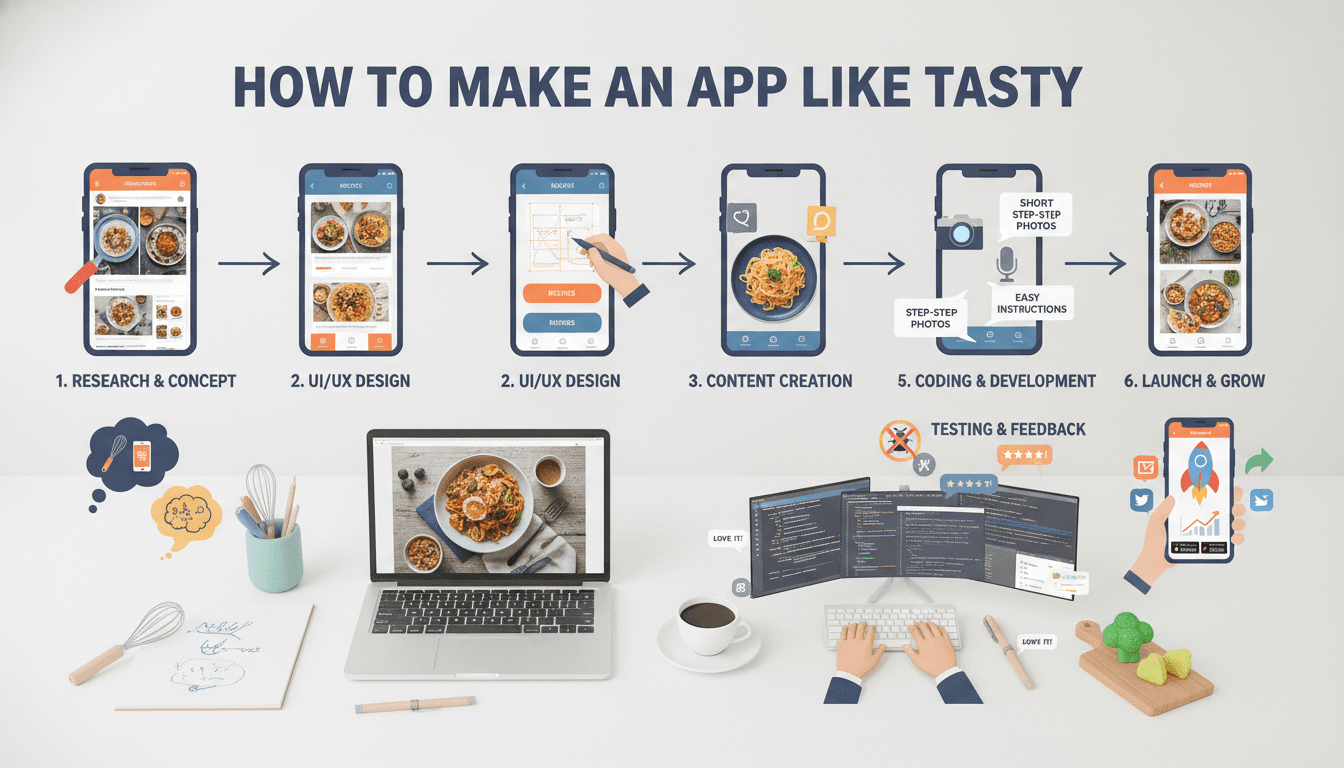
The Development Process
- Discovery and Research. Define your niche, analyze competitors (Tasty, Yummly, SideChef, Kitchen Stories), and lock down your core value proposition.
- Wireframing and UX Design. Recipe apps are consumed in the kitchen — with messy hands, at arm's length. Design for large tap targets, high contrast, and minimal reading.
- UI Design and Prototyping. Food is visual. Invest in typography, photography standards, and motion design.
- MVP Development. Ship with discovery feed, recipe detail pages, search, save, and shopping list. Leave AI and social for v2.
- Content Seeding. An empty recipe app is worthless. Budget for producing or licensing 300–500 high-quality recipes with video before launch.
- QA and Testing. Test video playback across devices and network conditions, plus offline mode.
- Launch and Iterate. Monitor retention cohorts, recipe completion rates, and shopping list usage.
Monetization Strategies
- Freemium subscription — free recipe browsing, paid meal planning, nutrition tracking, and ad-free viewing.
- Grocery affiliate commissions — earn a cut when users order ingredients through Instacart, Amazon Fresh, or regional partners.
- Branded and sponsored content — Tasty's primary revenue engine. Food brands pay for recipes featuring their products.
- In-app commerce — sell cookware, meal kits, or cookbooks.
- Display and video ads — viable at scale, but degrades UX if overused.
Estimated Cost and Timeline
Costs vary widely by region and scope, but rough ranges:
| Scope | Timeline | Estimated Cost |
|---|---|---|
| MVP (single platform, core features) | 3–4 months | $35,000 – $60,000 |
| Full cross-platform app | 5–7 months | $70,000 – $130,000 |
| Feature-rich app with AI and social | 8–12 months | $150,000+ |
Don't forget ongoing costs: video hosting and CDN bandwidth can become your largest recurring expense as viewership grows, alongside content production, server infrastructure, and maintenance.
Related reading: How to Make an App Like Mealime.
Common Pitfalls to Avoid
- Launching with thin content. Users judge a recipe app in the first 30 seconds of scrolling.
- Ignoring video load times. A three-second delay kills the feed experience.
- Over-designing the recipe page. Cooking users need clarity, not decoration.
- Skipping the shopping list. It's the feature that converts casual browsers into weekly users.
- Neglecting SEO and web presence. A companion web app captures enormous organic recipe search traffic that funnels into app installs.
Final Thoughts
Building an app like Tasty is less about replicating a feature list and more about owning a format and an audience. Tasty succeeded because it made cooking feel achievable in 60 seconds of silent video. Find your equivalent insight — whether it's ultra-budget meals, authentic regional cuisine, or AI-powered fridge-clearing recipes — and build the cleanest possible experience around it.
Start with a focused MVP, seed it with genuinely great content, and let user behavior tell you what to build next.
Have a project in mind? Contact Sodio Technologies to discuss your requirements and explore the right technology solution for your business.
/// Work with us
Talk to the engineers who'd build it
You'll get a technical scope, timeline and cost estimate from the people doing the work, not an account manager. In-house team, no subcontracting, since 2016.